
Unnumbered pageScan 14 of 67
14
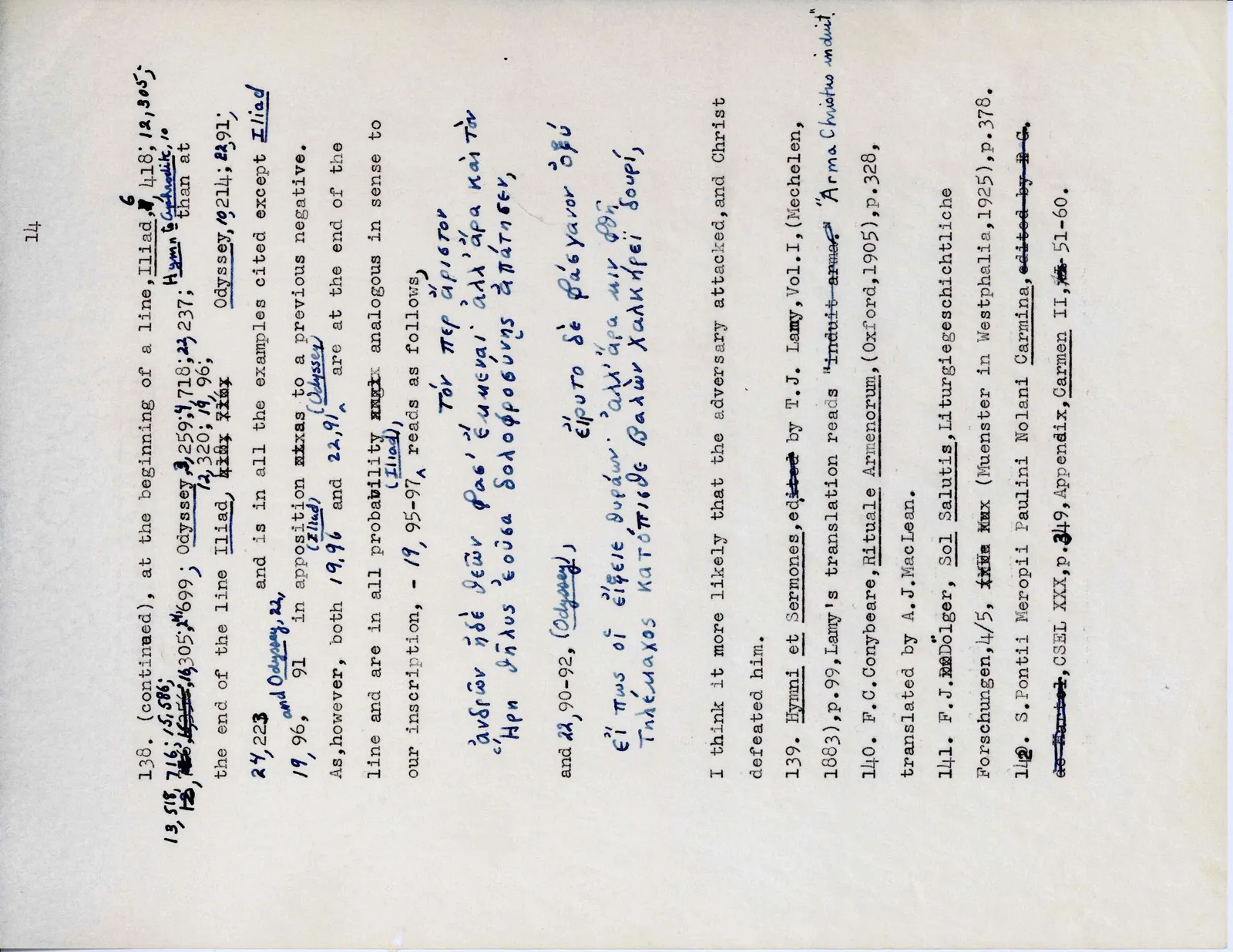
138. (continued), at the beginning of a line, Iliad, 6 [handwritten: 418]; 12,305; 13,518; 716; 15,586; 16,305; 16,699; Odyssey 3,259; 4,718; 22,237; 12,320; 19,96; Hymn 6 Cuthadic, 10 than at the end of the line Iliad, Odyssey, 10,214; 22,91; Odyssey, 24,223 and is in all the examples cited except Iliad 19,96, 91 in apposition to a previous negative. As, however, both 19,96 and 22,91 are at the end of the line and are in all probability analogous in sense to our inscription, - 19, 95-97 reads as follows
[handwritten: Τὸν περ ἄριστον ἀνδρῶν δὲ θεῶν φάτ' ἐνεῖναι· ἀλλ' ἄρα καὶ τὸν Ἤρη δῆλυς ἐοῦσα δολοφροσύνῃ ἀπάτησεν,]
and 22, 90-92, [handwritten: εἴρυτο δὲ φαίης ὄφ' εἴ πως οἱ εἴφειε θυράων· ἀλλ' ἄρα μιν θεὸς Τηλέμαχος κατ' ὄπιθε Βαλὼν Χαλκηρεὶ δουρί,]
I think it more likely that the adversary attacked, and Christ defeated him.
139.Hymni et Sermones, edited by T.J. Lamy, Vol.I, (Mechelen, 1883), p.99, Lamy's translation reads "induit arma." "Arma Christo induit"
140.F.C.Conybeare, Rituale Armenorum, (Oxford,1905), p.328, translated by A.J.MacLean.
141.F.J.Dölger, Sol Salutis, Liturgiegeschichtliche Forschungen,4/5, (Muenster in Westphalia,1925), p.378.
142.S.Pontii Meropi Paulini Nolani Carmina, edited by W.G. Hartel, CSEL XXX,p.349, Appendix, Carmen II, 51-60.
65 figures hard to readstruck struck outadded written in above” jug ditto, and what it repeatsword reading not certain