
Unnumbered pageScan 6 of 97
5
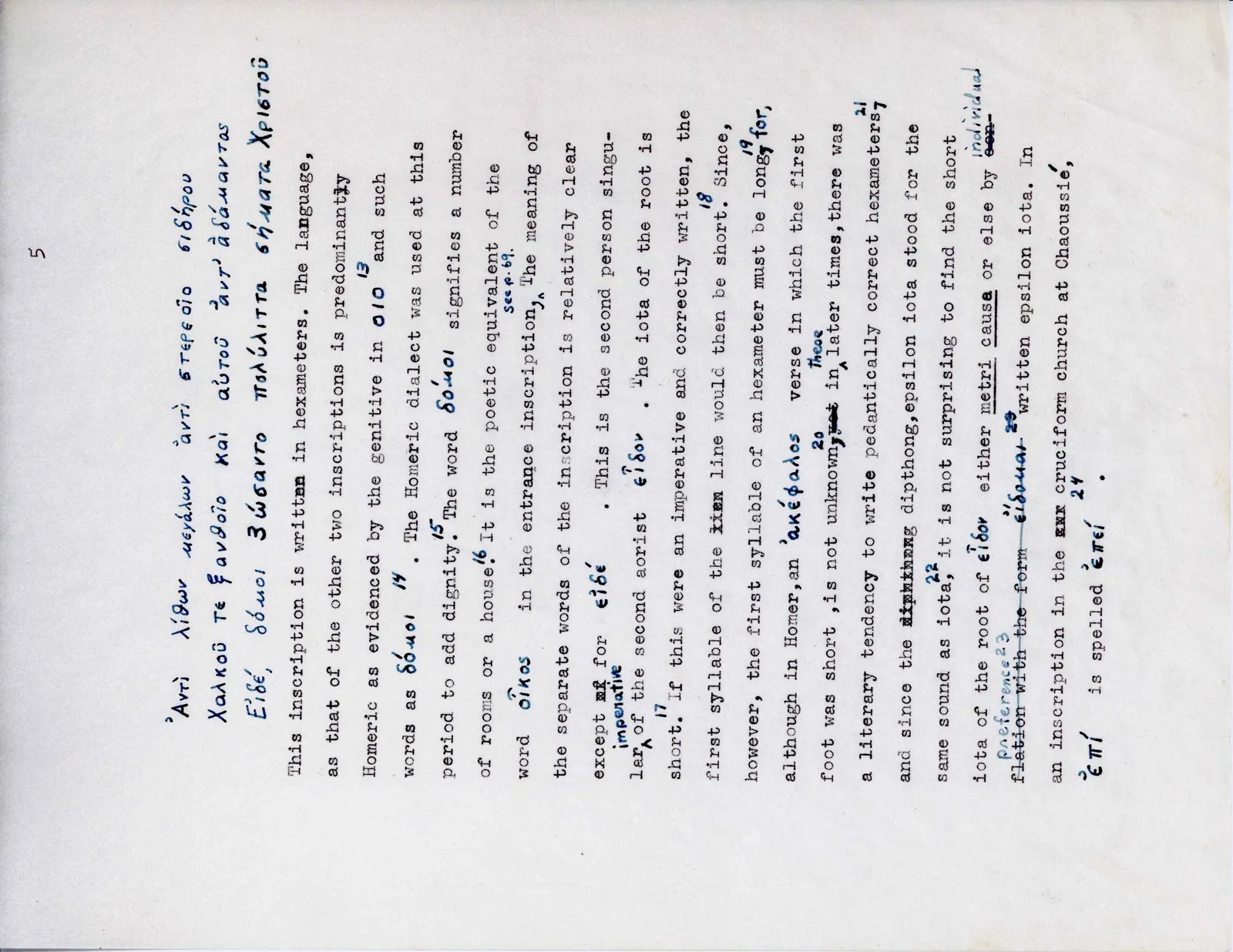
'Αντὶ λίθων μεγάλων 'αντὶ 6τερεοῖο 6ιδήρου Χαλκοῦ τε ξανθοῖο καὶ αὐτοῦ 'αντ' ἀδάμαντας Εἰδέ, δόμοι 3ώσαντο πολύλιττα 6ήματα Χριστοῦ
This inscription is written in hexameters. The language, as that of the other two inscriptions is predominantly [handwritten: 13] Homeric as evidenced by the genitive in οιο [handwritten: 13] and such words as δόμοι [handwritten: 14]. The Homeric dialect was used at this period to add dignity. [handwritten: 15] The word δόμοι signifies a number of rooms or a house. [handwritten: 16] It is the poetic equivalent of the word οἶκος [handwritten: see p.69.] in the entrance inscription. [handwritten: 'The meaning of] the separate words of the inscription is relatively clear except εἰδέ for [handwritten: imperative] lar of the second aorist εἶδον. [handwritten: 17] The iota of the root is short. If this were an imperative and correctly written, the first syllable of the [handwritten: xxxx] line would then be short. Since, [handwritten: 18] however, the first syllable of an hexameter must be long [handwritten: 19] for, although in Homer, an ἀκέφαλος [handwritten: verse] in which the first foot was short, is not unknown [handwritten: 20] [handwritten: theoe] in later times, there was a literary tendency to write pedantically correct hexameters [handwritten: 21] and since the diphthong, epsilon iota stood for the same sound as iota, [handwritten: 22] it is not surprising to find the short iota of the root of εἶδον [handwritten: individual] either metri cause or else by [handwritten: con-] fletion with the form εἴδομαι [handwritten: 23] [handwritten: preference] written epsilon iota. In an inscription in the [handwritten: xxx] crucuform church at Chaoussie, [handwritten: 24] ἐπί is spelled ἔπεί.
65 figures hard to readstruck struck outadded written in above” jug ditto, and what it repeatsword reading not certain