
Unnumbered pageScan 51 of 97
Stamp: none
Handwritten: 50
Handwritten: however
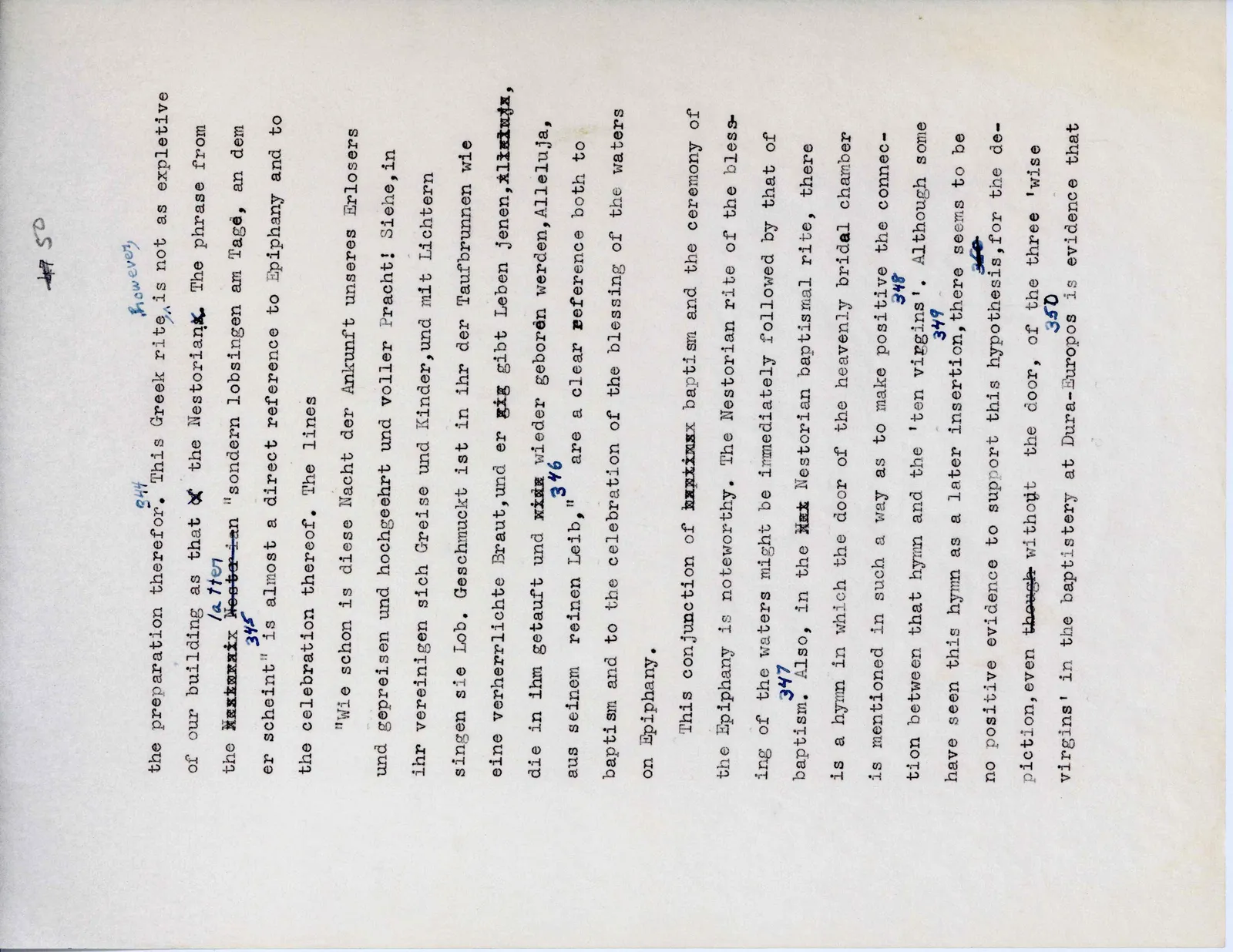
the preparation therefor. This Greek rite, is not as expletive of our building as that [handwritten: x] the Nestorian [handwritten: Nestor ian] "sondern lobsingen am Tage", an dem the [handwritten: later] Nestorian "sondern lobsingen am Tage, an dem er scheint" is almost a direct reference to Epiphany and to the celebration thereof. The lines "Wie schon is diese Nacht der Ankunft unseres Erlosers und gepreisen und hochgeehrt und voller Pracht! Siehe, in ihr vereinigen sich Greise und Kinder, und mit Lichtern singen sie Lob. Geschmuckt ist in ihr der Taufbrunnen wie eine verherrlichte Braut, und er [handwritten: xig] gibt Leben jenen, [handwritten: alleluja,] die in ihm getauft und [handwritten: wieder] wieder geboren werden, Alleluja, aus seinem reinen Leib," are a clear reference both to baptism and to the celebration of the blessing of the waters on Epiphany.
This conjunction of [handwritten: baptism] baptism and the ceremony of the Epiphany is noteworthy. The Nestorian rite of the blessing of the waters might be immediately followed by that of baptism. Also, in the [handwritten: Nes] Nestorian baptismal rite, there is a hymn in which the door of the heavenly bridal chamber is mentioned in such a way as to make positive the connection between that hymn and the 'ten virgins'. Although some have seen this hymn as a later insertion, there seems to be no positive evidence to support this hypothesis, for the depiction, even [handwritten: though] without the door, of the three 'wise virgins' in the baptistery at Dura-Europos is evidence that
65 figures hard to readstruck struck outadded written in above” jug ditto, and what it repeatsword reading not certain