
Unnumbered pageScan 45 of 97
44
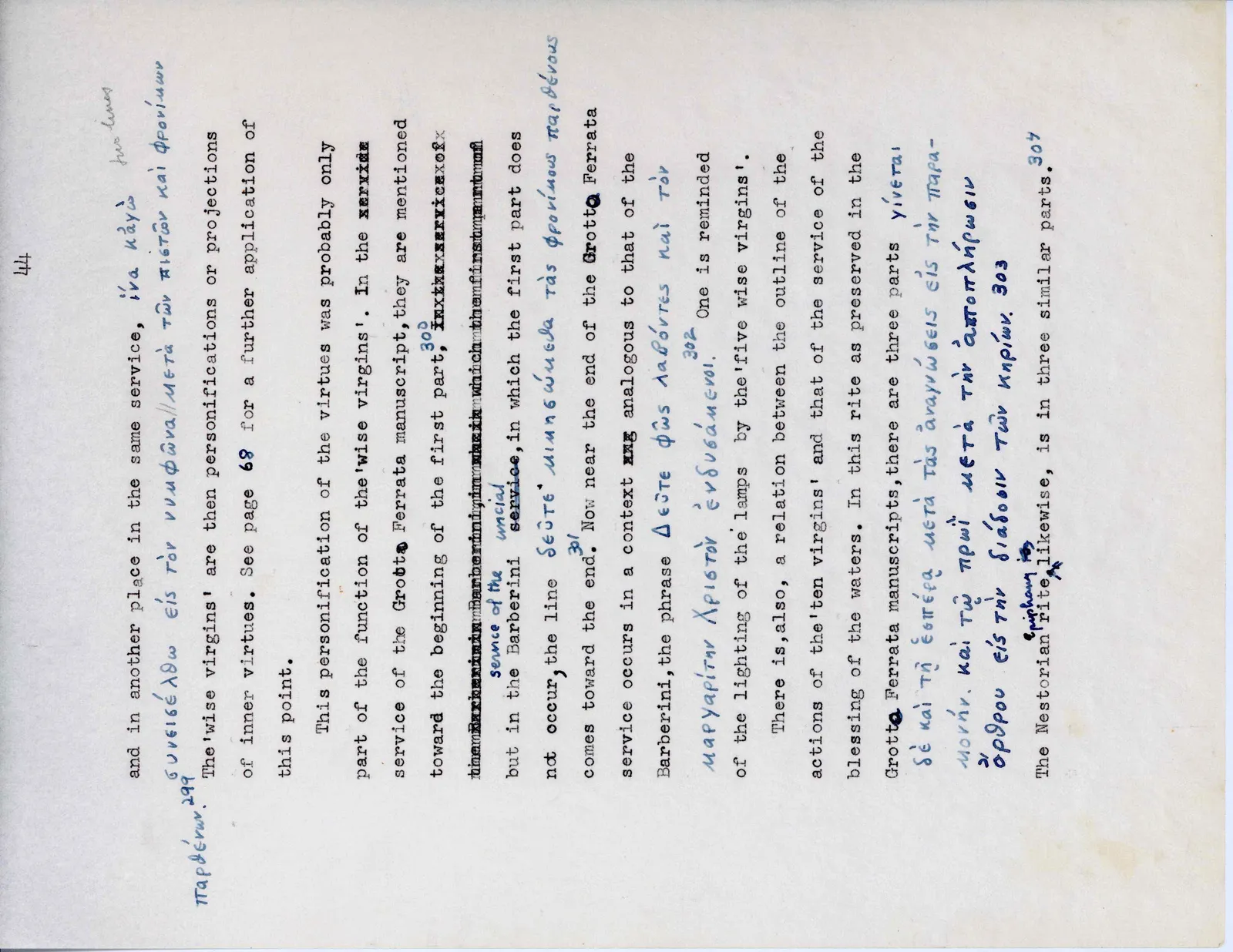
and in another place in the same service, [handwritten: ἵνα καὶ ὁ νυμφῶνα//μετὰ τῶν πιστῶν καὶ φρονίμων] [handwritten: παρθένων. 299] The [handwritten: 'wise virgins'] are then personifications or projections of inner virtues. See page 68 for a further application of this point.
This personification of the virtues was probably only part of the function of the 'wise virgins'. In the {strike: service} service of the Grotta Ferrata manuscript, they are mentioned toward the beginning of the first part, [handwritten: 300] ixxxxxxxxxxx [illegible] [handwritten: service of the unciai] but in the Barberini service, in which the first part does not occur, the line [handwritten: δεῦτε μιμησώμεθα τὰς φρονίμους παρθένους] comes toward the end. [handwritten: 301] Now near the end of the Grotta Ferrata service occurs in a context analogous to that of the Barberini, the phrase [handwritten: Δεῦτε φῶς λαβόντες καὶ τὸν] [handwritten: μαργαρίτην Χριστὸν ἐνδυσάμενοι. 302] One is reminded of the lighting of the lamps by the 'five wise virgins' and that of the 'ten virgins' and that of the service of the actions of the blessing of the waters. In this rite as preserved in the Grotta Ferrata manuscripts, there are three parts [handwritten: γίνεται δὲ καὶ τὴν ἑσπέραν μετὰ τὰς ἀναγνώσεις εἰς τὸν παρα-μονὴν. καὶ τῷ πρωΐ μετὰ τὴν ἀποπλήρωσιν ὀρθρου εἰς τὴν διαδοχὴν τῶν κηρίων. 303]
The Nestorian rite, likewise, is in three similar parts. [handwritten: 304]
65 figures hard to readstruck struck outadded written in above” jug ditto, and what it repeatsword reading not certain