
Unnumbered pageScan 34 of 97
Continued from p. 13
… 33
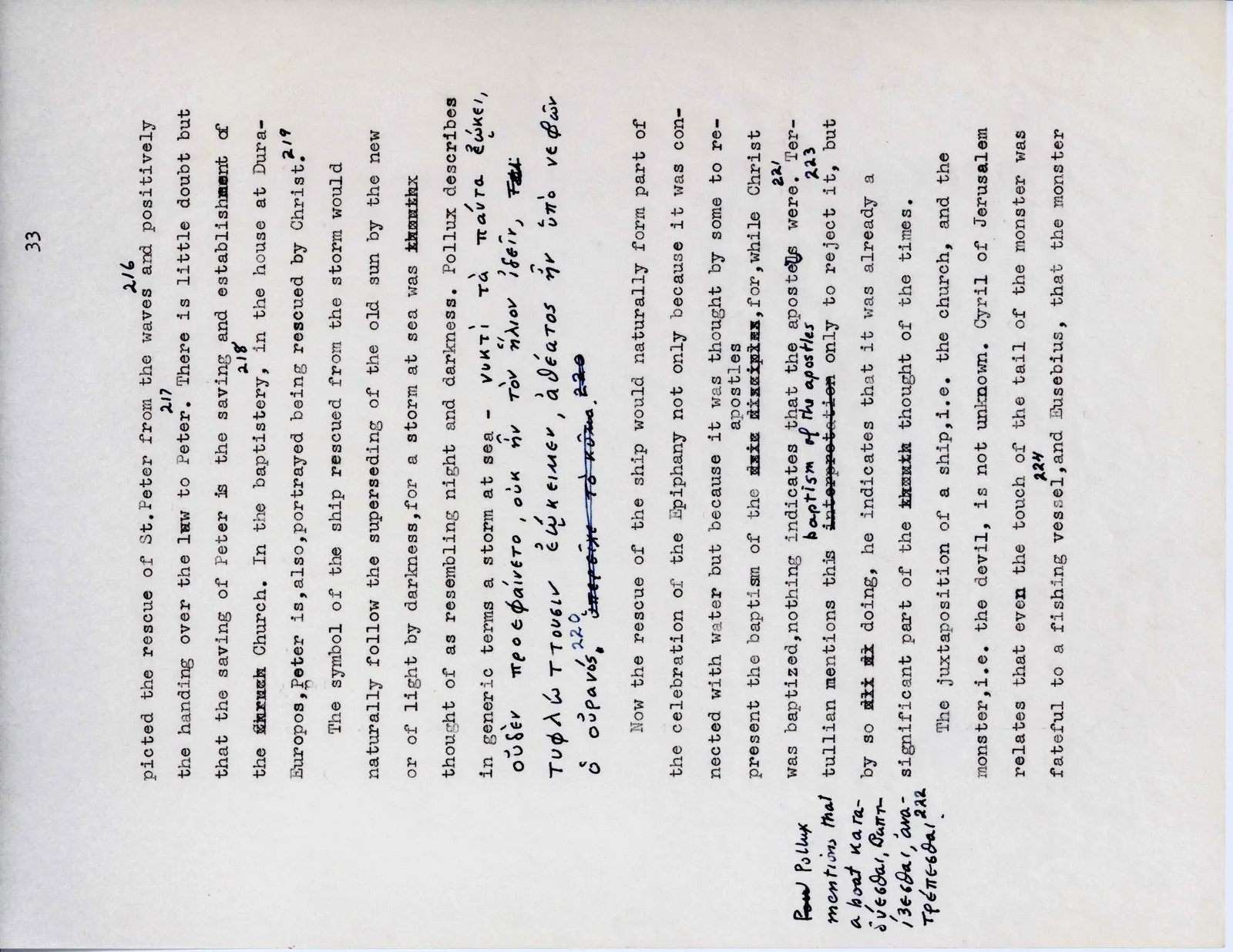
216 picted the rescue of St.Peter from the waves and positively 217 the handing over the law to Peter. There is little doubt but that the saving of Peter is the saving and establishment of 218 the [handwritten: ?] Church. In the baptistery, in the house at Dura- Europos, Peter is, also, portrayed being rescued by Christ.219
The symbol of the ship rescued from the storm would naturally follow the superseding of the old sun by the new or of light by darkness, for a storm at sea was thought of as resembling night and darkness. Pollux describes [handwritten: ταῦτα ἐώκει, ὑγρά τε πάντα] in generic terms a storm at sea - [handwritten: νυκτὶ ἐοικέναι]
Handwritten: οὐδὲν προσφαίνετο, οὐκ ἦν τὸν πλοῖον ἰδεῖν, ἀλλά
Handwritten: ταύτῃ ἀνθρώπου ἀδέατος ἦν ὑπὸ νεφῶν
[handwritten: ὁ οὐρανός.] 220
Now the rescue of the ship would naturally form part of the celebration of the Epiphany not only because it was connected with water but because it was thought by some to reapostles present the baptism of the apostles for, while Christ 221 was baptized, nothing indicates that the apostles were. Ter- 223 tullian mentions this interpretation only to reject it, but by so doing, he indicates that it was already a significant part of the thought of the times.
The juxtaposition of a ship, i.e. the church, and the monster, i.e. the devil, is not unknown. Cyril of Jerusalem relates that even the touch of the tail of the monster was fateful to a fishing vessel, and Eusebius, that the monster 224
[printed: Pollux mentions that a boat καταδύεσθαι, βυθῷ ἀναπτερουσθαι.] 222
65 figures hard to readstruck struck outadded written in above” jug ditto, and what it repeatsword reading not certain