
Page 13Scan 33 of 97
32
Handwritten: Ventus diabolus, qui commovebat tempestates et furores gentilium adversus sanctam ecclesiam. -- At hoc dixerit man, hoc est caeculus: Tace et diabolo dixerit: Obmutesce, amplius non potenit persecutiones movere et fiet mansuetissimus
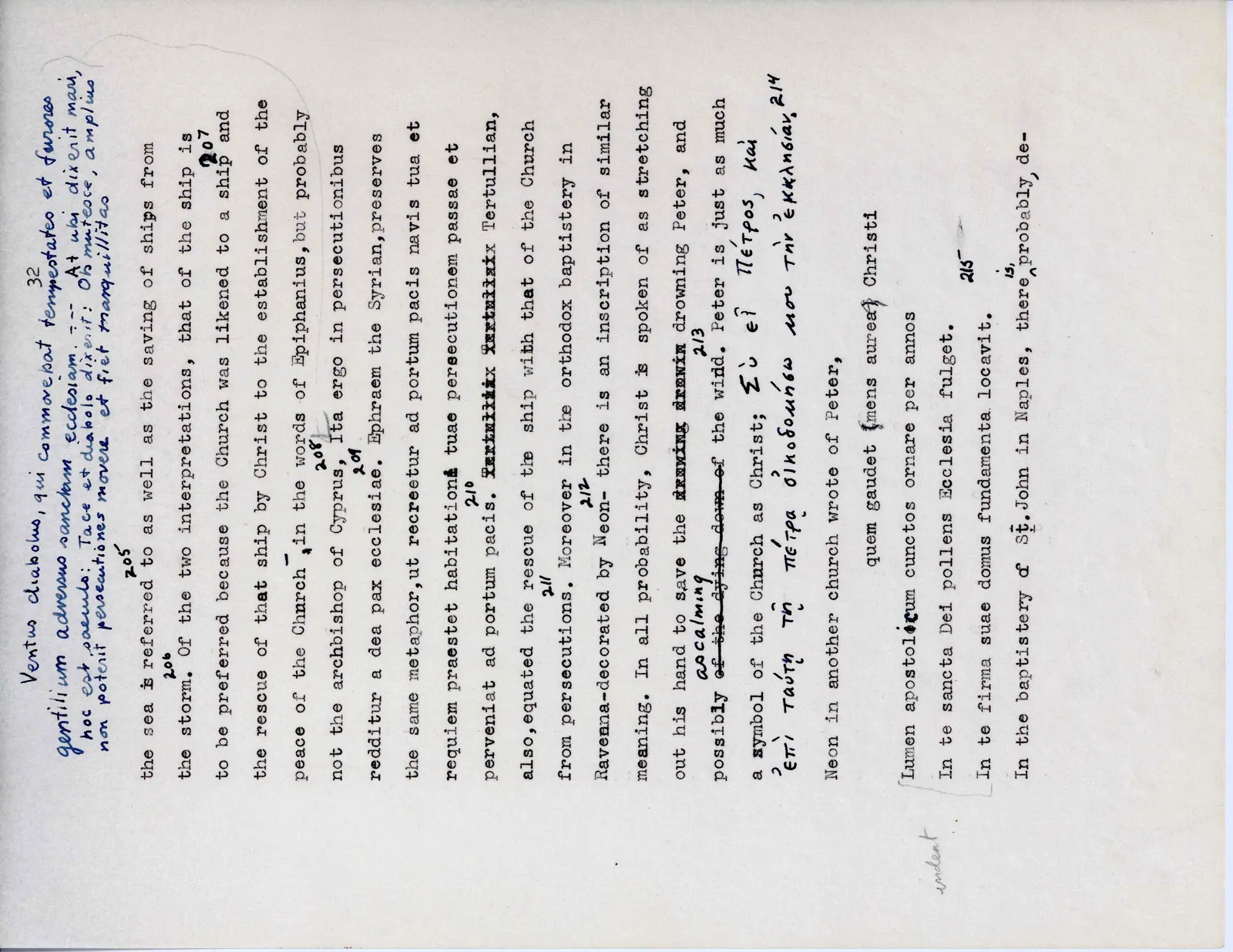
the sea is referred to as well as the saving of ships from 205 the storm. Of the two interpretations, that of the ship is 206 to be preferred because the Church was likened to a ship and 207 the rescue of that ship by Christ to the establishment of the peace of the Church, in the words of Epiphanius, but probably 208 not the archbishop of Cyprus, Ita ergo in persecutionibus 209 redditur a dea pax ecclesiae. Ephraem the Syrian, preserves the same metaphor, ut recreetur ad portum pacis navis tua et requiem praestet habitationi tuae persecutionem passae et 210 pervenaet ad portum pacis. Tertullian, Tertullian also, equated the rescue of the ship with that of the Church also, equated the rescue of the ship with that of the Church from persecutions. Moreover in the orthodox baptistery in 211 Ravenna-decorated by Neon- there is an inscription of similar meaning. In all probability, Christ is spoken of as stretching 212 out his hand to save the drowning Peter, and [handwritten: calming] 213 possibly of the dying down of the wind. Peter is just as much a symbol of the Church as Christ; [handwritten: Σὺ εἶ Πέτρος, καὶ ἐπὶ ταύτῃ τῇ πέτρᾳ οἰκοδομήσω τὴν ἐκκλησίαν] 214
Neon in another church wrote of Peter, quem gaudet [handwritten: mens aurea] Christi
Lumen apostolicum cunctos ornare per annos 215 In te sancta Dei pollens Ecclesia fulget. In te firma suae domus fundamenta locavit. In the baptistery of St. John in Naples, there, probably, de- … continues
65 figures hard to readstruck struck outadded written in above” jug ditto, and what it repeatsword reading not certain