
Unnumbered pageScan 25 of 97
Handwritten: 24
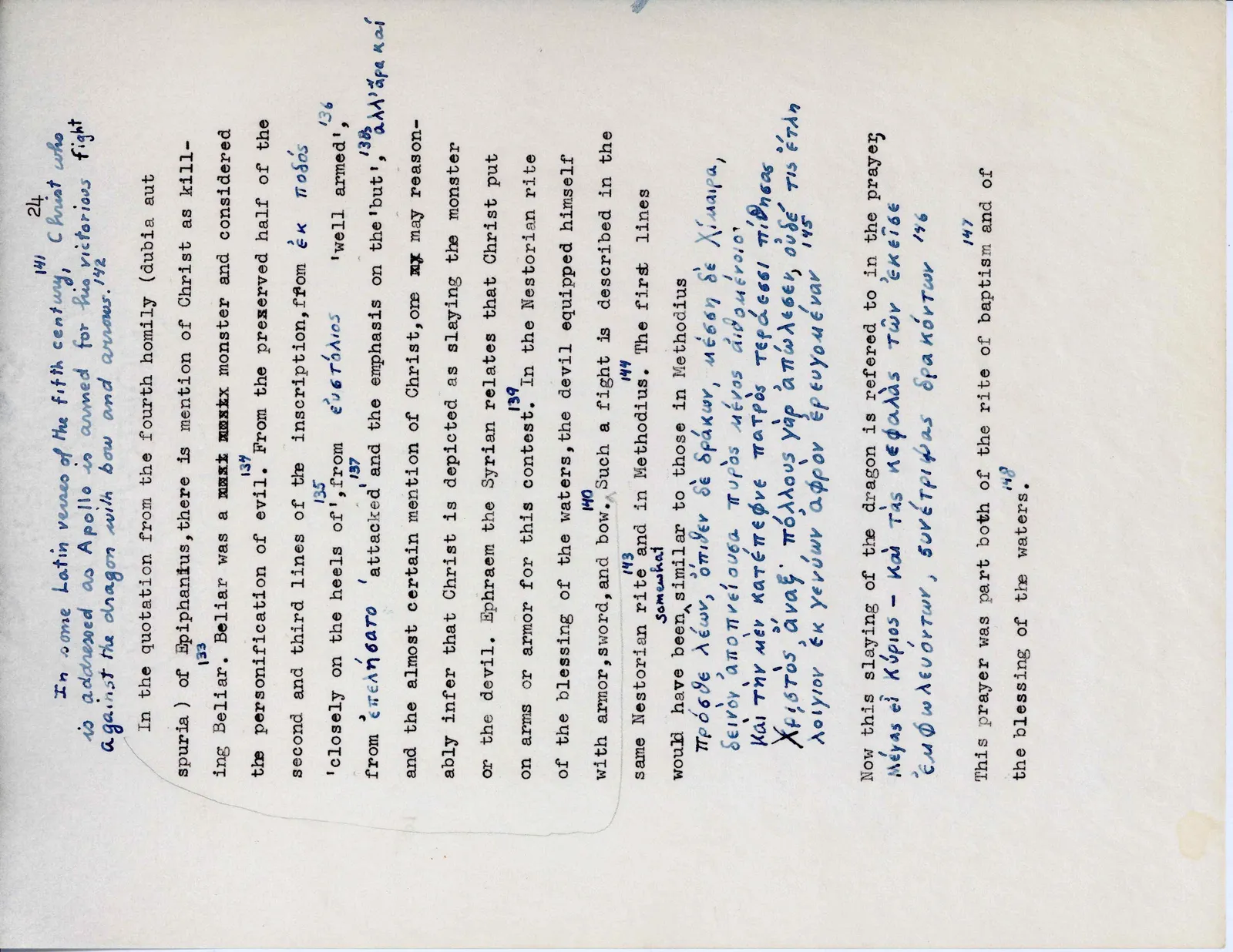
[handwritten: In some Latin version of the fifth century, Christ who is addressed as Apollo is armed for the victorious fight against the dragon with bow and arrows.] [handwritten: 141] [handwritten: 142]
In the quotation from the fourth homily (dubia aut spuria) of Epiphanius, there is mention of Christ as killing Beliar. Beliar was a [handwritten: mexs monster] monster and considered the personification of evil. [handwritten: 134] From the preserved half of the second and third lines of the inscription, from [handwritten: 135] 'closely on the heels of', from [handwritten: ἐνέ... ἐπελήθατο] 'attacked' and the almost certain mention of Christ, one may reason-ably infer that Christ is depicted as slaying the monster or the devil. Ephraem the Syrian relates that Christ put on arms or armor for this contest. [handwritten: 139] In the Nestorian rite of the blessing of the waters, the devil equipped himself with armor, sword, and bow. [handwritten: 140] Such a fight is described in the same Nestorian rite and in Methodius. [handwritten: 143] The first lines would have been, [handwritten: somewhat] similar to those in Methodius [handwritten: προόδε λέων, οπίθεν δὲ δράκων, πέσσῃ δὲ Χίμαιρα, δεινὸν ἀποπνείουσα πῦρος μένος αἰδομένοιο, καὶ τὴν μὲν κατέπεφνε πατρὸς τερασσεί πιθῶρ ... Χριστὸς ἀναξ, πόλλους γὰρ ἀπώλεσεν, οὐδὲ τις ἔτλη λοιγὸν ἐκ γενεῶν ἐρευνῶν ἀφρον ἐρεχυομένων]. [handwritten: 144] [handwritten: 145]
Now this slaying of the dragon is referred to in the prayer [handwritten: Μέγας εἶ Κύριος – καὶ τὰς νεφάλας τῶν ἐκείσε] [handwritten: ἐνΦωλεύοντων, συνέτριψας δράκοντας] [handwritten: 146]
This prayer was part both of the rite of baptism and of the blessing of the waters. [handwritten: 147] [handwritten: 148]
65 figures hard to readstruck struck outadded written in above” jug ditto, and what it repeatsword reading not certain