
Unnumbered pageScan 11 of 97
10
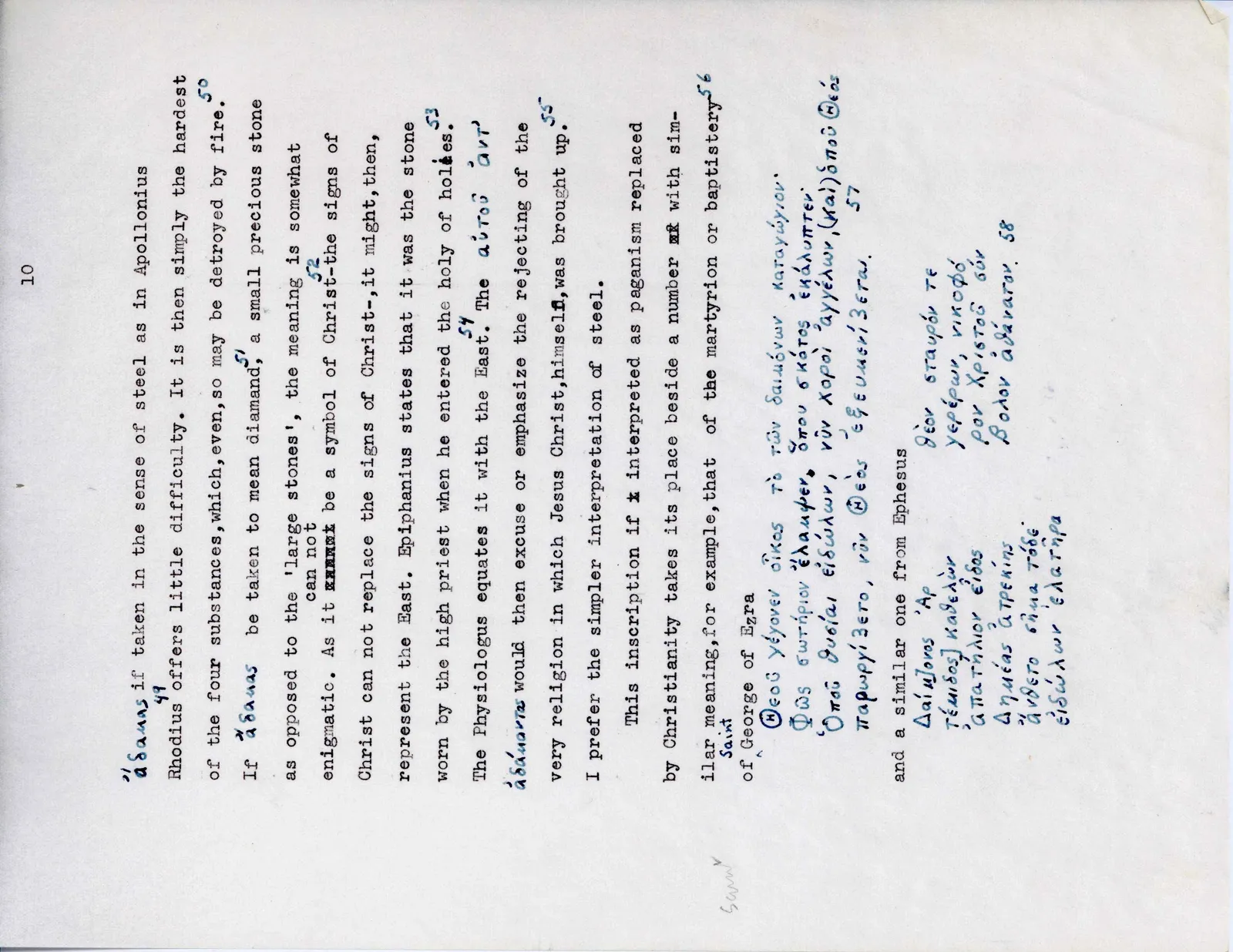
[handwritten: ἄδαμας] if taken in the sense of steel as in Apollonius [handwritten: 49] Rhodius offers little difficulty. It is then simply the hardest [handwritten: 50] of the four substances,which,even,so may be detroyed by fire. If [handwritten: ἄδαμας] be taken to mean diamand, [handwritten: 51] a small precious stone as opposed to the 'large stones', the meaning is somewhat [handwritten: 52] can not enigmatic. As it [handwritten: cannot] be a symbol of Christ-the signs of Christ can not replace the signs of Christ-, it might,then, [handwritten: 53] represent the East. Epiphanius states that it was the stone worn by the high priest when he entered the holy of holies. [handwritten: 54] The Physiologus equates it with the East. [handwritten: αὐτοῦ αὐτ] The [handwritten: ἀδάμαντα] would then excuse or emphasize the rejecting of the [handwritten: 55] very religion in which Jesus Christ,himself,was brought up. I prefer the simpler interpretation of steel.
This inscription if [handwritten: ϗ] interpreted as paganism replaced by Christianity takes its place beside a number [handwritten: with] with sim-[handwritten: 56] ilar meaning,for example,that of the martyrion or baptistery of George of Ezra [handwritten: Saint] [handwritten: Θεοῦ γέγονεν οἶκος τὸ τῶν δαιμόνων καταγώγιον. Φῶς σωτήριον ἐκάλυπτεν, ὅπου σκότος ἐκάλυπτεν. Ὄπου θυσίαι εἰσῴλων, νῦν χοροὶ ἀγγέλων, (καὶ) ὅπου Θεὸς παρωργίσθετο, νῦν Θεὸς ἐξευσεῖ ἔσται. {hw: 57] Θεὸν σταυρὸν τε γερέρων, νικοροῦ ρον Χριστοῦ οὖν Βολον ἀδάναν [handwritten: 58] Δαίμονος Ἀρ Τέμενος ναὸν ἑλαν Απατηλιον εἴδος Δημέας ἀτρεκης ἀνδρὸς σῆμα τοῦδε εἰσελθων ἐλατηρα} and a similar one from Ephesus
65 figures hard to readstruck struck outadded written in above” jug ditto, and what it repeatsword reading not certain