
Page 79Scan 55 of 77
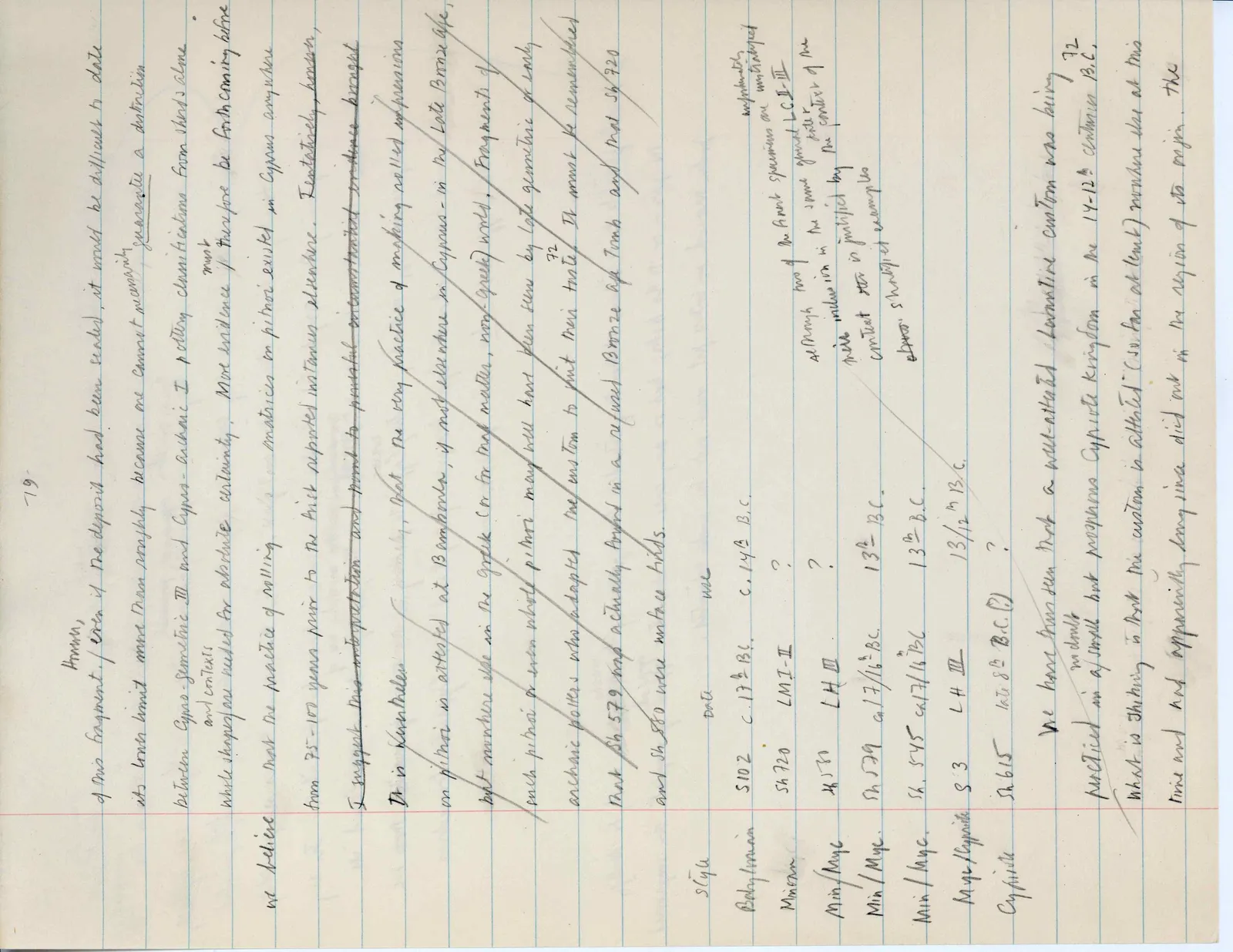
of this fragment. However, even if the deposit had been sealed, it would be difficult to date its lower limit more than roughly, because one cannot necessarily guarantee a distinction between Cypro-Geometric III and Cypro-Archaic I pottery classifications from sherds alone. While shapes and contexts are needed for absolute certainty, More evidence must therefore be forthcoming before we believe that the practice of rolling matrices on pithoi existed in Cyprus anywhere from 75-100 years prior to the first reported instances elsewhere. Tentatively, however, I suggest this interpretation and point to powerful circumstantial evidence brought It is nevertheless 71 that the very practice of making rolled impressions on pithoi is attested at Bamboula, if not elsewhere in Cyprus - in the Late Bronze Age, but nowhere else in the Greek (or for that matter, non-Greek) world. Fragments of such pithoi or even whole pithoi may well have been seen by Late Geometric or Early Archaic potters who adapted the custom to suit their taste. 72 It must be remembered that Sh 579 was actually found in a re[used] Bronze Age tomb and that Sh 720 and Sh 580 were surface finds.
| Style | Date | use | |
| Babylonian | S 102 | c. 17th B.C. | c. 14th B.C. |
| Minoan | Sh 720 | LM I-II | ? |
| Min/Myc | LH II | ? | |
| Min/Myc. | Sh 579 | c. 17/16th B.C. | 13th B.C. |
| Min/Myc. | Sh. 545 | c. 17/16th B.C. | 13th B.C. |
| Myc/Cypriote | S 3 | LH III | 13/12th B.C. |
| Cypriote | Sh 615 | late 8th B.C.(?) | ? |
Although two of the finest specimens are unstratified, their inclusion in the same unfortunate general L.C. II-III context star is justified by the pottery context of the other 3 stratified examples
We have thus seen that a well-attested Levantine custom was being 72 practiced in a small but prosperous Cypriote kingdom in the 14-12th centuries B.C. no doubt What is striking is that this custom is attested (so far at least) nowhere else at this time and had apparently long since died out in the region of its origin. The … continues
65 figures hard to readstruck struck outadded written in above” jug ditto, and what it repeatsword reading not certain