
Unnumbered pageScan 54 of 77
Margin left: 2.6 / 11.4 = 4.6 / x | 11.4 / 4.6 / 684 / 456 / 52.44 | 20 / 2.6)52.44 / 52
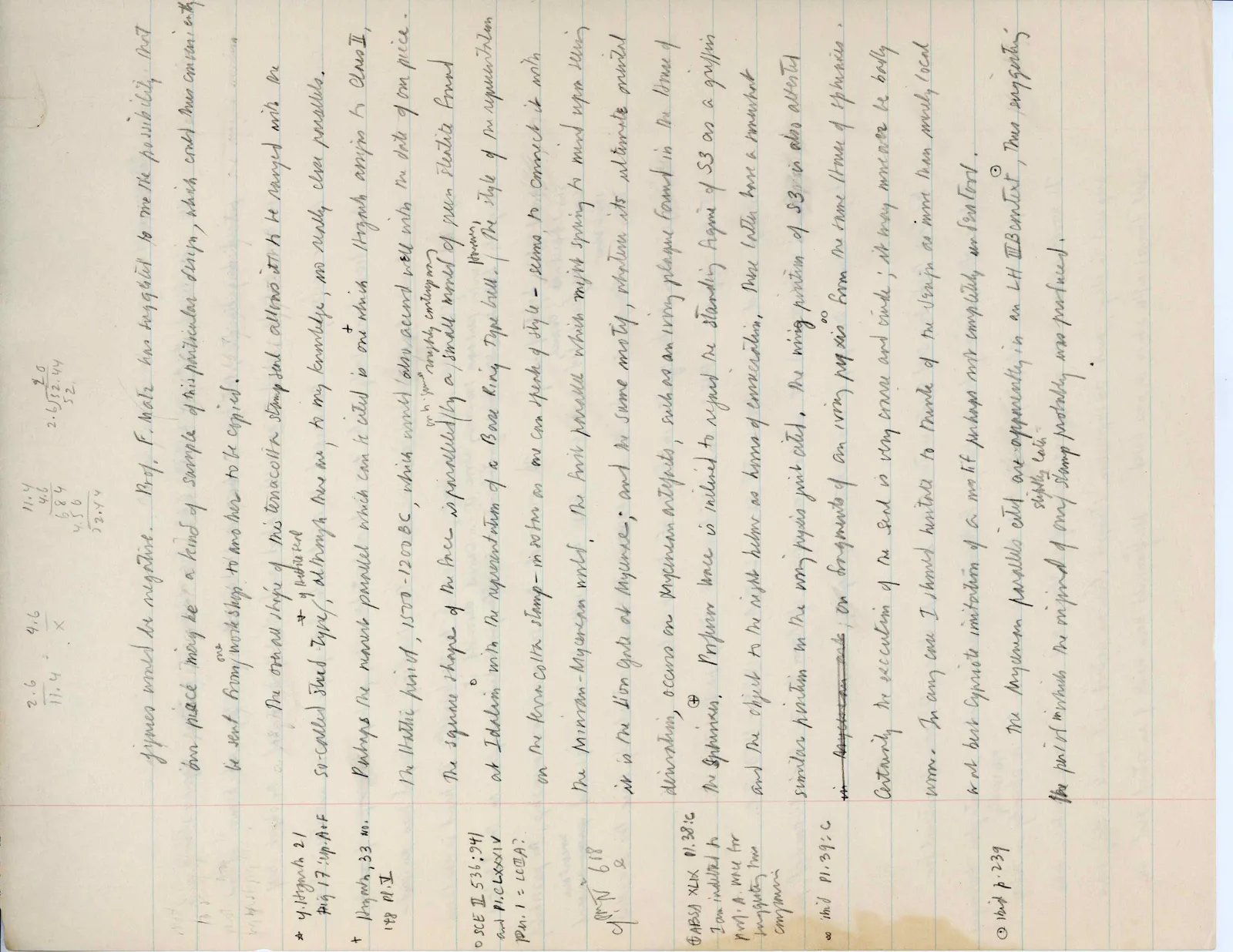
figures would be negative. Prof. F. Matz has suggested to me the possibility that this piece may be a kind of sample of this particular design, which could then conveni-ently be sent from one workshop to another to be copied.
The overall shape of this terracotta stamp seal allows it to be ranged with the so-called 'shed type', although there are, to my knowledge, no really close parallels.
Margin left: * 4. Hogarth 21 / fig 17; & p. 4+f / + Hogarth, 33 no. / 178 pl. V
Perhaps the nearest parallel which can be cited is one which * Hogarth assigns to Class II, the Hittite period, 1500-1200 BC, which would + also accord well with the date of our piece.
Margin left: 0 SCE II 536:941 / and Pl. CLXXXIV / Per. 1 = LCIIA?
The square shape of the face is paralleled /by a \with or just roughly contemporaneous small animal of green steatite found at Idalion with the representation of a Base Ring type bull. However, the style of the representation on the terra-cotta stamp - in so far as one can speak of style - seems to connect it with the Minoan-Mycenaean world. The first parallel which might spring to mind upon [illegible] is in the Lion Gate at Mycenae; and the same motif, whatever its ultimate oriental
Margin left: ⊕ ABSA XLIX Pl. 38:c / I am indebted to / Prof. A. Wace for / suggesting this / comparison
derivation, occurs on Mycenaean artefacts, such as an ivory plaque found in the House of the Sphinxes. ⊕ Professor Wace is inclined to regard the standing figure of S3 as a griffin and the object to the right below as horns of consecration. These latter have a somewhat
Margin left: ∞ ibid Pl. 39: c
similar position in the ivory pyxis just cited. The wing portion of S3 is also attested in Mycenaean art; on fragments of an ivory pyxis from the same House of Sphinxes. ∞
Certainly the execution of the seal is very coarse and crude; it may moreover be badly worn. In any case I should hesitate to think of the design as more than merely local work at best Cypriote imitation of a motif perhaps not completely understood.
[circle with dot in centeribid p. 239] The Mycenaean parallels cited are apparently in an LH IIIB context, [circle with dot in center] thus suggesting slightly later the period in which the original of our stamp probably was produced.
65 figures hard to readstruck struck outadded written in above” jug ditto, and what it repeatsword reading not certain