
Unnumbered pageScan 36 of 77
6.
59. AJA 42 (1938) 268 Fig.10a; p.270. 5 cm. square with a present height of 3 cm. It was found in a re-used pit in the north corner of Room 8 of House VII in Area A in Level D:2,which is the LC IIIA period (1225-1150 B.C.,in Daniel's tentative chronology). Being in a pit, it must have been discarded already in antiquity, perhaps because its top was broken off then.
Handwritten: 60. Prof. Panda tells me, on the basis of Prof. R.J. Braidwood's manuscript on the early levels of the excavations in the Plain of Antioch, that ledged sherds occur there, and that there are also a few examples from the Amuq region datable in the earlier part of the first millennium. But she emphasises that Cypriote examples do not necessarily have to be derived from Syria, especially since chronological indications are not in accord.
61. AntJ 32 (1952) 163 and Pl. XXVI:A; P. Dikaios, A Guide to the Cyprus Museum (Nicosia 1953) 99:13.
62. 1935 XII-23/1; 1954, III-4/7 I owe my knowledge of these to Prof. Panda.
63. ABSA XLIX Pl.38:c. Cf. also PM IV Pt.2,608:e.
64. Ibid Pl.39:c. Cf. p.239 for dating of this and the foregoing pyxis.
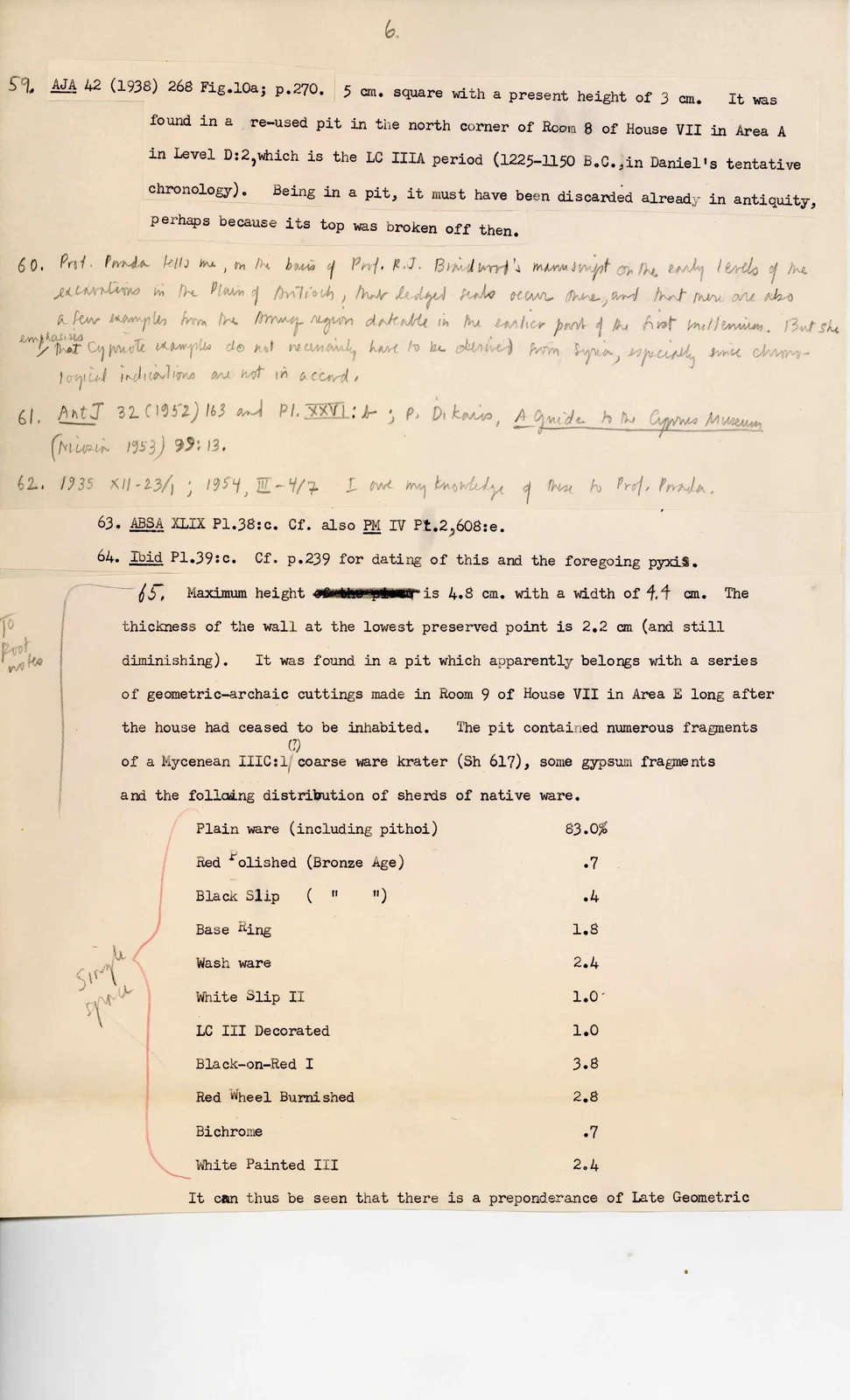
65. Maximum height [handwritten: of the pot] is 4.8 cm. with a width of 4.4 cm. The thickness of the wall at the lowest preserved point is 2.2 cm (and still diminishing). It was found in a pit which apparently belongs with a series of geometric-archaic cuttings made in Room 9 of House VII in Area E long after the house had ceased to be inhabited. The pit contained numerous fragments of a Mycenean IIIC:1 [handwritten: (?)] coarse ware krater (Sh 617), some gypsum fragments and the following distribution of sherds of native ware.
| Plain ware (including pithoi) | 83.0% |
| Red Polished (Bronze Age) | .7 |
| Black Slip ( " " ) | .4 |
| Base Ring | 1.8 |
| Wash ware | 2.4 |
| White Slip II | 1.0 |
| LC III Decorated | 1.0 |
| Black-on-Red I | 3.8 |
| Red Wheel Burnished | 2.8 |
| Bichrome | .7 |
| White Painted III | 2.4 |
It can thus be seen that there is a preponderance of Late Geometric
65 figures hard to readstruck struck outadded written in above” jug ditto, and what it repeatsword reading not certain