
Unnumbered pageScan 29 of 77
Continued from scan 28
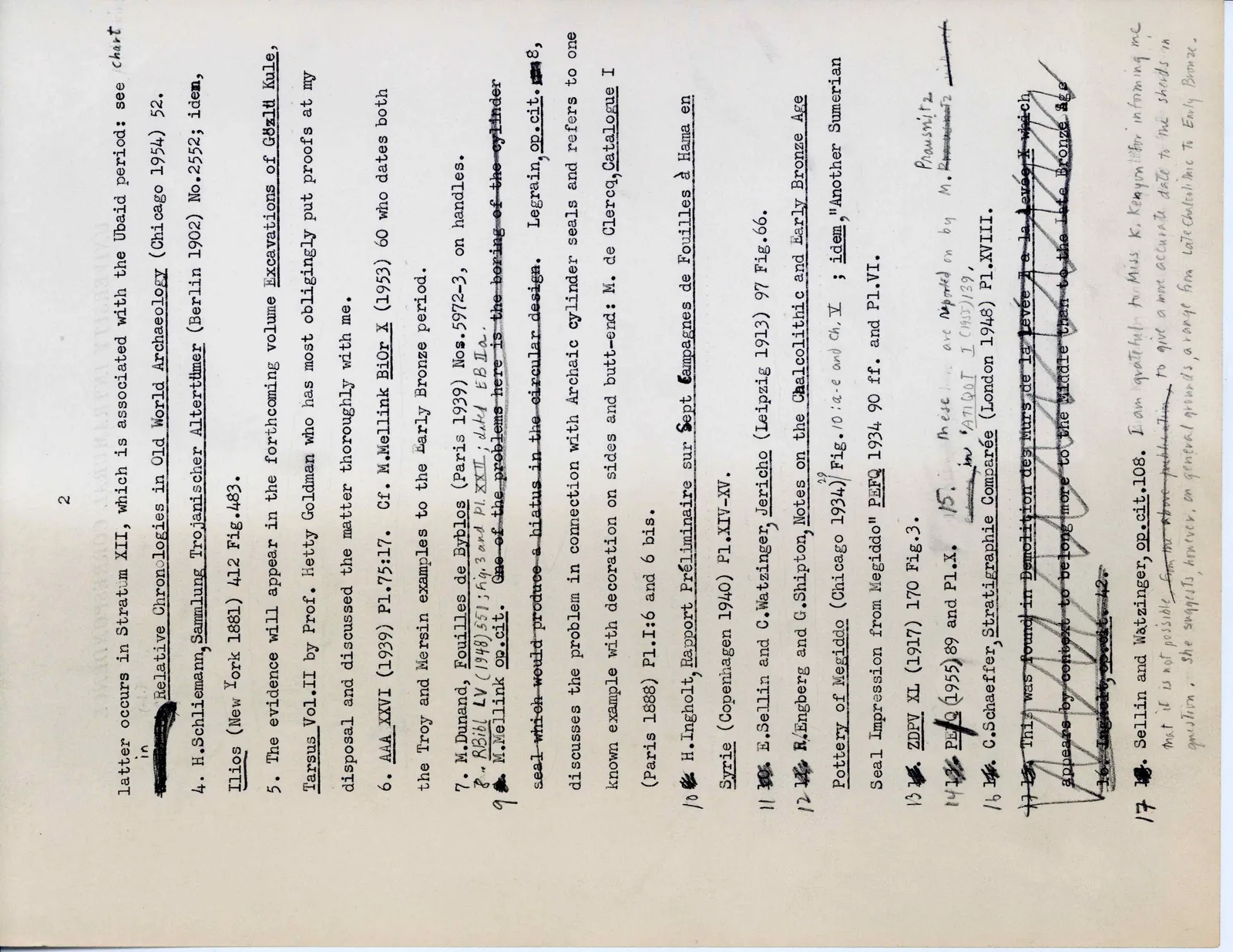
… latter occurs in Stratum XII, which is associated with the Ubaid period: see [handwritten: chart] in Relative Chronologies in Old World Archaeology (Chicago 1954) 52. 4. H.Schliemann, Sammlung Trojanischer Alterthümer (Berlin 1902) No.2552; idem, Ilios (New York 1881) 412 Fig.483. 5. The evidence will appear in the forthcoming volume Excavations of Gözlü Kule, Tarsus Vol.II by Prof. Hetty Goldman who has most obligingly put proofs at my disposal and discussed the matter thoroughly with me. 6. AAA XXVI (1939) Pl.75:17. Cf. M.Mellink BiOr X (1953) 60 who dates both the Troy and Mersin examples to the Early Bronze period. 7. M.Dunand, Fouilles de Byblos (Paris 1939) Nos.5972-3, on handles.
Handwritten: RBibl LV (1948) 551; fig.3 and Pl. XXII; dated EB IIa.
[handwritten: M.Mellink op.cit.] One of the problems here is the boring of the cylinder seal which would produce a hiatus in the circular design. Legrain, op.cit. pg. seal which would produce a hiatus in the circular design. Legrain, op.cit. discusses the problem in connection with Archaic cylinder seals and refers to one known example with decoration on sides and butt-end: M. de Clercq, Catalogue I (Paris 1888) Pl.I:6 and 6 bis. 9. H.Ingholt, Rapport Préliminaire sur Sept Campagnes de Fouilles à Hama en Syrie (Copenhagen 1940) Pl.XIV-XV. 10. E.Sellin and C.Watzinger, Jericho (Leipzig 1913) 97 Fig.66. 11. R.Engberg and G.Shipton, Notes on the Chalcolithic and Early Bronze Age Pottery of Megiddo (Chicago 1934) Fig.10:a-e and ch. V; idem "Another Sumerian Seal Impression from Megiddo" PEFQ 1934 90 ff. and Pl.VI. 12. ZDPV XL (1917) 170 Fig.3. 13. PEFQ (1955) 89 and Pl.X. 14. C.Schaeffer, Stratigraphie Comparée (London 1948) Pl.XVIII. 15. [handwritten: these are reported on by M. Prausnitz in 'ATIQOT I (1955) 139.] 16. [illegible] 17. This was found in Demolition des murs de la levée Ta la levee X which appears by context to belong more to the Middle Chalcolithic to the Late Bronze Age [handwritten: ca] 18. Sellin and Watzinger, op.cit. 42. [handwritten: I am gratefull to Miss K. Kenyon for informing me that it is not possible from the stone publication to give a more accurate date to the shards in question. She suggests however, on general grounds, a range from Late Chalcolithic to Early Bronze.]
65 figures hard to readstruck struck outadded written in above” jug ditto, and what it repeatsword reading not certain