
Unnumbered pageScan 65 of 87
Printed: University of Missouri-Columbia
Printed: UNIVERSITY MUSEUM
Printed: Director's Office
Printed: College of Arts and Science
Printed: Department of Art History and Archaeology, 109 Pickard Hall, Columbia, Missouri 65211, Telephone (314) 882-6711
Stamp: NOV 14 1979
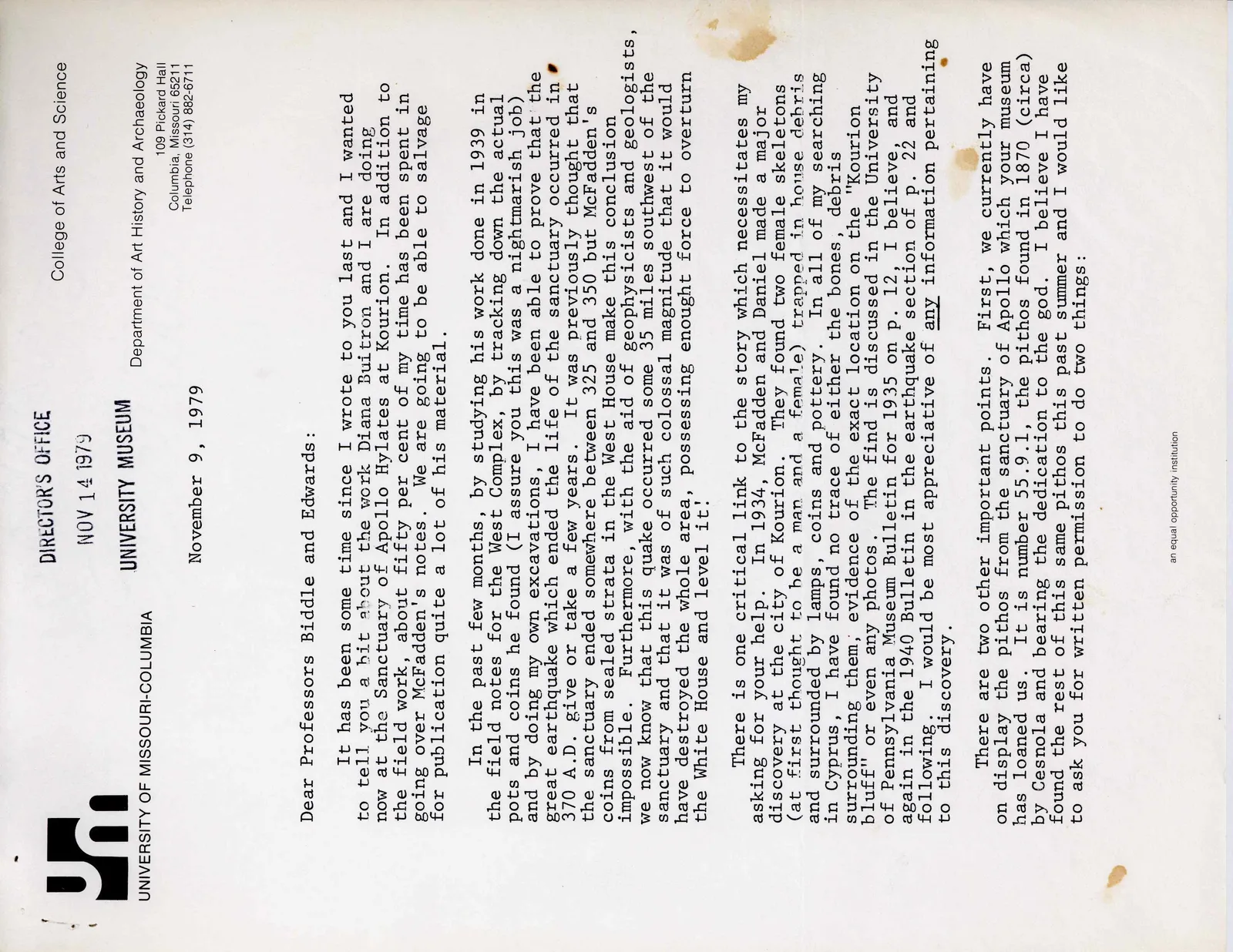
November 9, 1979Dear Professors Biddle and Edwards:
It has been some time since I wrote to you last and I wanted to tell you a bit about the work Diana Buitron and I are doing now at the Sanctuary of Apollo Hylates at Kourion. In addition to the field work, about fifty per cent of my time has been spent in going over McFadden's notes. We are going to be able to salvage for publication quite a lot of his material.
In the past few months, by studying his work done in 1939 in the field notes for the West Complex, by tracking down the actual pots and coins he found (I assure you this was a nightmarish job) and by doing my own excavations, I have been able to prove that the great earthquake which ended the life of the sanctuary occurred in 370 A.D. give or take a few years. It was previously thought that the sanctuary ended somewhere between 325 and 350 but McFadden's coins from sealed strata in the West House make this conclusion impossible. Furthermore, with the aid of geophysicists and geologists, we now know that this quake occurred some 35 miles southwest of the sanctuary and that it was of such colossal magnitude that it would have destroyed the whole area, possessing enough force to overturn the White House and level it!
There is one critical link to the story which necessitates my asking for your help. In 1934, McFadden and Daniel made a major discovery at the city of Kourion. They found two female skeletons (at first thought to be a man and a female) trapped in house debris and surrounded by lamps, coins and pottery. In all of my searching in Cyprus, I have found no trace of either the bones, debris surrounding them, evidence of the exact location on the "Kourion bluff" or even any photos. The find is discussed in the University of Pennsylvania Museum Bulletin for 1935 on p. 12, I believe, and again in the 1940 Bulletin in the earthquake section of p. 22 and following. I would be most appreciative of [handwritten: any] information pertaining to this discovery.
There are two other important points. First, we currently have on display the pithos from the sanctuary of Apollo which your museum has loaned us. It is number 55.9.1, the pithos found in 1870 (circa) by Cesnola and bearing the dedication to the god. I believe I have found the rest of this same pithos this past summer and I would like to ask you for written permission to do two things:
65 figures hard to readstruck struck outadded written in above” jug ditto, and what it repeatsword reading not certain