
Unnumbered pageScan 57 of 94
Continued from scan 56
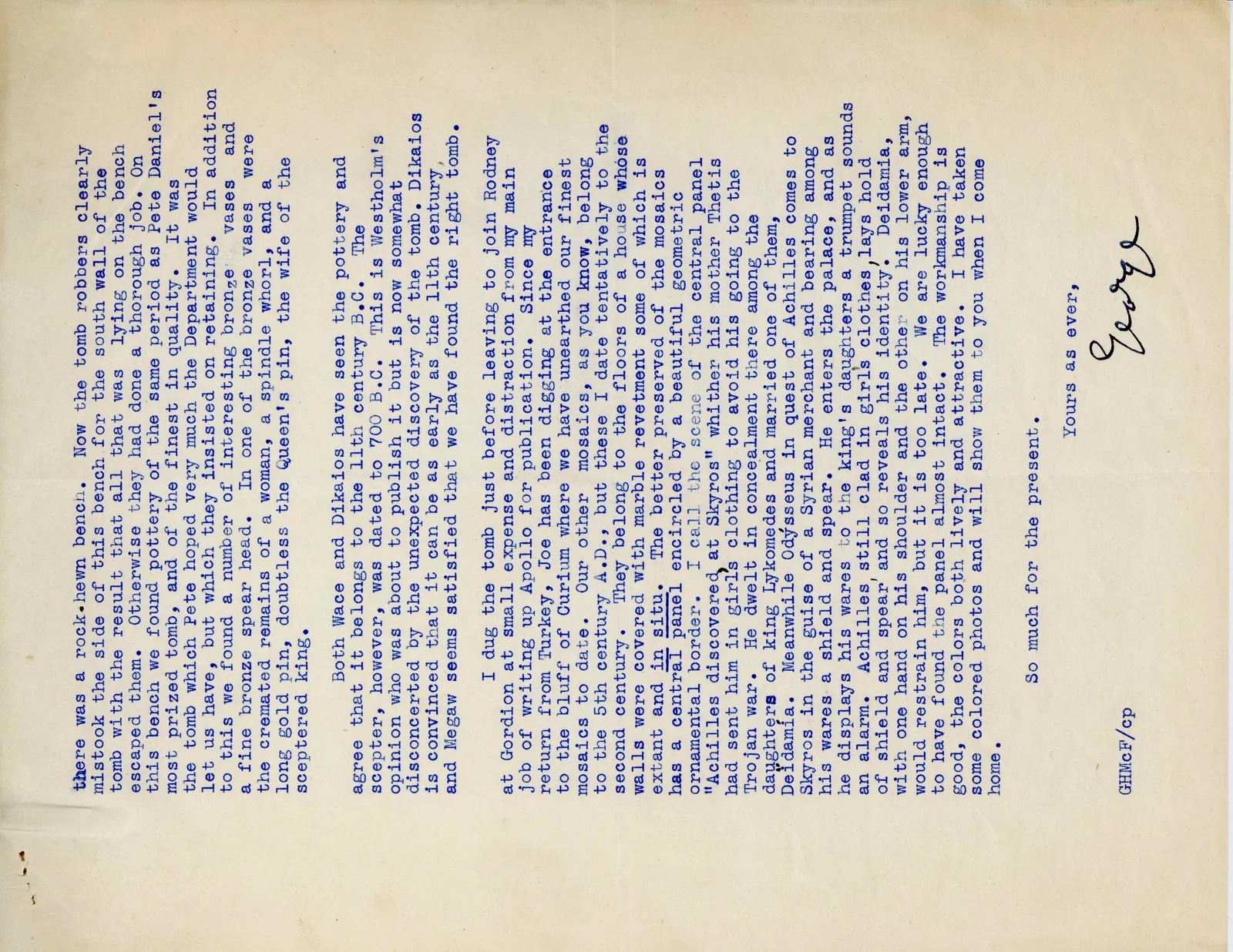
… there was a rock-hewn bench. Now the tomb robbers clearly mistook the side of this bench for the south wall of the tomb with the result that all that was lying on the bench escaped them. Otherwise they had done a thorough job. On this bench we found pottery of the same period as Pete Daniel's most prized tomb, and of the finest in quality. It was the tomb which Pete hoped very much the Department would let us have, but which they insisted on retaining. In addition to this we found a number of interesting bronze vases and a fine bronze spear head. In one of the bronze vases were the cremated remains of a woman, a spindle whorl, and a long gold pin, doubtless the Queen's pin, the wife of the sceptered king.
Both Wace and Dikaios have seen the pottery and agree that it belongs to the 11th century B.C. The scepter, however, was dated to 700 B.C. This is Westholm's opinion who was about to publish it but is now somewhat disconcerted by the unexpected discovery of the tomb. Dikaios is convinced that it can be as early as the 11th century and Megaw seems satisfied that we have found the right tomb.
I dug the tomb just before leaving to join Rodney at Gordion at small expense and distraction from my main job of writing up Apollo for publication. Since my return from Turkey, Joe has been digging at the entrance to the bluff of Curium where we have unearthed our finest mosaics to date. Our other mosaics, as you know, belong to the 5th century A.D., but these I date tentatively to the floors of a house whose walls were covered with marble revetment some of which is extant and in situ. The better preserved of the mosaics has a central panel encircled by a beautiful geometric ornamental border. I call the scene of the central panel "Achilles discovered at Skyros" whither his mother Thetis had sent him in girls clothing to avoid his going to the Trojan war. He dwelt in concealment there among the daughters of king Lykomedes and married one of them, Deidamia. Meanwhile Odysseus in quest of Achilles comes to Skyros in the guise of a Syrian merchant and bearing among his wares a shield and spear. He enters the palace, and as he displays his wares to the king's daughters a trumpet sounds an alarm. Achilles still clad in girls clothes, lays hold of shield and spear and so reveals his identity. Deidamia, with one hand on his shoulder and the other on his lower arm, would restrain him, but it is too late. We are lucky enough to have found the panel almost intact. The workmanship is good, the colors both lively and attractive. I have taken some colored photos and will show them to you when I come home.
So much for the present.
Yours as ever,
Handwritten: George
GHMcF/cp
65 figures hard to readstruck struck outadded written in above” jug ditto, and what it repeatsword reading not certain