
Unnumbered pageScan 32 of 142
THE INSTITUTE FOR ADVANCED STUDY SCHOOL OF HUMANISTIC STUDIES PRINCETON, NEW JERSEY
March 19, 1946Dear Mr. Hill:
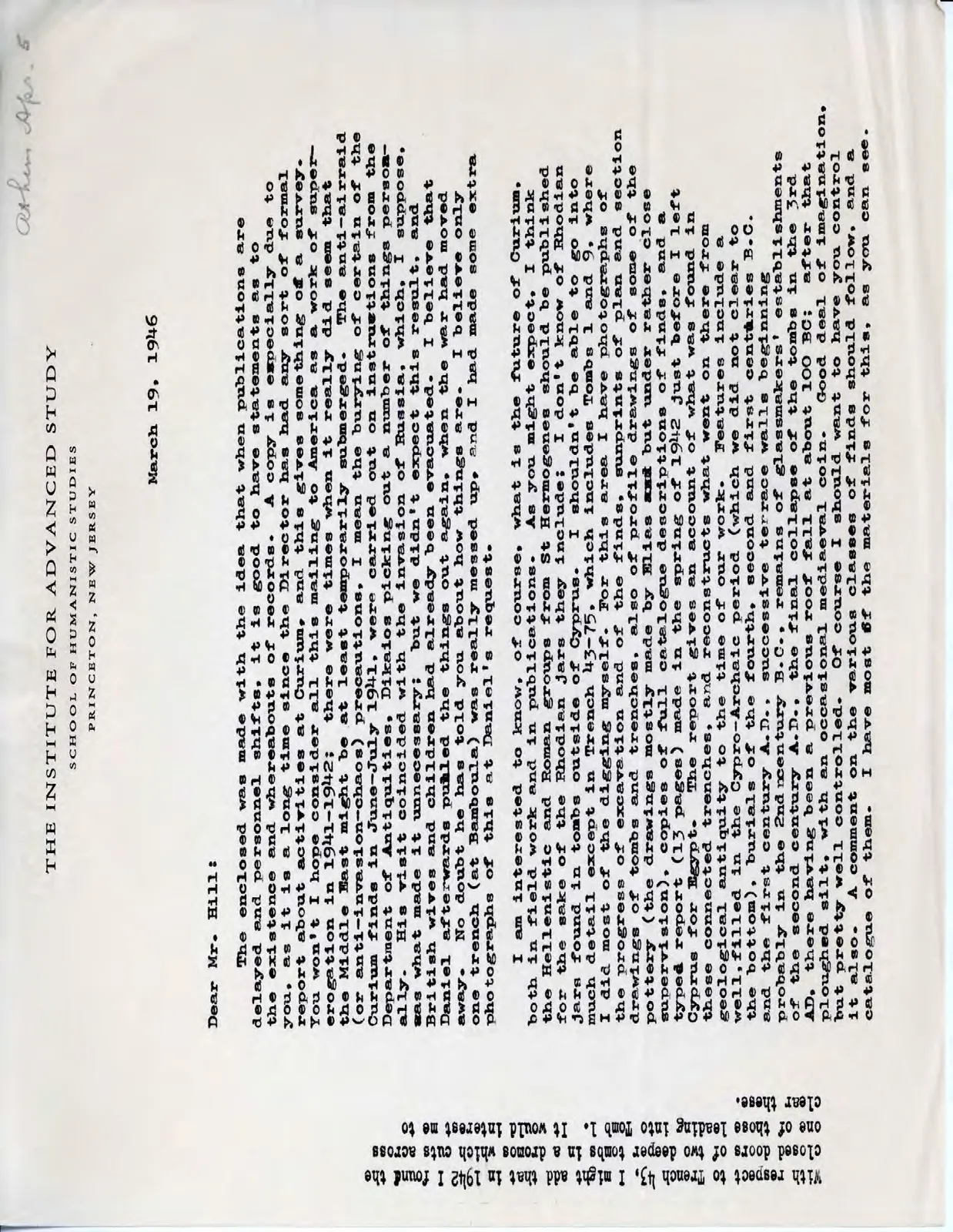
The enclosed was made with the idea that when publications are delayed and personnel shifts. it is good to have statements as to the existence and whereabouts of records. A copy is especially due to you. as it is a long time since the Director has had any sort of formal report about activities at Curium, and this gives something of a survey. You won't I hope consider all this mailing to America as a work of supererogation in 1941-1942; there were times when it really did seem that the Middle East might be at least temporarily submerged. I mean the burying of certain of the Curium finds in June-July 1941. were carried out on instructions from the Department of Antiquities. Dikaios picking out a number of things personally. His visit coincided with the invasion of Russia, which, I suppose, was what made it unnecessary; but we didn't expect this result. and British wives and children had already been evacuated. I believe that Daniel afterwards pushed the things out again, when the war had moved away. No doubt he has told you about how things are. I believe only one trench (at Bamboula) was really messed up, and I had made some extra photographs of this at Daniel's request.
I am interested to know, of course, what is the future of Curium. both in field work and in publications. As you might expect, I think the Hellenistic and Roman groups from St Hermogenes should be published for the sake of the Rhodian groups they include; I don't know of Rhodian jars found in tombs outside of Cyprus. I shouldn't be able to go into much detail except in Trench 43-75, which includes Tombs 1 and 9, where I did most of the digging myself. For this area I have photographs of the progress of excavation and of the finds, sunprints of plan and section drawings of tombs and trenches, also of profile drawings of some of the pottery (the drawings mostly made by Elias and but under rather close supervision), copies of full catalogue descriptions of finds, and a typed report (13 pages) made in the spring of 1942 just before I left Cyprus for Egypt. The report gives an account of what was found in these connected trenches, and reconstructs what went on there from geological antiquity to the time of our work. Features include a well, filled in the Cypro-Archaic period (which we did not clear to the bottom), burials of the fourth, second and first centuries B.C. and the first century A.D.; successive terrace walls beginning probably in the 2nd century B.C.; remains of glassmakers' establishments of the second century A.D.; the final collapse of the tombs in the 3rd AD. there having been a previous roof fall at about 100 BC; after that ploughed silt, with an occasional mediaeval coin. Good deal of imagination, but pretty well controlled. Of course I should want to have you control it also. A comment on the various classes of finds should follow, and a catalogue of them. I have most of the materials for this, as you can see.
With respect to Trench 43, I might add that in 1942 I found the closed doors of two deeper tombs in a dromos which cuts across one of those leading into Tomb 1. It would interest me to clear these.
65 figures hard to readstruck struck outadded written in above” jug ditto, and what it repeatsword reading not certain