
Unnumbered pageScan 60 of 79
NOTES
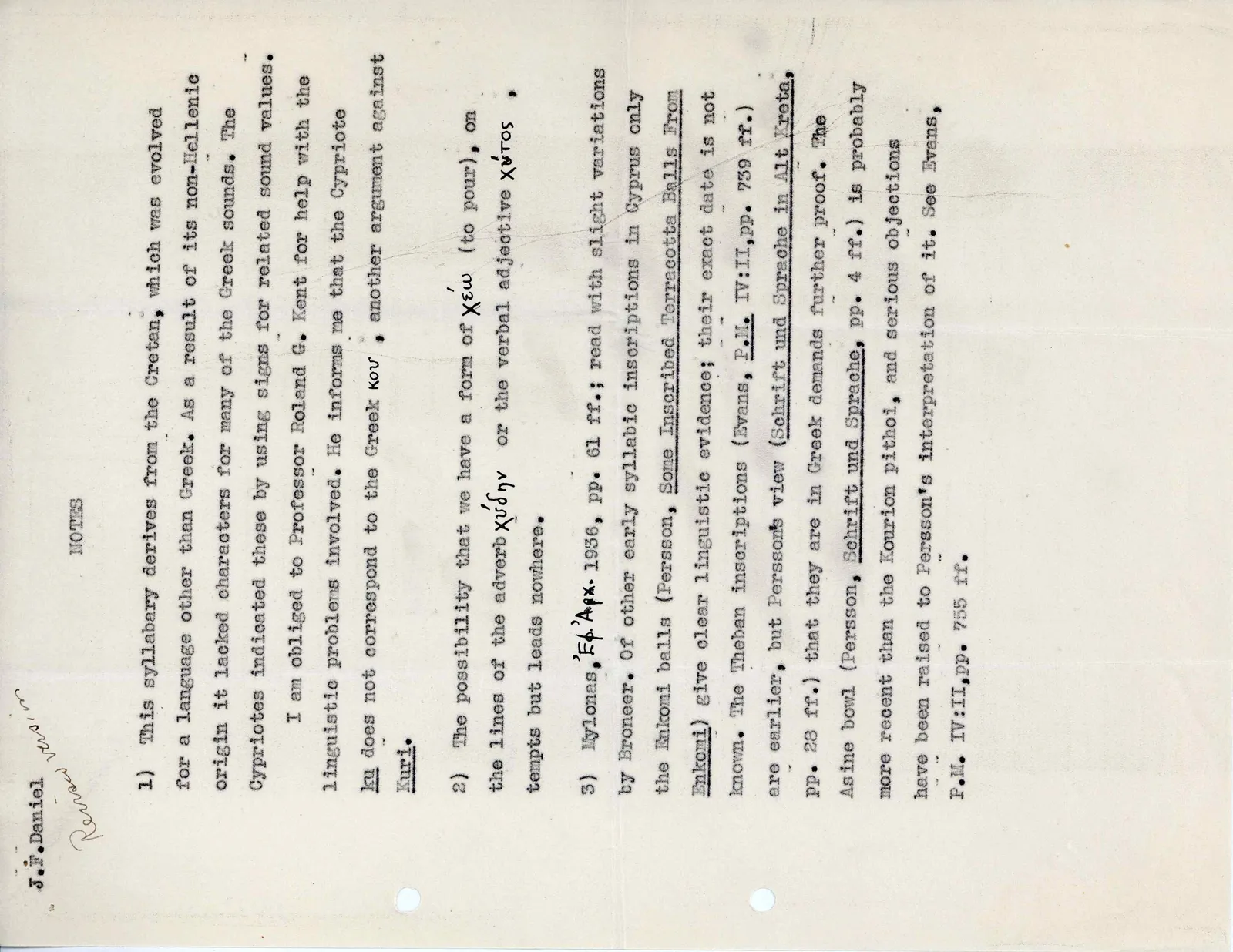
1) This syllabary derives from the Cretan, which was evolved for a language other than Greek. As a result of its non-Hellenic origin it lacked characters for many of the Greek sounds. The Cypriotes indicated these by using signs for related sound values. I am obliged to Professor Roland G. Kent for help with the linguistic problems involved. He informs me that the Cypriote ku does not correspond to the Greek κου: another argument against Kuri.
2) The possibility that we have a form of [handwritten: χέω] (to pour), or the lines of the adverb [handwritten: χυδὴν] or the verbal adjective [handwritten: χυτὸς] tempts but leads nowhere.
3) Mylonas. [handwritten: Ἐφ. Ἀρχ. 1936, pp. 61 ff.]; read with slight variations by Broneer. Of other early syllabic inscriptions in Cyprus only the Enkomi balls from Some Inscribed Terracotta Balls From Enkomi give clear linguistic evidence; their exact date is not known. The Theban inscriptions (Evans, P.M. IV:II,pp. 739 ff.) are earlier, but Persson's view (Schrift und Sprache in Alt Kreta pp. 28 ff.) that they are in Greek demands further proof. The Asine bowl (Persson, Schrift und Sprache pp. 4 ff.) is probably more recent than the Kourion pithoi, and serious objections have been raised to Persson's interpretation of it. See Evans, P.M. IV:II,pp. 755 ff.
65 figures hard to readstruck struck outadded written in above” jug ditto, and what it repeatsword reading not certain