
Page 9Scan 32 of 39
ENK. 60
East trench, sector 76 77 { cf. section-coupe { drawn up by W. Force
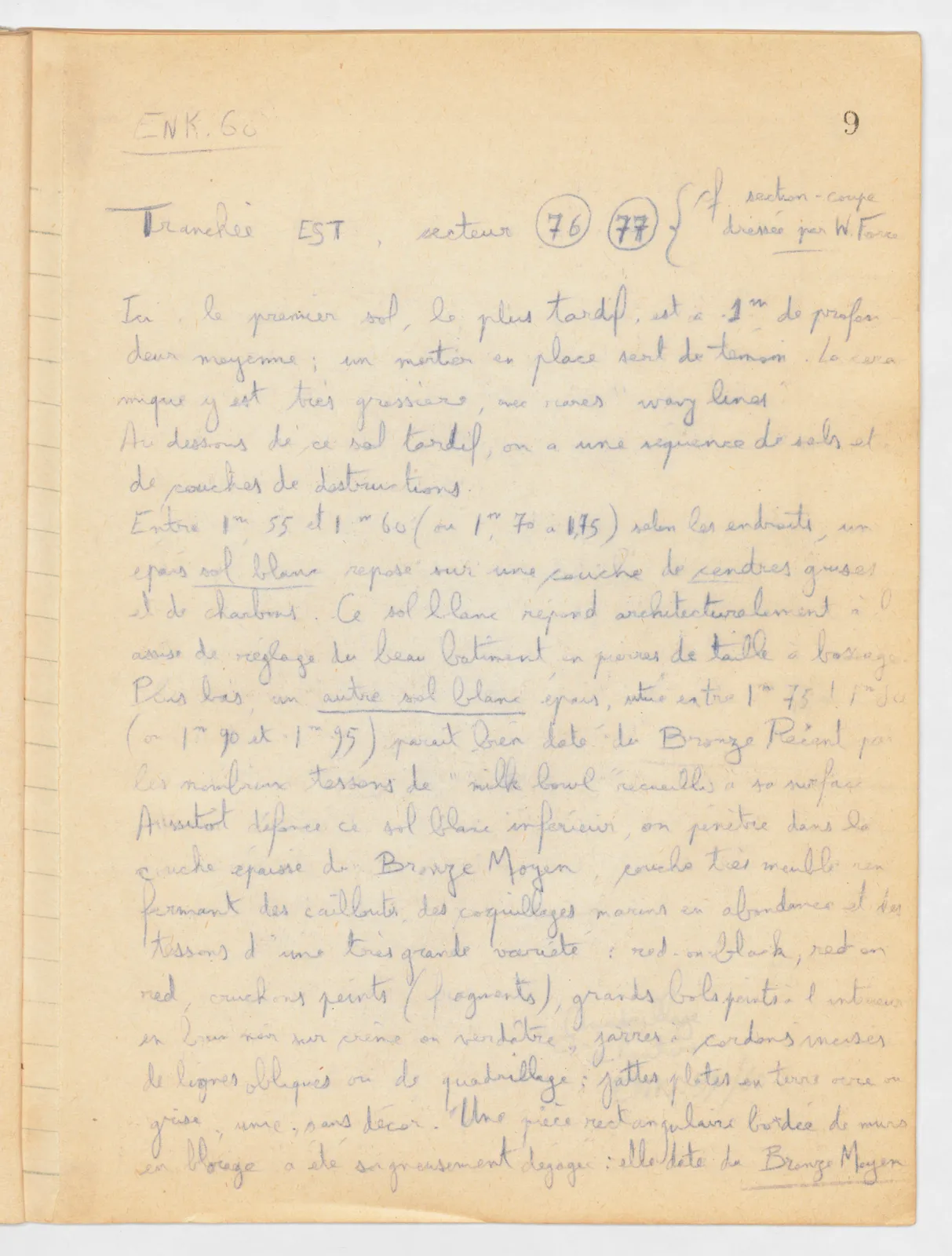
Here, the first floor, the latest, is at 1m average depth- ; an in situ mortar serves as witness. The potteryhere is very coarse, with rare "wavy lines". Below this late floor, there is a sequence of floors and of destruction layers. Between 1m 55 and 1m 60 (or 1m 70 to 1,75) depending on the place, a thick white floor rests on a layer of grey ashes and charcoal. This white floor corresponds architecturally to the levelling course of the fine building in ashlar with bossed blocks. Lower down, another thick white floor, situated between 1m 75 and 1m 80 (or 1m 90 and 1m 95) appears well dated to Late Bronze by the numerous "milk bowl" sherds recovered from its surface. As soon as this lower white floor is broken through, one enters the thick layer of Middle Bronze, a very loose layer containing pebbles, marine shells in abundance and sherds of very great variety: red-on-black, red-onred, painted jugs (fragments), large bowls painted on the inside in brown-black on cream or greenish, jars with incised cordons of oblique lines or cross-hatching; flat bowls in ochre or grey earth, plain, undecorated. A rectangular room bordered by walls of rubble has been carefully cleared: it dates to the Middle Bronze
65 figures hard to readstruck struck outadded written in above” jug ditto, and what it repeatsword reading not certain