
Unnumbered pageScan 9 of 10
5
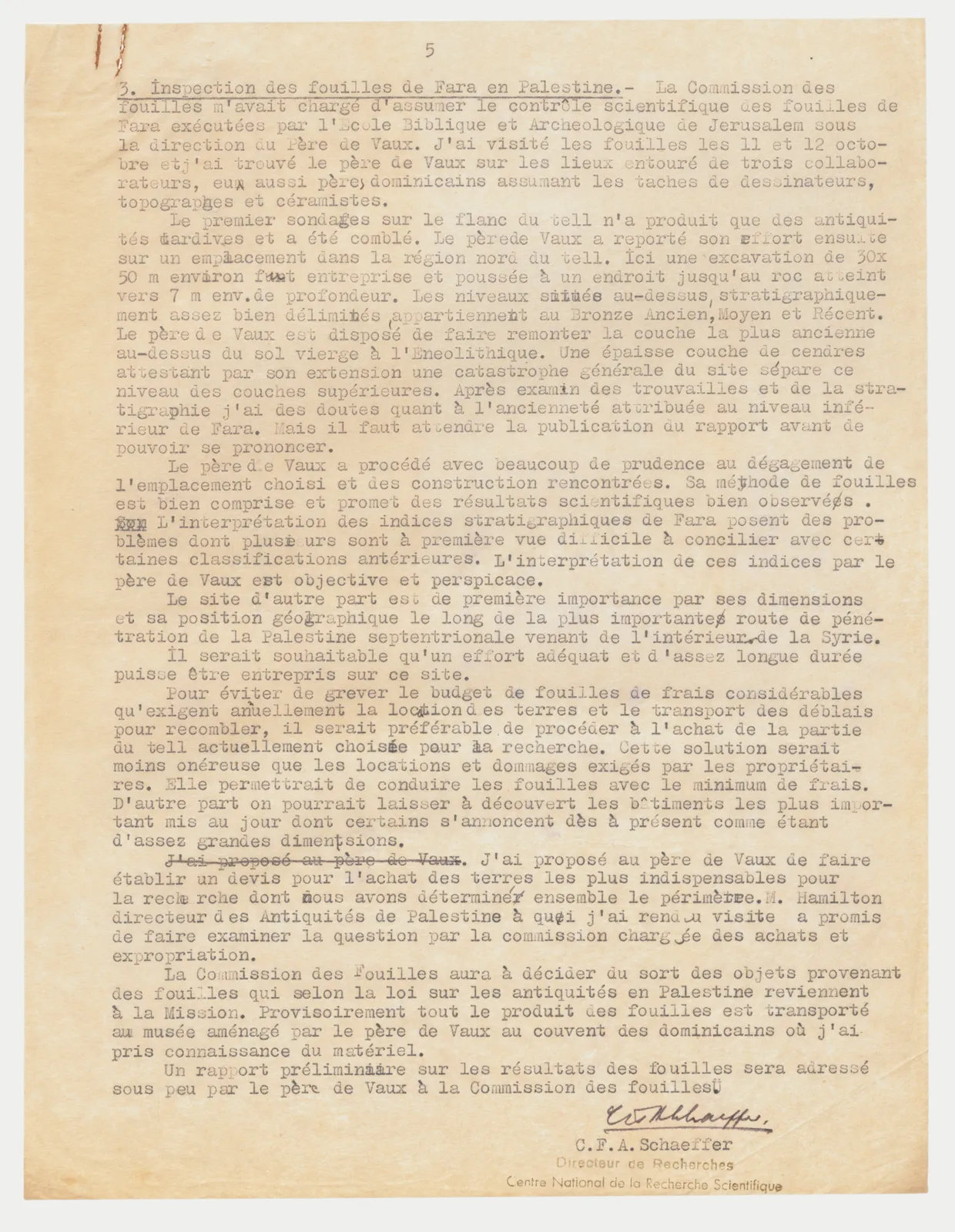
3. Inspection of the excavations at Fara in Palestine.- The Commission des Fouilles had instructed me to take on the scientific supervision of the excavations at Fara carried out by the École Biblique et Archéologique de Jérusalem under the direction of Père de Vaux. I visited the excavations on 11 and 12 October and found Père de Vaux on the spot surrounded by three collaborators, themselves also Dominican fathers, undertaking the tasks of draughtsmen, topographers and ceramicists.
The first sounding on the flank of the tell produced only later antiquities and has been backfilled. Père de Vaux then transferred his effort to a location in the northern area of the tell. Here an excavation of 30x 50 m approximately was undertaken and pushed at one point down to the rock reached at about 7 m depth. The levels lying above, stratigraphicallyfairly well delimited, belong to the Early, Middle and Late Bronze. Père de Vaux is inclined to date the oldest layer above the virgin soil to the Eneolithic. A thick layer of ash attesting by its extent a general catastrophe at the site separates this level from the upper layers. After examination of the finds and of the stratigraphy I have doubts as to the antiquity attributed to the lower level of Fara. But one must await publication of the report before being able to pronounce judgement.
Père de Vaux proceeded with great caution in clearing the chosen location and the constructions encountered. His excavation method is well understood and promises well-observed scientific results. The interpretation of the stratigraphic indications at Fara poses problems, several of which at first sight are difficult to reconcile with certain earlier classifications. The interpretation of these indications by Père de Vaux is objective and perceptive.
The site, on the other hand, is of prime importance for its dimensions and its geographical position along the most important route of penetration into northern Palestine coming from the interior of Syria. It would be desirable that an adequate and fairly long-term effort could be undertaken on this site.
To avoid burdening the excavation budget with considerable costs that the annual rental of land and the transport of spoil require for backfilling, it would be preferable to proceed with the purchase of the part of the tell currently chosen for the research. This solution would be less costly than the rentals and damages demanded by the proprietorsers. It would allow the excavations to be conducted with the minimum of costs. On the other hand, the most important buildings uncovered could be left exposed, some of which already appear to be of fairly large dimensions.
I proposed to Père de Vaux. I proposed to Père de Vaux that he have an estimate drawn up for the purchase of the land most indispensable for the research, the perimeter of which we determined together. Mr Hamilton Director of Antiquities of Palestine, whom I visited, has promised to have the question examined by the commission in charge of purchases and expropriation.
The Commission des Fouilles will have to decide the fate of the objects coming from the excavations which, according to the law on antiquities in Palestine, revert to the Mission. Provisionally all the produce of the excavations is transported to the museum arranged by Père de Vaux at the Dominican convent, where I examined the material.
A preliminary report on the results of the excavations will be sent shortly by Père de Vaux to the Commission des fouilles.
Handwritten: C.F.A. Schaeffer signature
C.F.A. Schaeffer Directeur de Recherches Centre National de la Recherche Scientifique
65 figures hard to readstruck struck outadded written in above” jug ditto, and what it repeatsword reading not certain