
Unnumbered pageScan 4 of 10
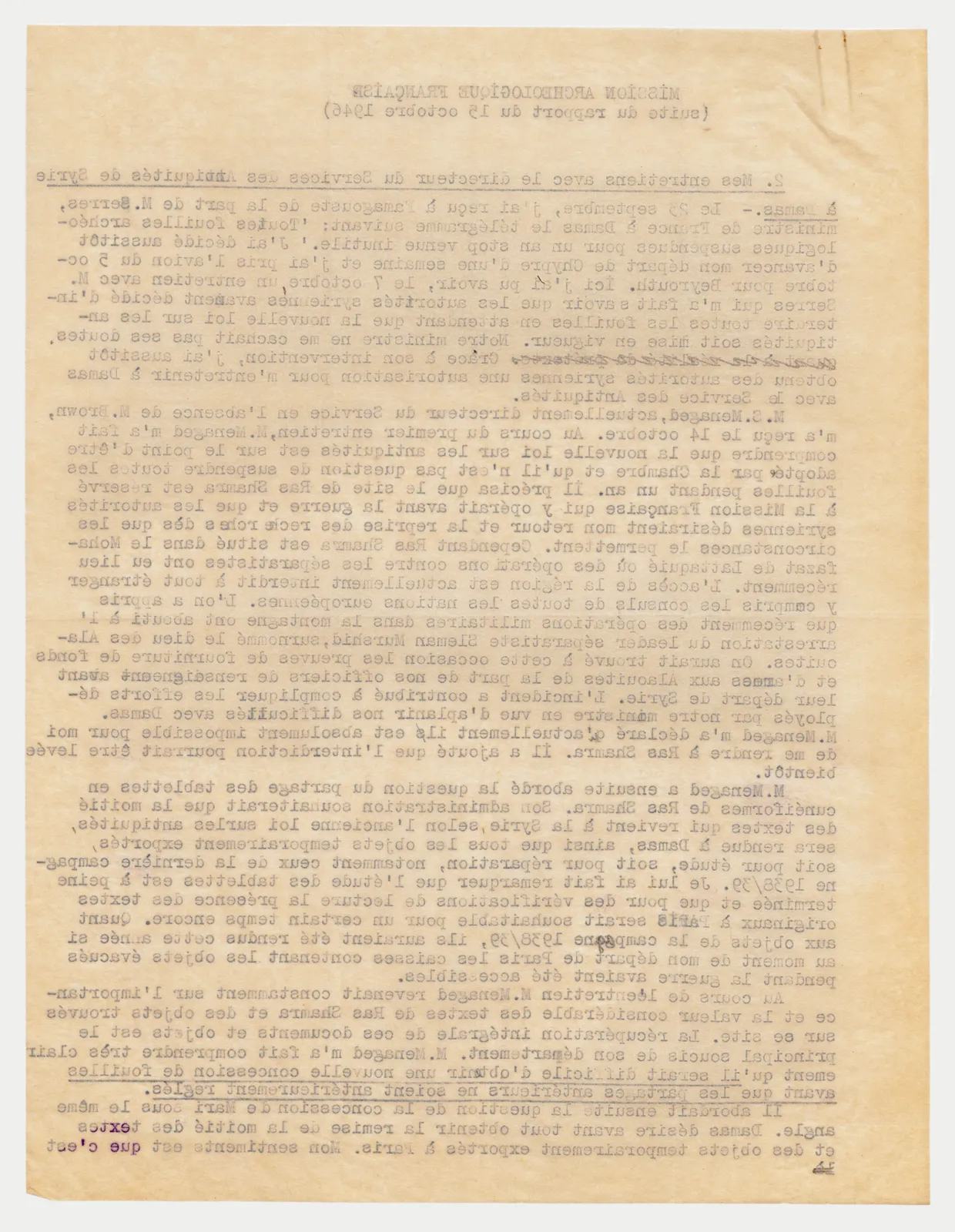
FRENCH ARCHAEOLOGICAL MISSION (continuation of the report of 15 October 1946)
2. My talks with the Director of the Antiquities Service of Syria
at Damascus.- On 29 September I received at Famagusta from M. Serres, French Minister at Damascus, the following telegram: 'All archaeological excavations suspended, stop, your coming useless.' I immediately decided to bring forward my departure from Cyprus by a week and took the plane of 5 October for Beirut. Here I was able to have, on 7 October, an interview with M. Serres who informed me that the Syrian authorities had decided to forbid all excavations until the new law on antiquities comes into force. Our Minister did not conceal his doubts as to the validity of this decision. Thanks to his intervention, I immediately obtained from the Syrian authorities an authorisation to confer at Damascus with the Antiquities Service.
M. S. Menaged, currently Director of the Service in the absence of M. Brown, received me on 14 October. During the first interview, M. Menaged made me understand that the new law on antiquities is about to be adopted by the Chamber and that there is no question of suspending all excavations for a year. He stated that the site of Ras Shamra is reserved for the French Mission, which was working there before the war, and that the Syrian authorities would fix my return and the resumption of research for when circumstances allow. However, Ras Shamra is situated in the Mohafazat of Latakia, where operations against the separatists have recently taken place. Access to the region is currently forbidden to all foreigners, including the consuls of all European nations. It has been learnt that recently military operations in the mountains led to the arrest of the separatist leader Slemen Murshid, known as the god of the Alaouites. On this occasion proofs are said to have been found of the supply of funds and arms to the Alaouites by our supply officers before their departure from Syria. The incident has helped to complicate the efforts made by our Minister to smooth over our difficulties with Damascus. M. Menaged declared to me that at present it is absolutely impossible for me to go to Ras Shamra. He added that the prohibition could be lifted soon.
M. Menaged then raised the question of the division of the cuneiform tablets of Ras Shamra. His administration would maintain that half of the texts which fall to Syria, under the former law on antiquities, will be returned to Damascus, as well as all the objects temporarily exported, either for study or for repair, notably those of the last campaign of 1938/39. I pointed out to him that the study of the tablets is barely finished and that for checking readings the presence of the original texts in Paris would be desirable for some time yet. As for the objects of the 1938/39 campaign, they would have been returned this year if, at the time of my departure from Paris, the crates containing the objects evacuated during the war had been accessible.
During the interview M. Menaged constantly returned to the importance and considerable value of the texts of Ras Shamra and of the objects found on this site. The complete reconstitution of these documents and objects is the main concern of his department. M. Menaged made it very clear to me that it would be difficult to obtain a new excavation concession before the earlier divisions had been settled.
He then broached the question of the concession at Mari from the same angle. Damascus wishes above all to obtain the return of half of the texts and of the objects temporarily exported to Paris. My feeling is that it is
Handwritten: signature
65 figures hard to readstruck struck outadded written in above” jug ditto, and what it repeatsword reading not certain