
Unnumbered pageScan 75 of 107
Proceedings of Prehistoric / Society, 1938, p. 221221. The Chronology of Troy.
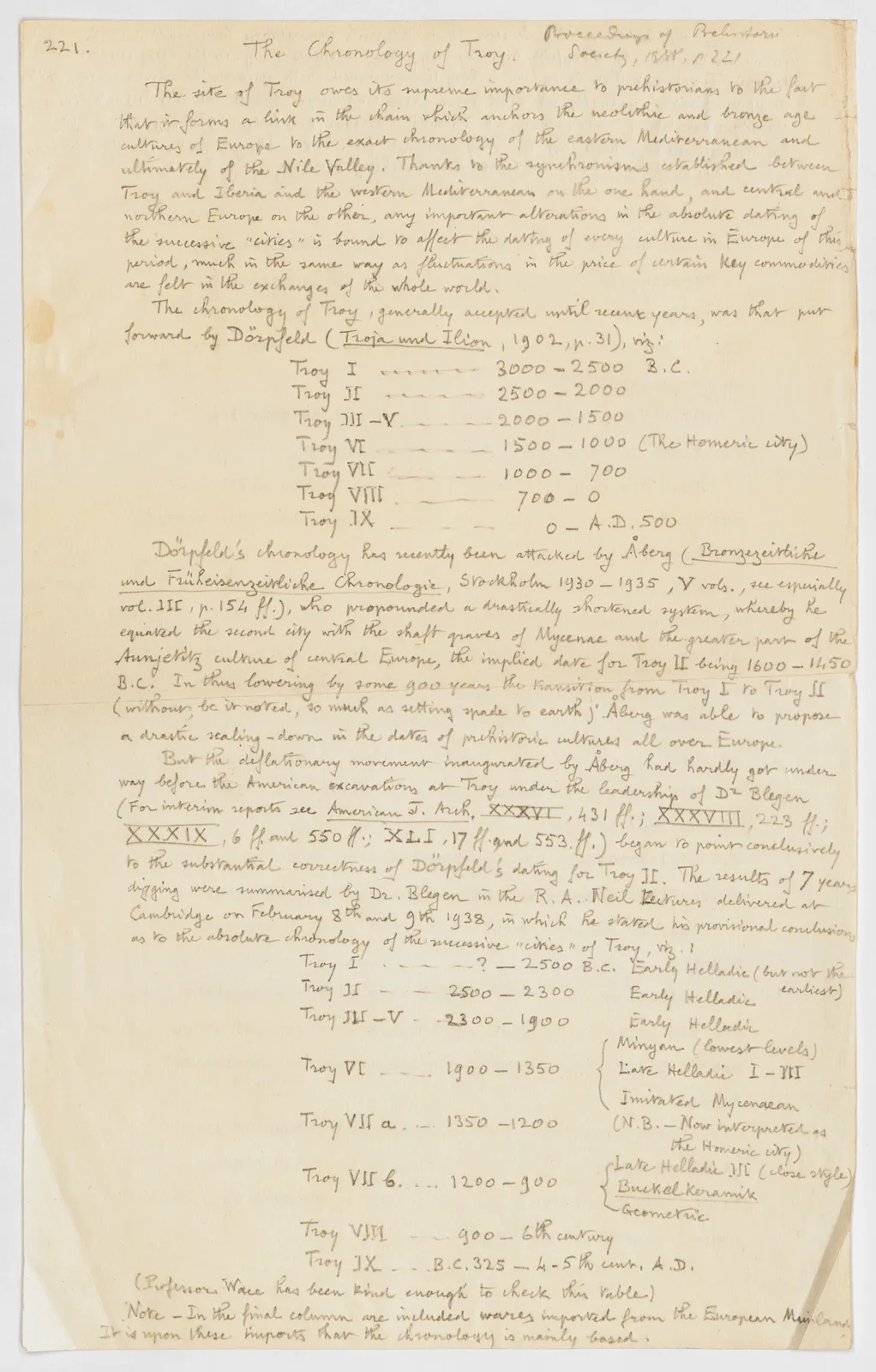
The site of Troy owes its supreme importance to prehistorians to the fact that it forms a link in the chain which anchors the neolithic and bronze age cultures of Europe to the exact chronology of the eastern Mediterranean and ultimately of the Nile Valley. Thanks to the synchronisms established between Troy and Iberia and the western Mediterranean on the one hand, and central and northern Europe on the other, any important alterations in the absolute dating of the successive "cities" is bound to affect the dating of every culture in Europe of this period, much in the same way as fluctuations in the price of certain key commodities are felt in the exchanges of the whole world. The chronology of Troy, generally accepted until recent years, was that put forward by Dörpfeld (Troja und Ilion, 1902, p. 31), viz.!
| Troy I | 3000 - 2500 B.C. | |
| Troy II | 2500 - 2000 | |
| Troy III - V | 2000 - 1500 | |
| Troy VI | 1500 - 1000 | (The Homeric city) |
| Troy VII | 1000 - 700 | |
| Troy VIII | 700 - 0 | |
| Troy IX | 0 - A.D. 500 |
Dörpfeld's chronology has recently been attacked by Åberg (Bronzezeitliche und Früheisenzeitliche Chronologie, Stockholm 1930 - 1935, V vols., see especially vol. III, p. 154 ff.), who propounded a drastically shortened system, whereby he equated the second city with the shaft graves of Mycenae and the greater part of the Aunjetitz culture of central Europe, the implied date for Troy II being 1600 - 1450 B.C. In thus lowering by some 900 years the transition from Troy I to Troy II (without, be it noted, so much as setting spade to earth) Åberg was able to propose a drastic scaling-down in the dates of prehistoric cultures all over Europe. But the deflationary movement inaugurated by Åberg had hardly got under way before the American excavations at Troy under the leadership of Dr Blegen (For interim reports see American J. Arch. XXXVI, 431 ff.; XXXVIII, 223 ff.; XXXIX, 6 ff. and 550 ff.; XLI, 17 ff. and 553 ff.) began to point conclusively to the substantial correctness of Dörpfeld's dating for Troy II. The results of 7 years' digging were summarised by Dr. Blegen in the R.A. Neil Lectures delivered at Cambridge on February 8th and 9th 1938, in which he stated his provisional conclusions as to the absolute chronology of the successive "cities" of Troy, viz.! Troy I | ? - 2500 B.C. | Early Helladic (but not the earliest) Troy II | 2500 - 2300 | Early Helladic Troy III - V | 2300 - 1900 | Early Helladic | | { Minyan (lowest levels) Troy VI | 1900 - 1350 | { Late Helladic I - III | | { Imitated Mycenaean Troy VII a. | 1350 - 1200 | (N.B. - Now interpreted as the Homeric city) | | { Late Helladic III (close style) Troy VII b. | 1200 - 900 | { Buckelkeramik | | { Geometric Troy VIII | 900 - 6th century | Troy IX | B.C. 325 - 4-5th cent. A.D. | (Professor Wace has been kind enough to check this table) Note - In the final column are included wares imported from the European Mainland. It is upon these imports that the chronology is mainly based.
65 figures hard to readstruck struck outadded written in above” jug ditto, and what it repeatsword reading not certain