
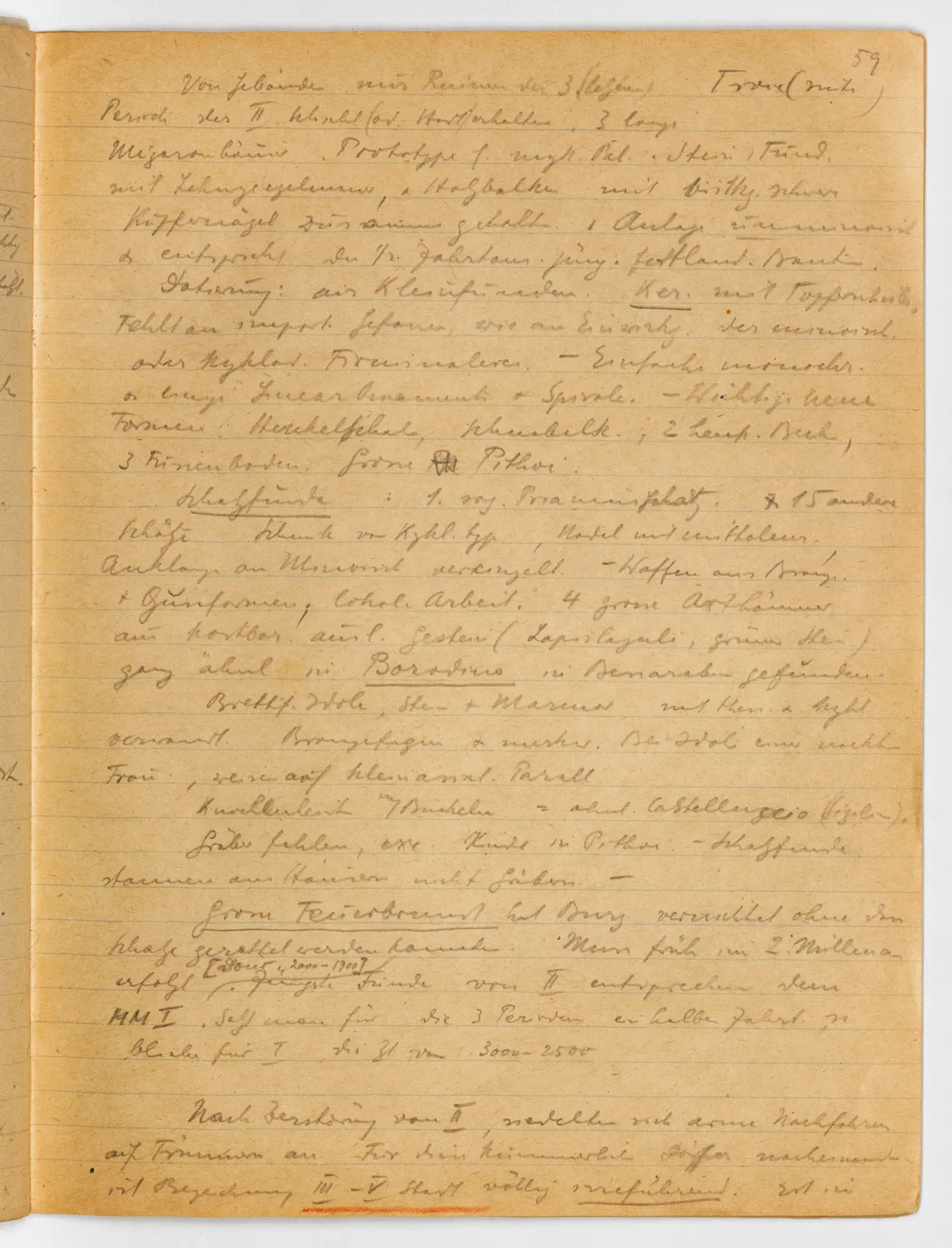
Page 59Scan 73 of 107
Of the buildings only ruins of the 3 (last) Troy (continued) Period of the II. Layer (or city) preserved. 3 long Megaron buildings. Prototype f. Mycenaean palace. - Stone find. with mudbrick wall, & wooden beams with up to 1 kg. heavy copper nails held together. 1 installation non-Minoan & corresponds to the 1/2 millennium later mainland buildings. Dating: from small finds. Ker. with potter's wheel, Lacking in imported vessels, as well as influence of the Minoan. or Cycladic varnish painting. - Simple monochr. or bent Linear ornaments & spiral. - Important new forms: handled bowl, beaked jug, 2 handled cups, 3 footed base, Large [illegible] pithoi. Treasure finds: 1. so-called Priam's Treasure. & 15 other treasures. Jewellery of Cycladic type, pin with Central European echoes of Minoan occasionally. - Weapons of bronze & casting moulds, local work. 4 large axe-hammers of precious foreign stone (lapis lazuli, green stone) very similar found at Borodino in Bessarabia. Board-shaped idols, stone & marble with Thessalian & Cycladic related. Bronze figure & remarkable lead idol of a naked woman, points to Anatolian parallels. Bone strip with knobs = similar to Castelluccio (Sicily). Graves lacking, exc. children in pithoi. - Treasure finds come from houses not graves. - Great conflagration destroyed the citadel without that treasures could be saved. Must have occurred early in the 2nd millennium occurred [about c. 2000-1900] . Latest finds from II correspond to the MM I. If one puts for the 3 periods half a millennium, so there remains for I the time from 3000-2500
After destruction of II, poor descendants settled on the ruins. For these wretched villages successively the designation III - V city is completely misleading. Only in
65 figures hard to readstruck struck outadded written in above” jug ditto, and what it repeatsword reading not certain