
Page -5-Scan 12 of 14
Continued from scan 11
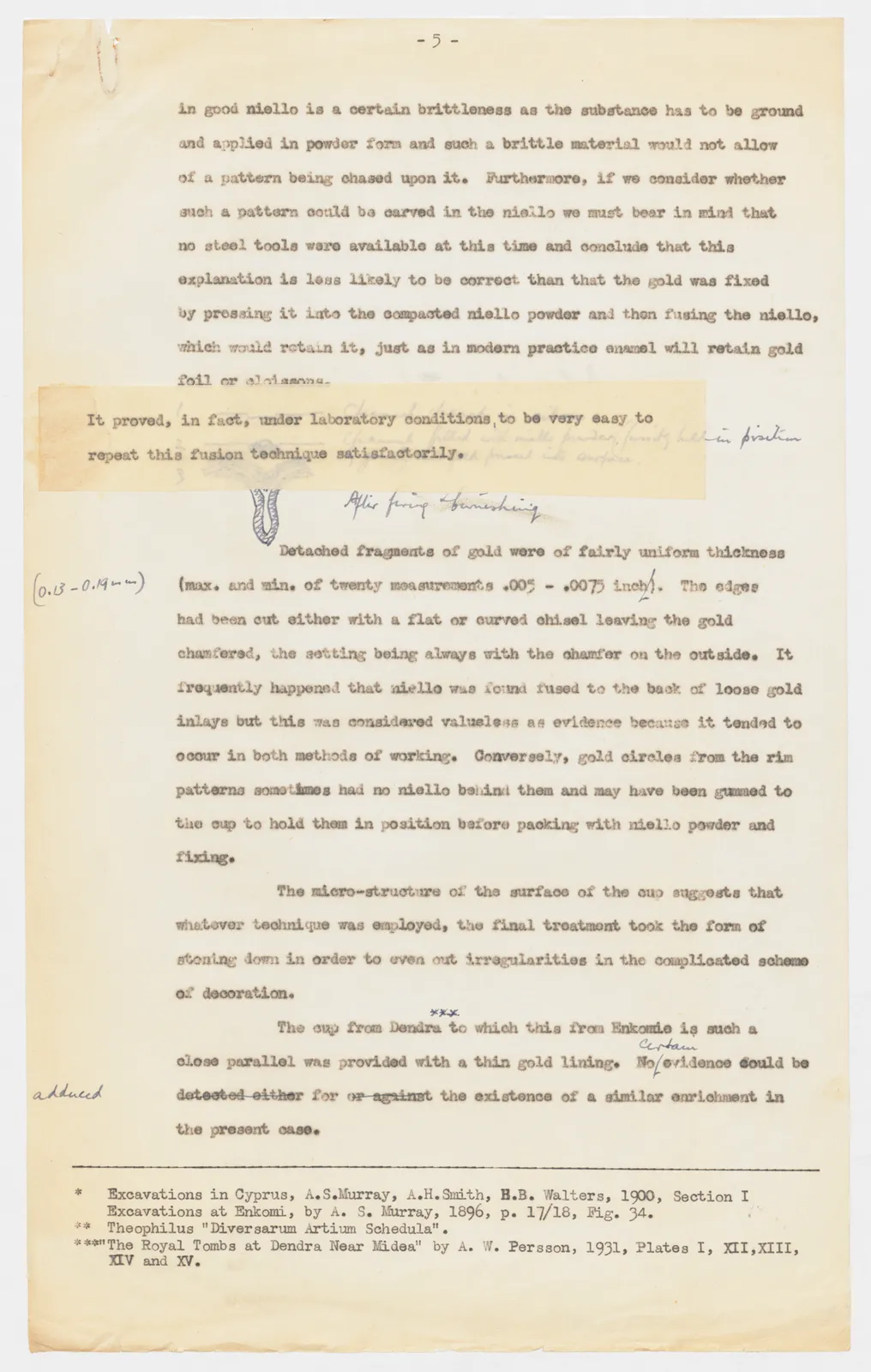
… in good niello is a certain brittleness as the substance has to be ground and applied in powder form and such a brittle material would not allow of a pattern being chased upon it. Furthermore, if we consider whether such a pattern could be carved in the niello we must bear in mind that no steel tools were available at this time and conclude that this explanation is less likely to be correct than that the gold was fixed by pressing it into the compacted niello powder and then fusing the niello, which would retain it, just as in modern practice enamel will retain gold foil or elalssons.
It proved, in fact, under laboratory conditions to be very easy to repeat this fusion technique satisfactorily.
Figure: handwritten annotations and a sketch of a cup section with a hand-drawn bracket; labels: "After firing burnishing", "(0.13 - 0.19 mm)" in margin, "enamel filled with niello powder, fusing held in position", "...ground smooth its surface" (faint)
Detached fragments of gold were of fairly uniform thickness (max. and min. of twenty measurements .005 - .0075 inch). The edges had been cut either with a flat or curved chisel leaving the gold chamfered, the setting being always with the chamfer on the outside. It frequently happened that niello was found fused to the back of loose gold inlays but this was considered valueless as evidence because it tended to occur in both methods of working. Conversely, gold circles from the rim patterns sometimes had no niello behind them and may have been gummed to the cup to hold them in position before packing with niello powder and fixing.
The micro-structure of the surface of the cup suggests that whatever technique was employed, the final treatment took the form of stoning down in order to even out irregularities in the complicated scheme of decoration.
The cup from Dendra to which this from Enkomie is such a close parallel was provided with a thin gold lining. [handwritten: Certain] No[handwritten: /] evidence could be detected either for or against the existence of a similar enrichment in the present case. [handwritten: adduced]
______________________________________________________________________
* Excavations in Cyprus, A.S.Murray, A.H.Smith, H.B.Walters, 1900, Section I Excavations at Enkomi, by A. S. Murray, 1896, p. 17/18, Fig. 34. ** Theophilus "Diversarum Artium Schedula". ***"The Royal Tombs at Dendra Near Midea" by A. W. Persson, 1931, Plates I, XII,XIII, XIV and XV.
65 figures hard to readstruck struck outadded written in above” jug ditto, and what it repeatsword reading not certain