
Unnumbered pageScan 4 of 4
Continued from scan 3
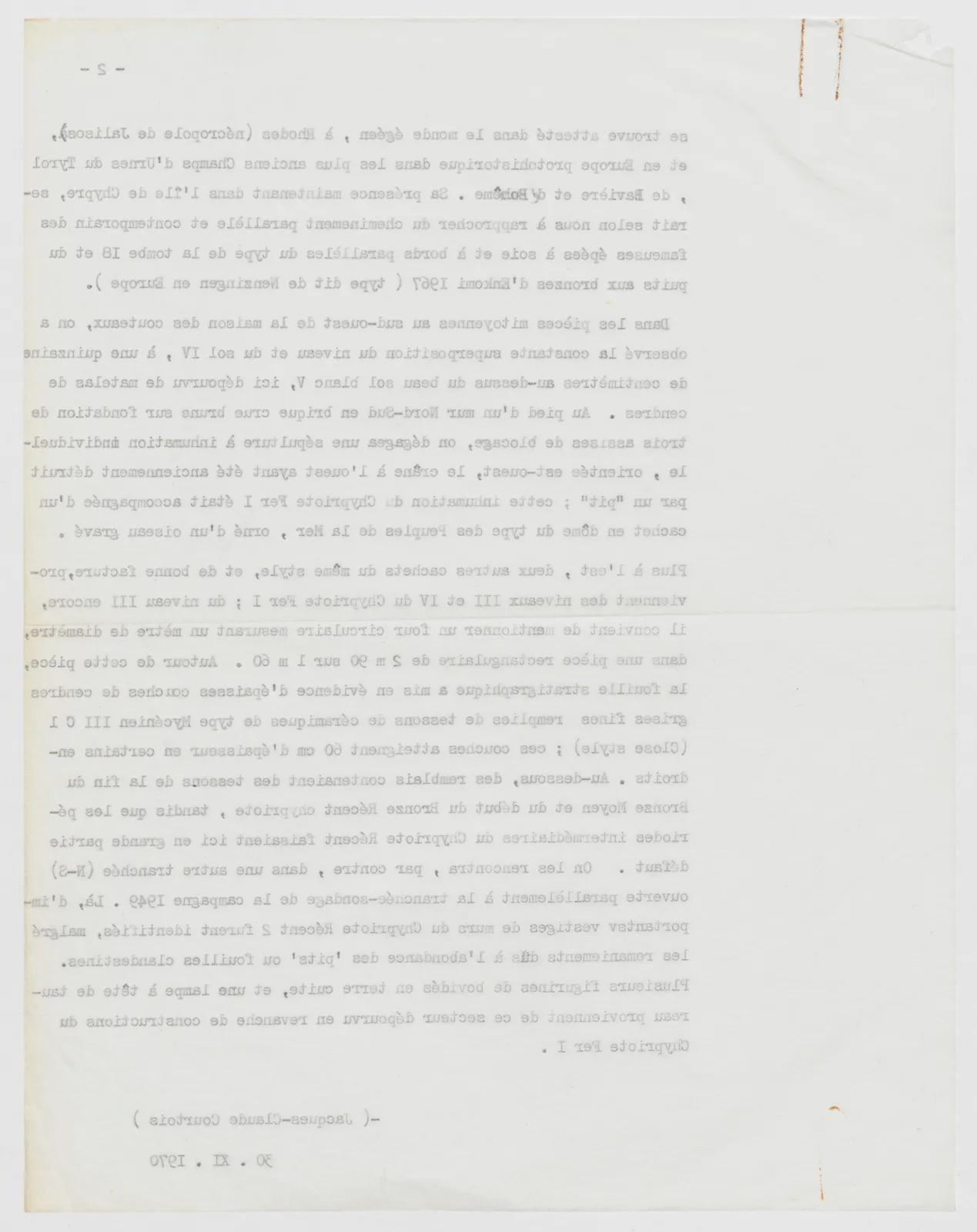
… is attested in the Aegean world, at Rhodes (necropolis of Ialisos), and in protohistoric Europe in the oldest Urnfields of the Tyrol , of Bavaria and Bohemia. Its presence now in the island of Cyprus, sewould in our view be linked with the parallel and contemporary development of the famous tanged swords with parallel edges of the type of Tomb 18 and the point of the bronzes of Enkomi 1967 (so-called Nenningen type in Europe).
In the adjoining rooms south-west of the house of the brokers, one observed the constant superimposition of level and floor IV, about fifteen centimetres above the fine white floor V, here freed of a mattress of ashes. At the foot of a North-South wall of mud brick, burnt, on a foundation of three courses of rubble, a single burial was cleared, oriented east-west, the skull at the west having been anciently destroyed by a "pit"; this burial of Cypriot Iron I was accompanied by a sheet-metal bird of the Sea Peoples type, decorated with an engraved bird.
Further east, two other seals of the same style, and of good workmanship, come from levels III and IV of Cypriot Iron I; also from level III, it should be mentioned a circular kiln measuring one metre in diameter, in a rectangular room of 2 m 90 by 1 m 60. Around this room, the stratigraphic excavation has revealed thick layers of ash fine grey, filled with sherds of Mycenaean III C 1 type pottery (Close style); these layers reach 60 cm in thickness in certain places. Below, fills contained sherds of the end of Middle Bronze and the beginning of Cypriot Late Bronze, while the periods of intermediate Late Cypriot were here largely absent. They were, however, met with in another trench (N-S) opened parallel to the trench-sounding of the 1949 campaign. There, important remains of walls of Late Cypriot 2 were identified, despite the disturbance due to the abundance of "pits" or clandestine diggings. Several terracotta bovid figurines, and a lamp with a bull's head, come from this sector, freed on the other hand of constructions of Cypriot Iron I.
-( Jacques-Claude Courtois )
30 . XI . 1970
65 figures hard to readstruck struck outadded written in above” jug ditto, and what it repeatsword reading not certain