
Page 2Scan 2 of 4
ENKOMI 1970
/+/+/+/
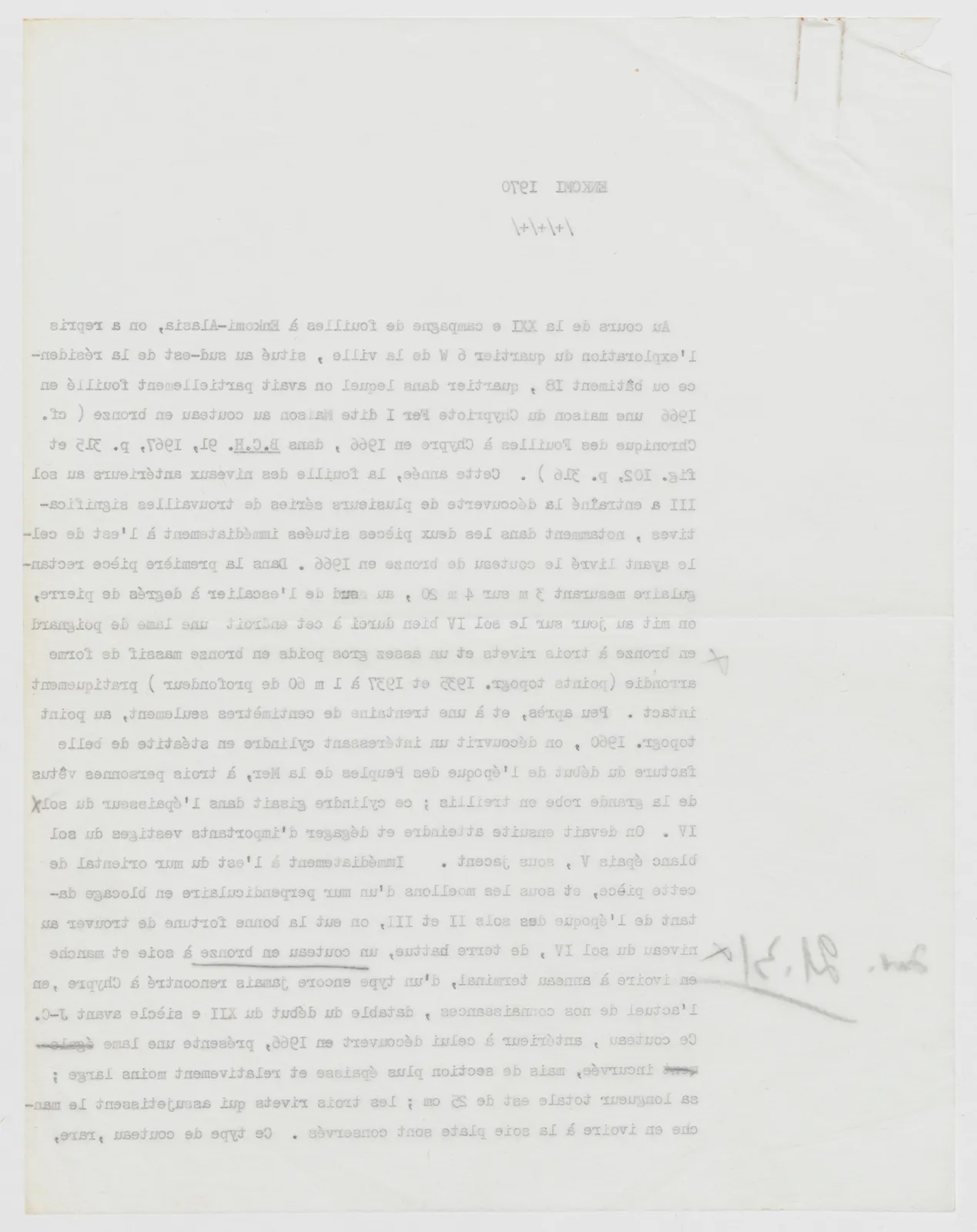
During the XXI e campaign of excavations at Enkomi-Alasia, we resumed the exploration of quarter 6 W of the town, situated to the south-east of the residence or building 18, a quarter in which partial excavation had been carried out in 1966 a house of the Cypriot Iron I known as the Bronze Knife House (cf. Chronicle of Excavations in Cyprus in 1966, in B.C.H. 91, 1967, p. 315 et fig. 102, p. 316). This year, excavation of the levels earlier than floor III led to the discovery of several series of significant findings, notably in the two rooms situated immediately east of thatwhich yielded the bronze knife in 1966. In the first rectangular room measuring 3 m by 4 m 20, at the foot of the stone-step staircase, was uncovered on floor IV, well dated at this spot, a dagger blade of bronze with three rivets and a fairly large weight of solid bronze of rounded form (topographic point 1935 and 1937 at 1 m 60 depth) almost intact. Shortly after, and only about thirty centimetres away, at point topographic 1960, an interesting steatite cylinder of fine workmanship of the beginning of the Sea Peoples period, with three figures dressed in the long latticed robe; this cylinder lay in the thickness of floor IV. We then had to reach and clear important remains of the thick white floor V, underlying. Immediately east of the eastern wall of this room, and under the rubble of a perpendicular rubble-core wall dating from the period of floors II and III, we had the good fortune to find at the level of floor IV, of beaten earth, a bronze knife with tang and handle of ivory with terminal ring, of a type never yet encountered in Cyprus, in the present state of our knowledge, datable to the beginning of the XII e century BC. This knife, earlier than the one found in 1966, has a blade equally curved, but of thicker section and relatively narrower; its total length is 25 cm; the three rivets which secure the handle of ivory to the flat tang are preserved. This type of knife, rare,
[handwritten: X] [marginal mark at right of "fouilles" line area]
[handwritten: X] [marginal mark beside "soie" line]
[handwritten: Sac. 3/4 X] [handwritten annotation in right margin, lower part, underlined] … continues
65 figures hard to readstruck struck outadded written in above” jug ditto, and what it repeatsword reading not certain