
Page _5_Scan 9 of 20
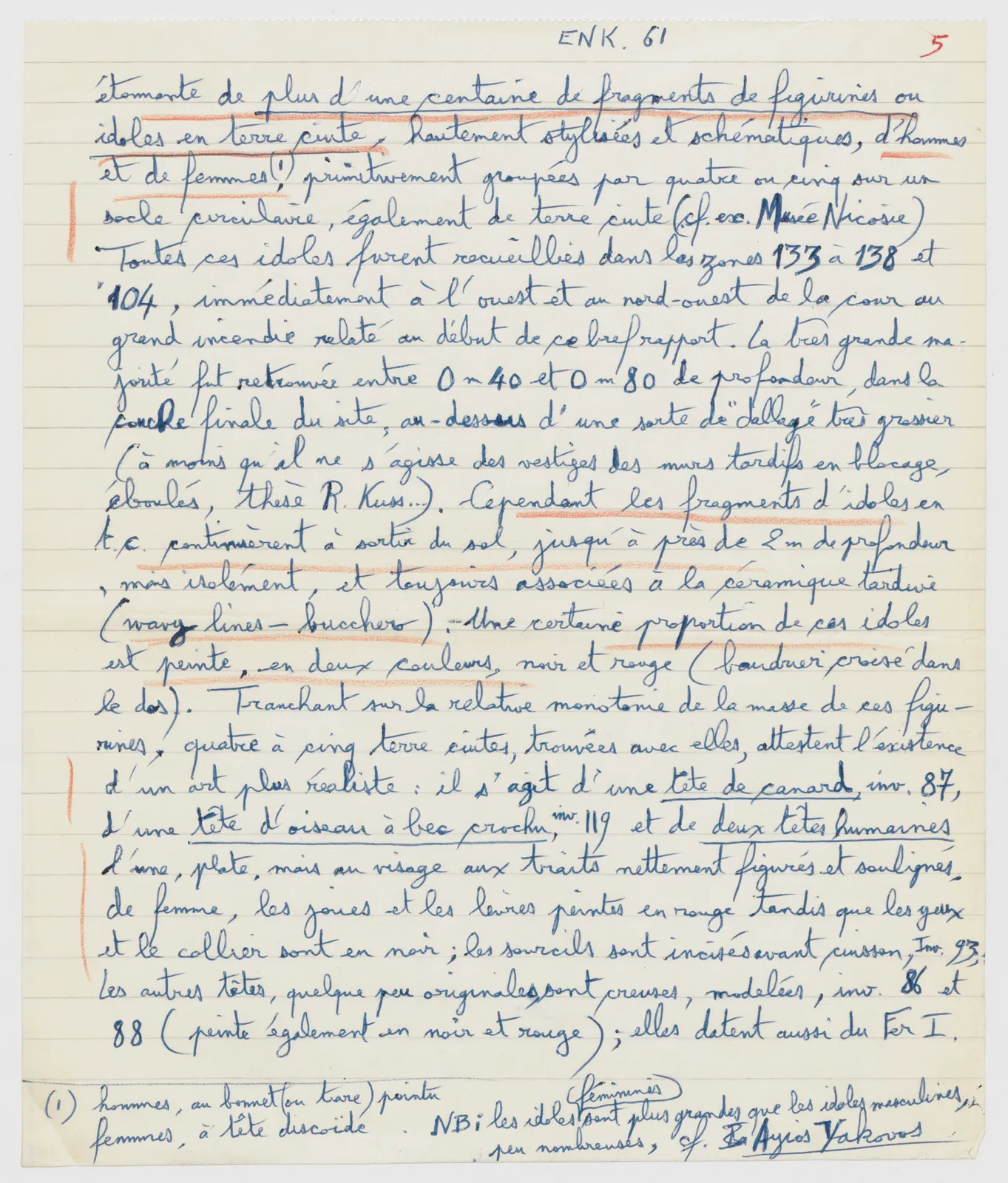
ENK. 61 astonishing number of more than a hundred fragments of figurines or terracotta idols, highly stylised and schematic, of men and of women(1) originally grouped four or five to a circular base, also of terracotta (cf. e.g. Nicosia Museum) All these idols were recovered in areas 133 to 138 and 104, immediately to the west and north-west of the courtyard with the great fire described at the beginning of this brief report. The very great majority was found between 0m40 and 0m80 deep, in the final layer of the site, beneath a kind of very rough "paving" (unless these are the remains of late walls in rubble, collapsed, thesis R. Kuss...). However the fragments of idols in terracotta continued to emerge from the ground, down to nearly 2m deep , but singly, and always associated with late pottery (wavy lines - bucchero). A certain proportion of these idols is painted, in two colours, black and red (crossed baldric on the back). Standing out against the relative monotony of the mass of these figurines, four to five terracottas found with them attest the existence of a more realistic art: there is a duck's head, inv. 87, a bird's head with hooked beak, inv. 119 and two human heads one, flat, but with a face whose features are clearly depicted and emphasised, of a woman, the cheeks and lips painted red while the eyes and the necklace are in black; the eyebrows are incised before firing, Inv. 93. The other heads, somewhat unusual, are hollow, modelled, inv. 86 and 88 (also painted in black and red); they also date to Iron I.
(1) men, with pointed cap (or tiara) women, with discoid head. NB: the female idols are larger than the male idols, few in number, cf. Ta Ayios Yakovos
65 figures hard to readstruck struck outadded written in above” jug ditto, and what it repeatsword reading not certain