
Page 4Scan 7 of 20
ENK. 61
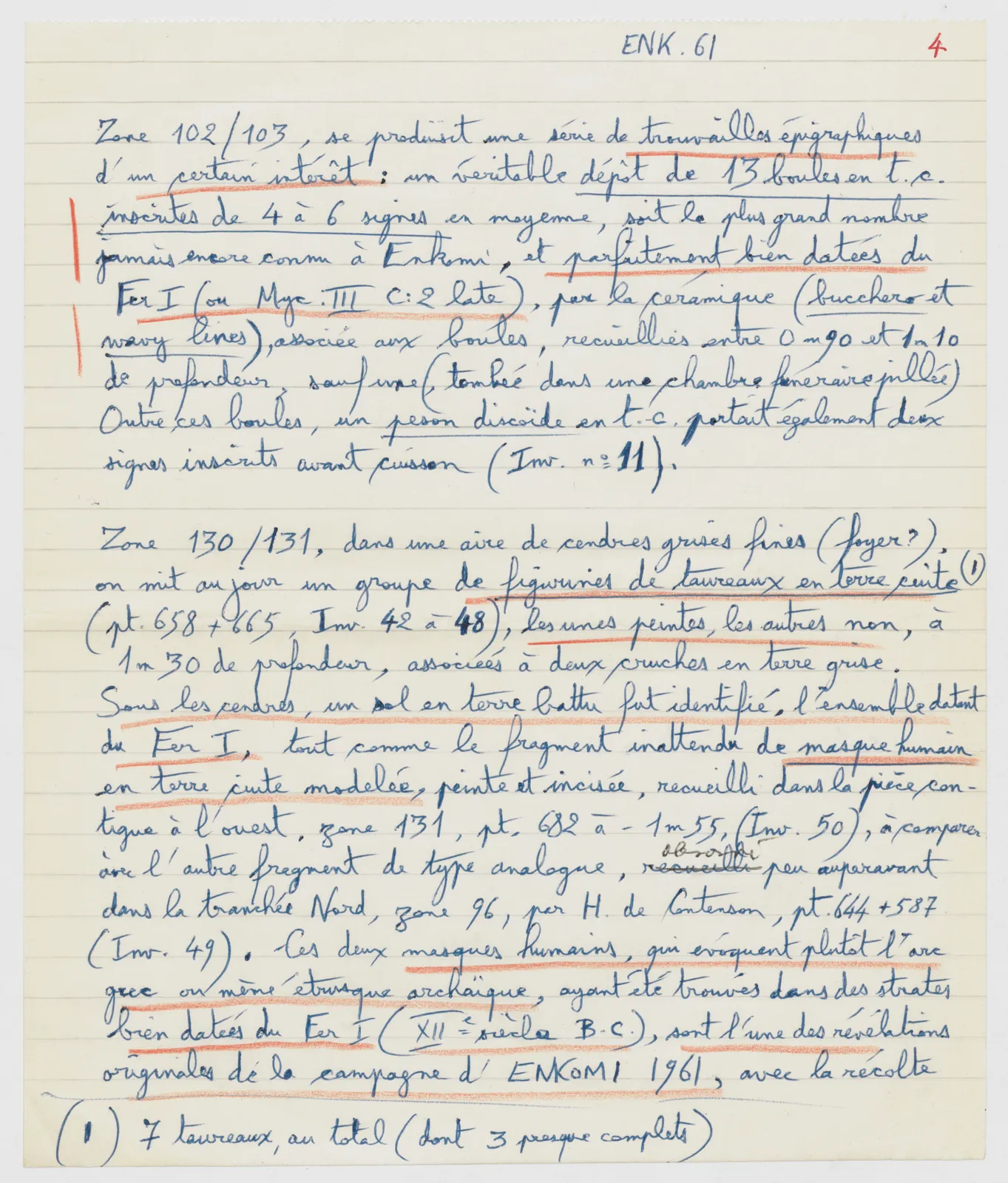
Zone 102/103, a series of epigraphic finds occurred of some interest: a genuine deposit of 13 balls in E.C.? — no. inscribed with 4 to 6 signs on average, the largest number ever known at Enkomi, and very well dated to the _Iron I (or Myc. III C:1 late_), by the pottery (bucchero and wavy lines), associated with the balls, recovered between 0 m 90 and 1 m 10 deep, except one (fallen into a looted burial chamber) Besides these balls, a discoid loom-weight in E.C. also bore two signs inscribed before firing (Inv. no. 11).
Zone 130/131, in an area of fine grey ash (hearth?), a group of terracotta bull figurines (1) was uncovered (pt. 658 + 665, Inv. 42 to 48), some painted, others not, at 1 m 30 depth, associated with two grey clay jugs. Beneath the ash, a beaten earth floor was identified, the whole dating to Iron I, like the fragment unexpected of a human mask in modelled terracotta, painted and incised, recovered in the adjoining room to the west, zone 131, pt. 682 at - 1 m 55, (Inv. 50), to compare with the other fragment of similar type, recovered observed shortly before in the North trench, zone 96, by H. de Contenson, pt. 644 + 587 (Inv. 49). These two human masks, which evoke rather the art Greek or even Archaic Etruscan, having been found in strata well _dated to Iron I (XIIth c. B.C.), are one of the original revelations of the ENKOMI 1961 campaign, with the harvest
(1) 7 bulls, in total (of which 3 almost complete)
65 figures hard to readstruck struck outadded written in above” jug ditto, and what it repeatsword reading not certain