
Page 2Scan 3 of 20
ENK. 61
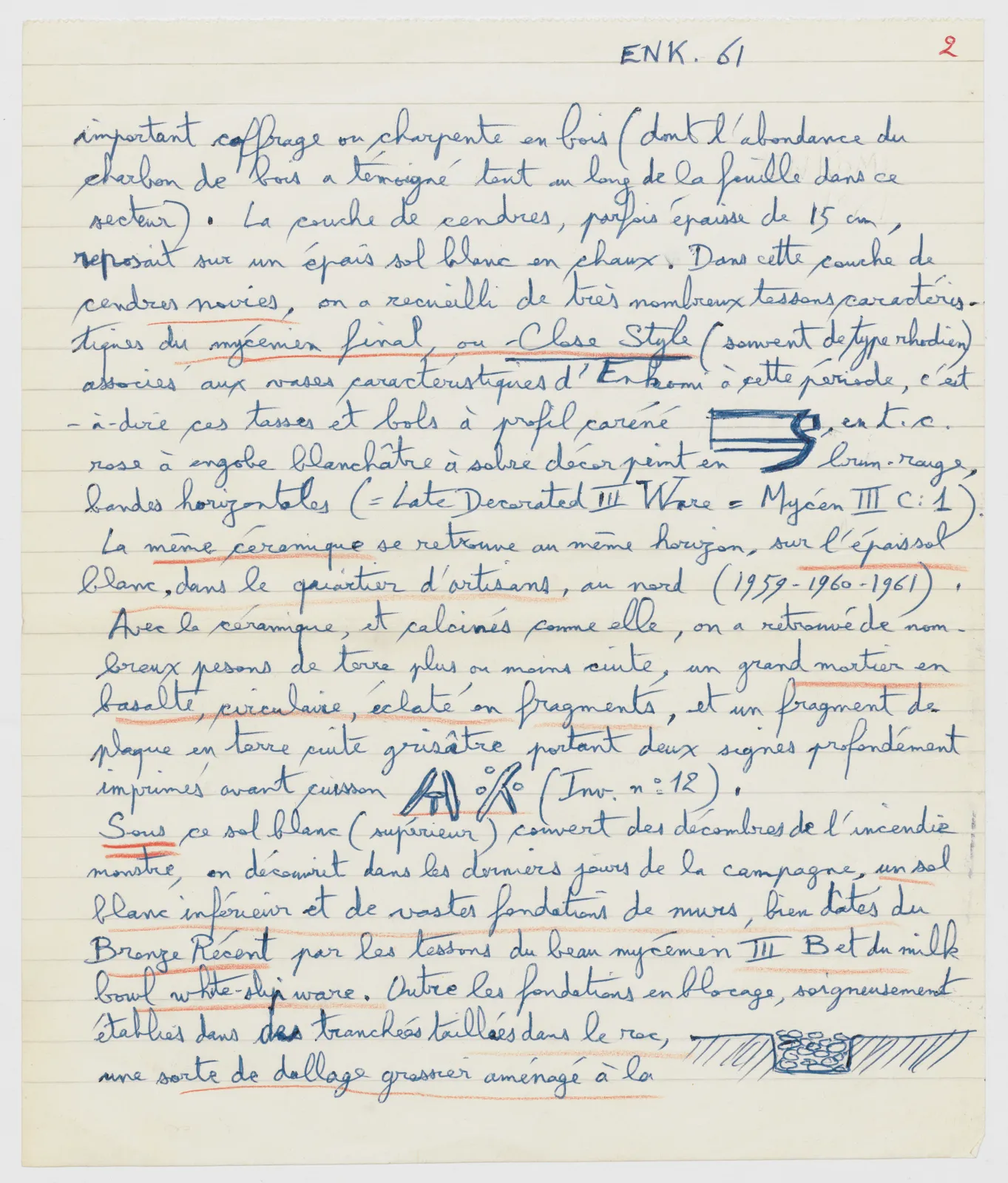
important wooden formwork or framework (the abundance of which charcoal bore witness throughout the excavation in this sector). The layer of ash, sometimes 15 cm thick, lay on a thick white lime floor. In this layer of black ash, very numerous characteristic sherds were recovered of Final Mycenaean, or -Close Style (often of Rhodian type) associated with the vessels characteristic of Enkomi at this period, that is i.e. these cups and bowls with a carinated profile (drawing) , in t.c. pink with whitish slip, sparingly decorated in red-brown paint, horizontal bands (= Late Decorated III Ware = Mycenaean III C:1). The same pottery is found at the same horizon, on the thick floor white, in the artisans' quarter, to the north (1959-1960-1961). With the pottery, and calcined like it, many were found again loom weights of more or less fired earth, a large mortar of basalt, circular, broken into fragments, and a fragment of plaque in greyish fired earth bearing two signs deeply impressed before firing (drawing) (Inv. no.: 12). Under this white floor (upper), covered by the debris of the great fire, in the last days of the campaign, a floor lower white and extensive wall foundations, well dated to the Late Bronze by the sherds of fine Mycenaean III B and of milk bowl white-slip ware. Besides the rubble foundations, carefully laid in the trenches cut into the rock, a kind of rough paving arranged at the (drawing)
65 figures hard to readstruck struck outadded written in above” jug ditto, and what it repeatsword reading not certain