
Unnumbered pageScan 5 of 10
Continued from scan 4
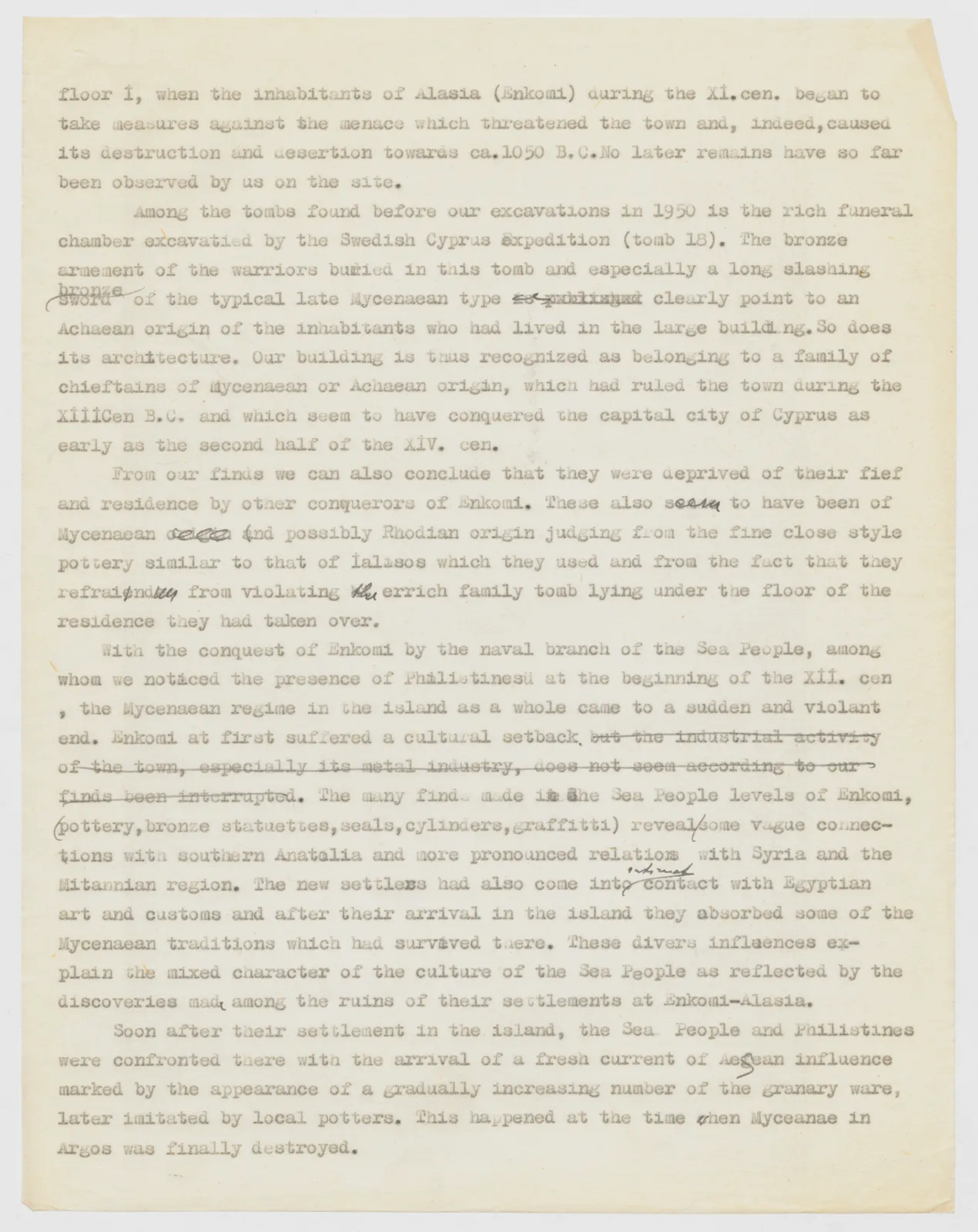
… floor I, when the inhabitants of Alasia (Enkomi) during the XI.cen. began to take measures against the menace which threatened the town and, indeed,caused its destruction and desertion towards ca.1050 B.C.No later remains have so far been observed by us on the site.
Among the tombs found before our excavations in 1950 is the rich funeral chamber excavatied by the Swedish Cyprus Expedition (tomb 18). The bronze armement of the warriors buried in this tomb and especially a long slashing bronze [handwritten: bronze annotation curve connecting to "sword"] sword of the typical late Mycenaean type of the exhibited clearly point to an Achaean origin of the inhabitants who had lived in the large building. So does its architecture. Our building is thus recognized as belonging to a family of chieftains of Mycenaean or Achaean origin, which had ruled the town during the XIIICen B.C. and which seem to have conquered the capital city of Cyprus as early as the second half of the XIV. cen.
From our finds we can also conclude that they were deprived of their fief and residence by other conquerors of Enkomi. These also seem to have been of Mycenaean origin (and possibly Rhodian origin judging from the fine close style pottery similar to that of Ialasos which they used and from the fact that they refraindy from violating the errich family tomb lying under the floor of the residence they had taken over.
With the conquest of Enkomi by the naval branch of the Sea People, among whom we noticed the presence of Philistinesu at the beginning of the XII. cen , the Mycenaean regime in the island as a whole came to a sudden and violant end. Enkomi at first suffered a cultural setback but the industrial activity of the town, especially its metal industry, does not seem according to our finds been interrupted. The many finds made in the Sea People levels of Enkomi, (pottery, bronze statuettes, seals, cylinders, graffitti) reveal some vague connections with southern Anatolia and more pronounced relations with Syria and the Mitannian region. The new settlers had also come into contact with Egyptian art and customs and after their arrival in the island they absorbed some of the Mycenaean traditions which had survived there. These divers influences explain the mixed character of the culture of the Sea People as reflected by the discoveries mad among the ruins of their settlements at Enkomi-Alasia.
Soon after their settlement in the island, the Sea People and Philistines were confronted there with the arrival of a fresh current of Aegean influence marked by the appearance of a gradually increasing number of the granary ware, later imitated by local potters. This happened at the time when Myceanae in Argos was finally destroyed.
65 figures hard to readstruck struck outadded written in above” jug ditto, and what it repeatsword reading not certain