
Unnumbered pageScan 10 of 10
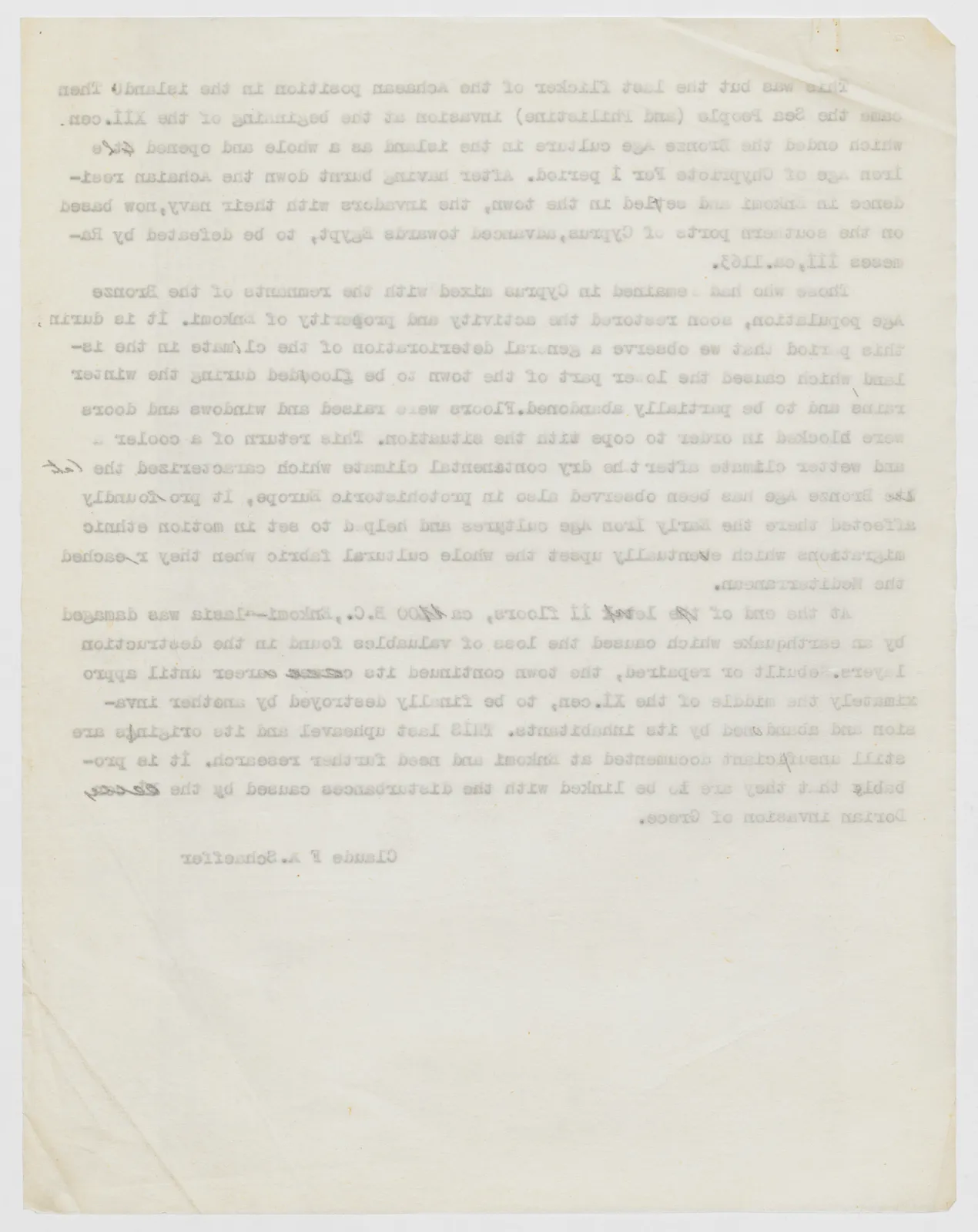
This was but the last flicker of the Achaean position in the island. Then came the Sea Peoples (and Philistine) invasion at the beginning of the XIIth century B.C., which ended the Bronze Age culture in the island as a whole and opened the Iron Age of Cypriote Pre I period. After having burnt down the Achaean residence in Enkomi and settled in the town, the invaders with their navy, now based on the southern ports of Cyprus, advanced towards Egypt, to be defeated by Rameses III, ca.1163.
Those who had remained in Cyprus mixed with the remnants of the Bronze Age population, soon restored the activity and prosperity of Enkomi. It is during this period that we observe a general deterioration of the climate in the island which caused the lower part of the town to be flooded during the winter rains and to be partially abandoned. Floors were raised and windows and doors were blocked in order to cope with the situation. This return of a cooler and wetter climate after the dry continental climate which characterized the Late Bronze Age has been observed also in protohistoric Europe. It profoundly affected there the Early Iron Age cultures and helped to set in motion ethnic migrations which eventually upset the whole cultural fabric when they reached the Mediterranean.
At the end of the Level II Floors, ca. 1200 1100 B.C., Enkomi-Alasia was damaged by an earthquake which caused the loss of valuables found in the destruction layers. Rebuilt or repaired, the town continued its career career until approximately the middle of the XI. cen, to be finally destroyed by another invasion and abandoned by the inhabitants. This last upheaval and the origins are still unsufficiently documented at Enkomi and need further research. It is probably that they are to be linked with the disturbances caused by the Dorian Dorian invasion of Greece.
Claude F. A. Schaeffer
65 figures hard to readstruck struck outadded written in above” jug ditto, and what it repeatsword reading not certain