
Page 345Scan 37 of 48
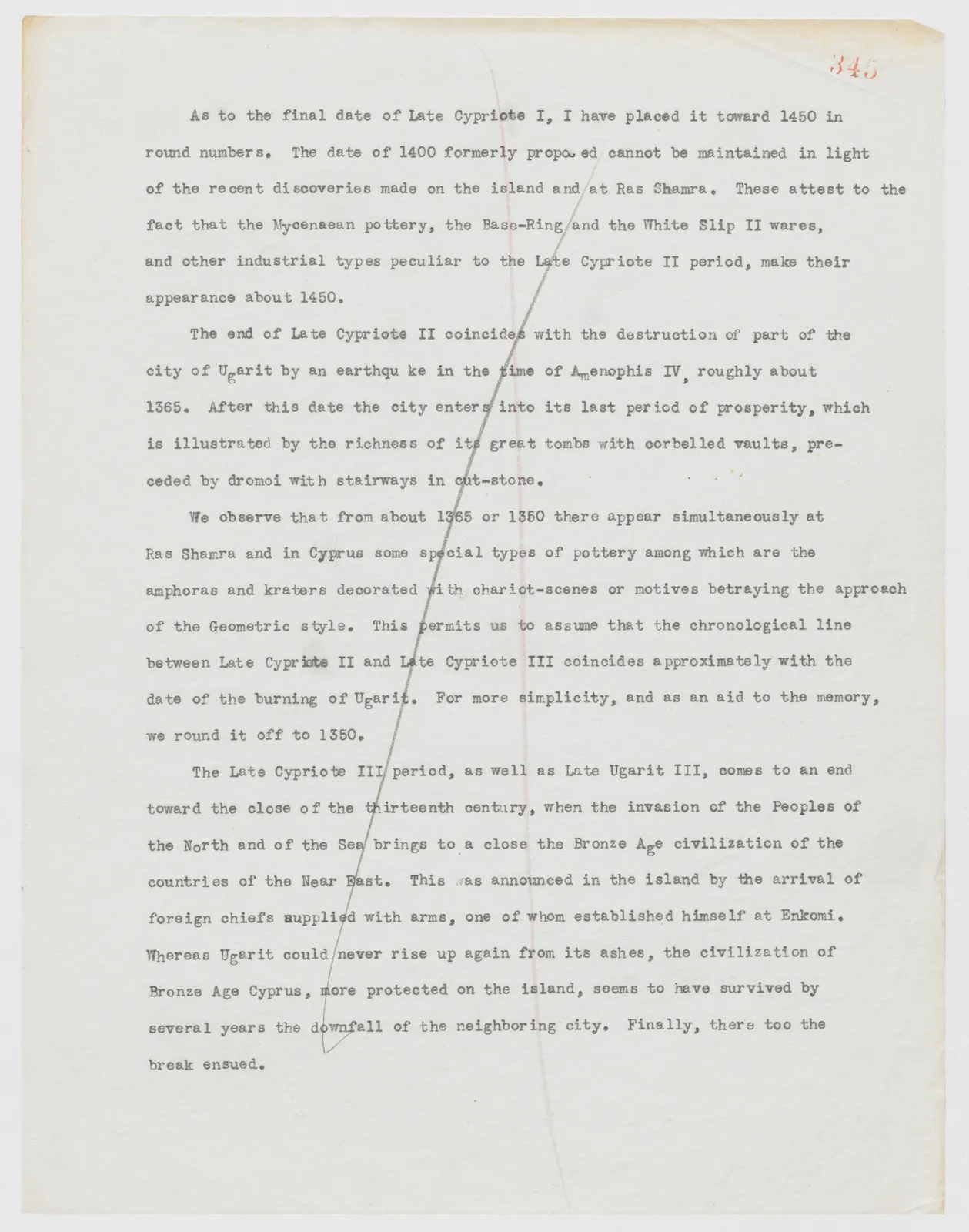
As to the final date of Late Cypriote I, I have placed it toward 1450 in round numbers. The date of 1400 formerly proposed cannot be maintained in light of the recent discoveries made on the island and at Ras Shamra. These attest to the fact that the Mycenaean pottery, the Base-Ring and the White Slip II wares, and other industrial types peculiar to the Late Cypriote II period, make their appearance about 1450.
The end of Late Cypriote II coincides with the destruction of part of the city of Ugarit by an earthquake in the time of Amenophis IV, roughly about 1365. After this date the city enters into its last period of prosperity, which is illustrated by the richness of its great tombs with corbelled vaults, preceded by dromoi with stairways in cut-stone.
We observe that from about 1365 or 1350 there appear simultaneously at Ras Shamra and in Cyprus some special types of pottery among which are the amphoras and kraters decorated with chariot-scenes or motives betraying the approach of the Geometric style. This permits us to assume that the chronological line between Late Cypriote II and Late Cypriote III coincides approximately with the date of the burning of Ugarit. For more simplicity, and as an aid to the memory, we round it off to 1350.
The Late Cypriote III period, as well as Late Ugarit III, comes to an end toward the close of the thirteenth century, when the invasion of the Peoples of the North and of the Sea brings to a close the Bronze Age civilization of the countries of the Near East. This was announced in the island by the arrival of foreign chiefs supplied with arms, one of whom established himself at Enkomi. Whereas Ugarit could never rise up again from its ashes, the civilization of Bronze Age Cyprus, more protected on the island, seems to have survived by several years the downfall of the neighboring city. Finally, there too the break ensued.
65 figures hard to readstruck struck outadded written in above” jug ditto, and what it repeatsword reading not certain