
Page 335Scan 17 of 48
Continued from scan 16
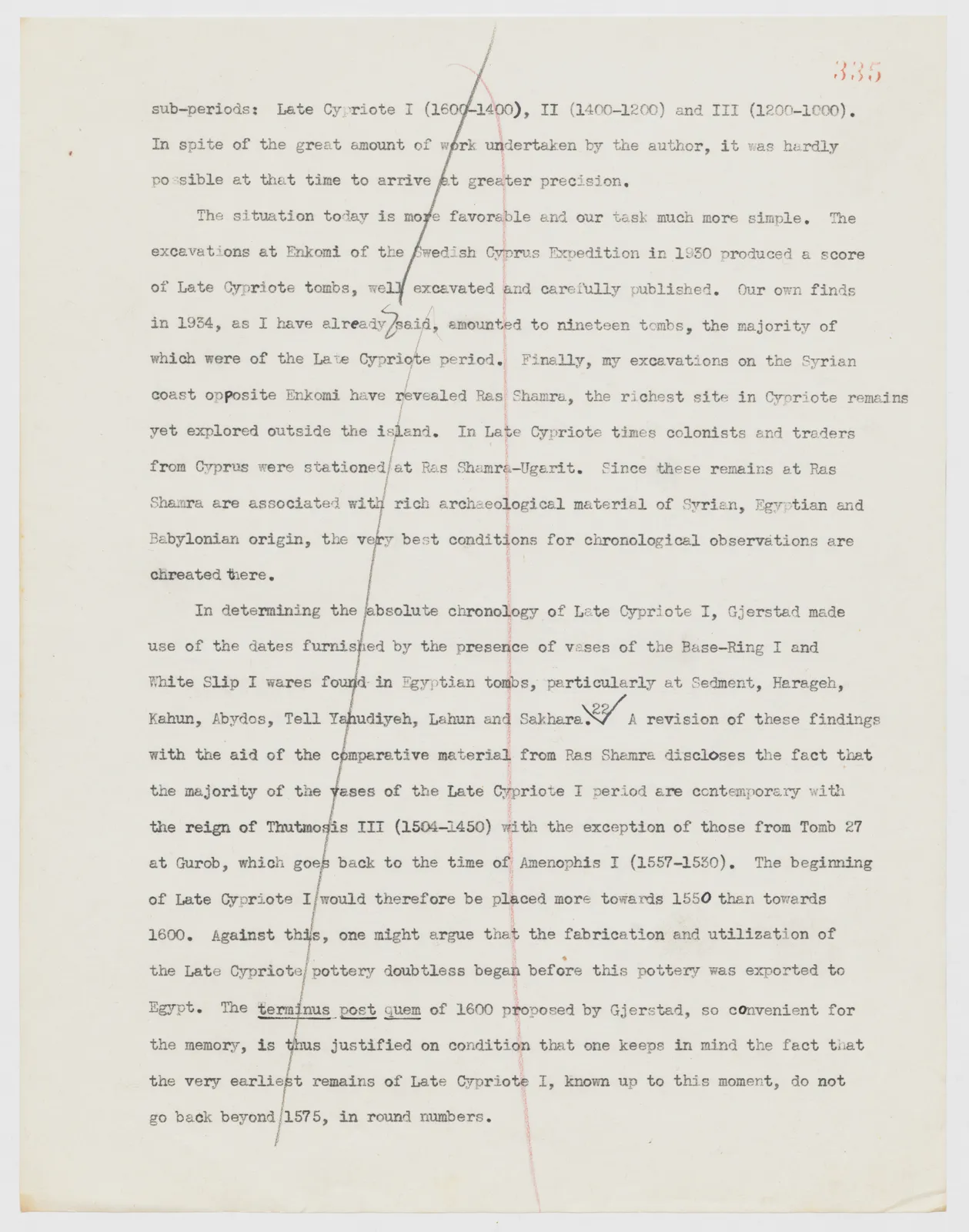
… sub-periods: Late Cypriote I (1600-1400), II (1400-1200) and III (1200-1000). In spite of the great amount of work undertaken by the author, it was hardly possible at that time to arrive at greater precision.
The situation today is more favorable and our task much more simple. The excavations at Enkomi of the Swedish Cyprus Expedition in 1930 produced a score of Late Cypriote tombs, well excavated and carefully published. Our own finds in 1934, as I have already said, amounted to nineteen tombs, the majority of which were of the Late Cypriote period. Finally, my excavations on the Syrian coast opposite Enkomi have revealed Ras Shamra, the richest site in Cypriote remains yet explored outside the island. In Late Cypriote times colonists and traders from Cyprus were stationed at Ras Shamra-Ugarit. Since these remains at Ras Shamra are associated with rich archaeological material of Syrian, Egyptian and Babylonian origin, the very best conditions for chronological observations are chreated there.
In determining the absolute chronology of Late Cypriote I, Gjerstad made use of the dates furnished by the presence of vases of the Base-Ring I and White Slip I wares found in Egyptian tombs, particularly at Sedment, Harageh, Kahun, Abydos, Tell Yahudiyeh, Lahun and Sakhara. [handwritten: 22] A revision of these findings with the aid of the comparative material from Ras Shamra discloses the fact that the majority of the vases of the Late Cypriote I period are contemporary with the reign of Thutmosis III (1504-1450) with the exception of those from Tomb 27 at Gurob, which goes back to the time of Amenophis I (1557-1530). The beginning of Late Cypriote I would therefore be placed more towards 1550 than towards 1600. Against this, one might argue that the fabrication and utilization of the Late Cypriote pottery doubtless began before this pottery was exported to Egypt. The terminus post quem of 1600 proposed by Gjerstad, so convenient for the memory, is thus justified on condition that one keeps in mind the fact that the very earliest remains of Late Cypriote I, known up to this moment, do not go back beyond 1575, in round numbers.
65 figures hard to readstruck struck outadded written in above” jug ditto, and what it repeatsword reading not certain