
Unnumbered pageScan 1 of 8
J.-C.C.
1
Preliminary Report on the Excavations at Enkomi in 1963.
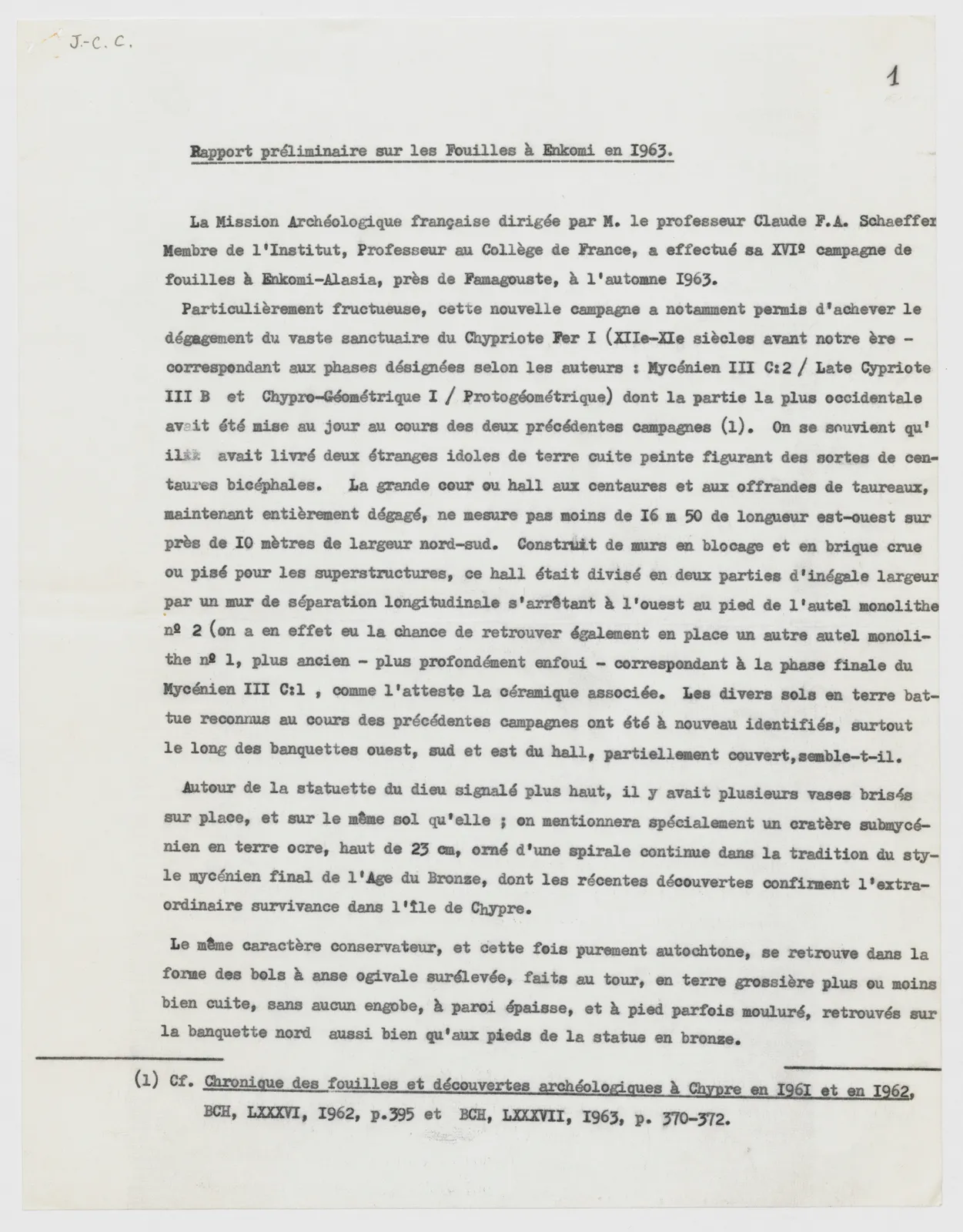
The French Archaeological Mission directed by Mr Professor Claude F.A. Schaeffer Member of the Institute, Professor at the Collège de France, carried out his XVIº campaign of excavations at Enkomi-Alasia, near Famagusta, in autumn 1963. Particularly fruitful, this new campaign made it possible in particular to complete the clearing of the vast sanctuary of the Cypriot Iron I (12th-11th centuries before our era - corresponding to the phases designated by different authors: Mycenaean III C:2 / Late Cypriote III B and Cypro-Geometric I / Protogeometric) of which the most western part had been uncovered during the two previous campaigns (1). It will be recalled that ills had yielded two strange painted terracotta idols depicting kinds of cen- -taurs bicephalous. The large courtyard or hall with the centaurs and the bull offerings, now fully cleared, measures no less than 16 m 50 in length east-west over nearly 10 metres in width north-south. Built of walls of rubble and mud brick or pisé for the superstructures, this hall was divided into two parts of unequal width by a longitudinal dividing wall ending in the west at the foot of the monolithic altar no. 2 (we were in fact lucky enough to also find in place another monolithic altar the no. 1, earlier - more deeply buried - corresponding to the final phase of Mycenaean III C:1, as the associated pottery attests. The various beaten-earth floors tue recognised during the previous campaigns have again been identified, especially along the west, south and east benches of the hall, partly covered, it seems.
Around the statuette of the god mentioned above, there were several broken vessels in situ, and on the same floor as it; special mention should be made of a sub-Mycenaean krater -nean in ochre clay, 23 cm high, decorated with a continuous spiral in the tradition of the sty- -le final Mycenaean style of the Bronze Age, whose recent discoveries confirm the extraordinary survival in the island of Cyprus.
The same conservative, and this time purely autochthonous, character is found in the form of bowls with raised pointed handle, wheel-made, in coarse clay more or less well fired, without any slip, with thick walls, and with sometimes moulded foot, found on the north bench as well as at the feet of the bronze statue.
(1) Cf. Chronicle of excavations and archaeological discoveries in Cyprus in 1961 and in 1962, BCH, LXXXVI, 1962, p.395 and BCH, LXXXVII, 1963, p. 370-372.
65 figures hard to readstruck struck outadded written in above” jug ditto, and what it repeatsword reading not certain