
Page -12-Scan 2 of 2
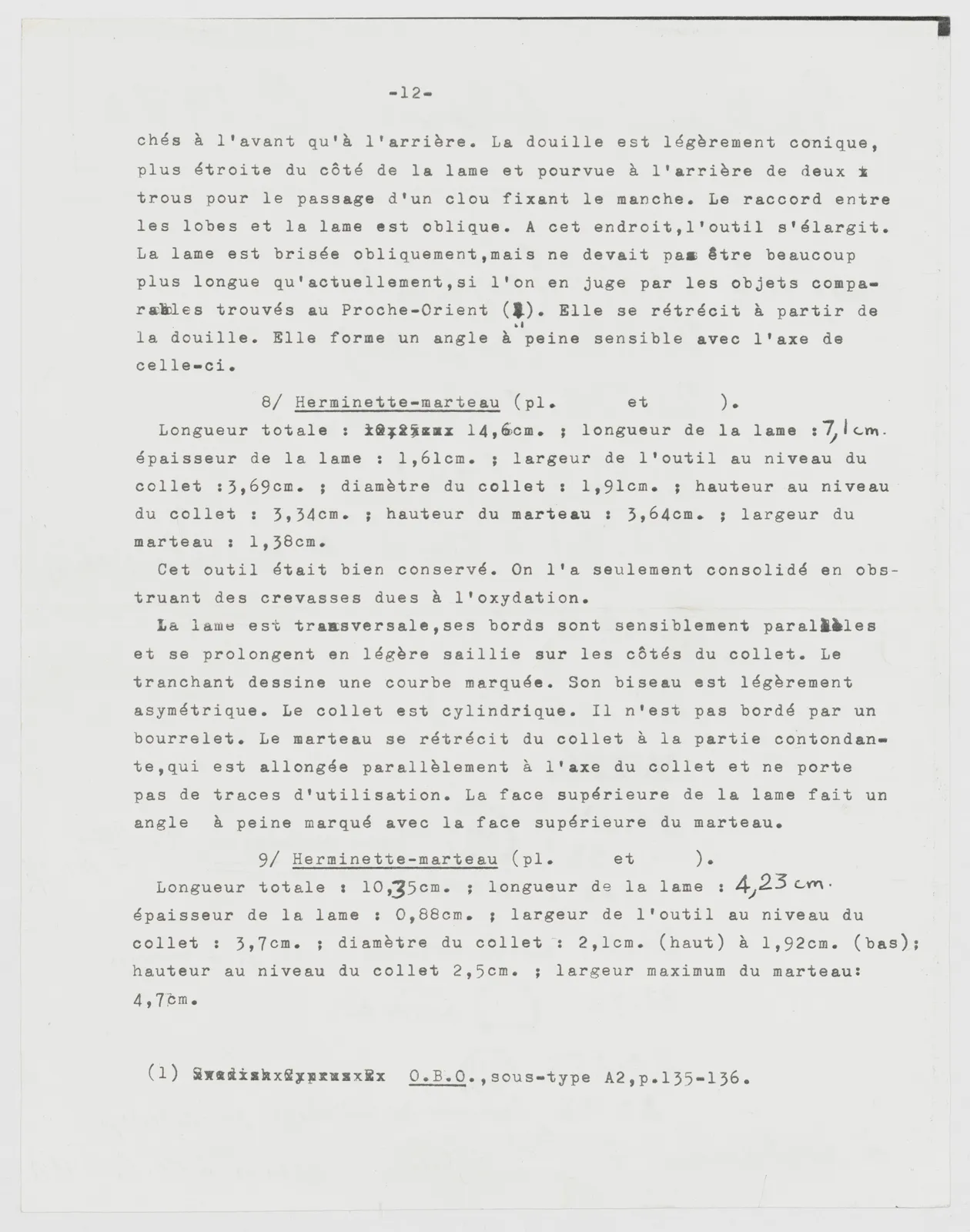
chés at the front than at the back. The socket is slightly conical, narrower on the blade side and provided at the back with two t holes for the passage of a nail fixing the haft. The junction between the lobes and the blade is oblique. At this point the tool widens. The blade is broken obliquely, but was not meant to be much longer than at present, judging by comparable objects found in the Near East (1). It narrows from the socket. It forms a barely perceptible angle with the axis of it.
8/ Adze-hammer (pl. and ). Total length: 10,25cm 14,6cm.; length of the blade: 7,1 cm. thickness of the blade: 1,61cm.; width of the tool at the level of the collar: 3,69cm.; diameter of the collar: 1,91cm.; height at the level of the collar: 3,34cm.; height of the hammer: 3,64cm.; width of the hammer: 1,38cm. This tool was well preserved. It was only consolidated by obstructing cracks due to oxidation. The blade is transverse, its edges are substantially parallel and extend in a slight projection on the sides of the collar. The cutting edge forms a marked curve. Its bevel is slightly asymmetrical. The collar is cylindrical. It is not bordered by a bead. The hammer narrows from the collar to the blunt part which is elongated parallel to the axis of the collar and bears no traces of use. The upper face of the blade forms an barely marked angle with the upper face of the hammer.
9/ Adze-hammer (pl. and ). Total length: 10,35cm.; length of the blade: 4,23 cm. thickness of the blade: 0,88cm.; width of the tool at the level of the collar: 3,7cm.; diameter of the collar: 2,1cm. (top) to 1,92cm. (bottom); height at the level of the collar 2,5cm.; maximum width of the hammer: 4,7cm.
(1) Swedish Cyprus Ex O.B.O., sub-type A2, p.135-136.
65 figures hard to readstruck struck outadded written in above” jug ditto, and what it repeatsword reading not certain