
Page 72Scan 29 of 50
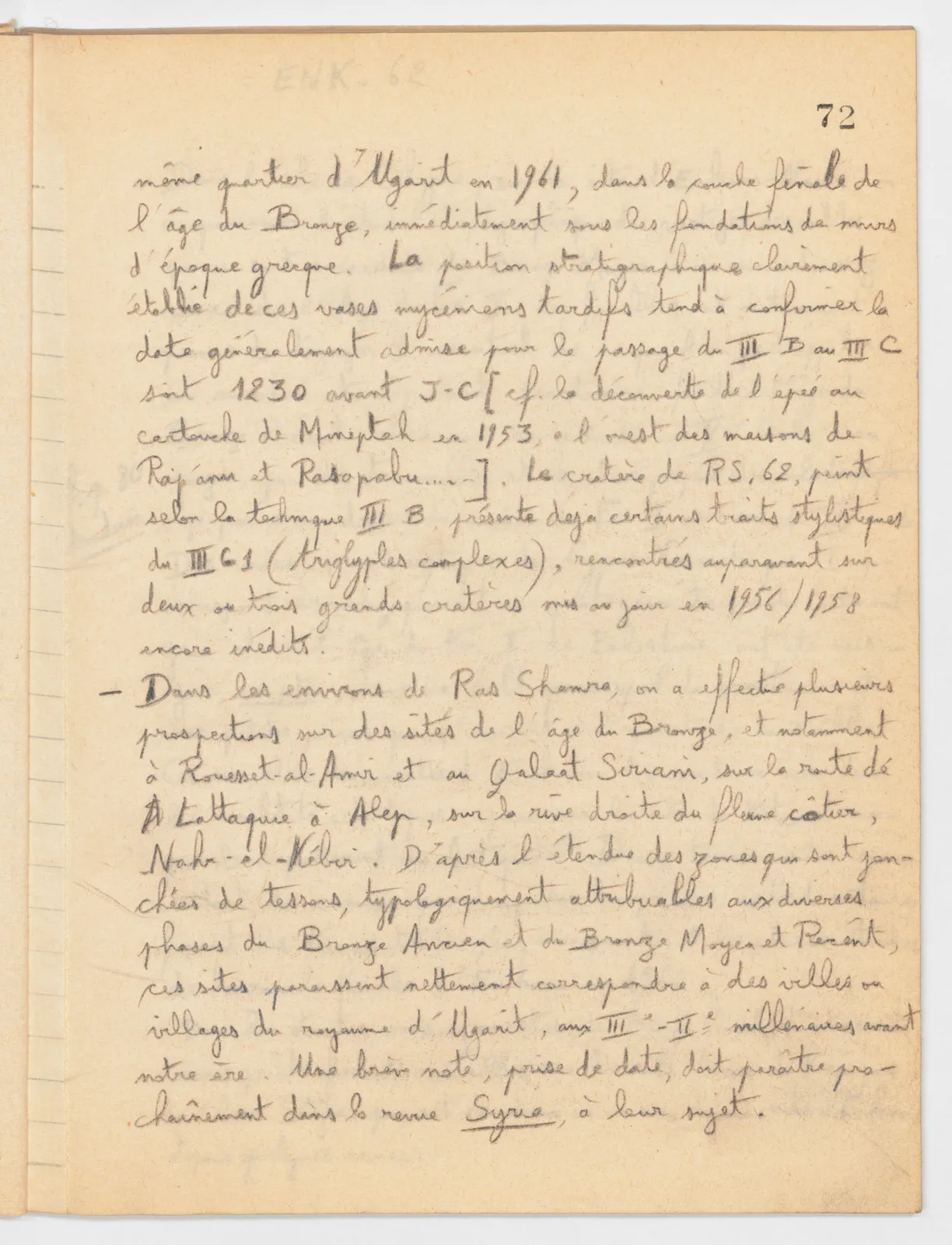
same quarter of Ugarit in 1961, in the final layer of the Bronze Age, immediately under the foundations of walls of the Greek period. The stratigraphic position clearly established for these late Mycenaean vessels tends to confirm the generally accepted date for the transition from III B to III C i.e. 1230 BC [cf. the discovery of the sword with cartouche of Mineptah in 1953, to the west of the houses of Rap'anu and Rasapabu... -]. The krater from RS. 62, painted in the III B technique, already shows certain stylistic features of III C 1 (complex triglyphs), previously encountered on two or three large kraters uncovered in 1956/1958 still unpublished.
– In the vicinity of Ras Shamra, several surveys were carried out on Bronze Age sites, and in particular at Rouesset-al-Amir and Qalaat Souani, on the road from A Lattakia to Aleppo, on the right bank of the coastal river, Nahr-el-Kébir. Judging by the extent of the areas strewn with sherds, typologically attributable to the various phases of the Early Bronze and Middle and Late Bronze, these sites clearly appear to correspond to towns or villages of the kingdom of Ugarit, from the IIIrd-IInd millennia BC our era. A brief note, date reserved, is due to appear shortly in the journal Syria, on their subject.
65 figures hard to readstruck struck outadded written in above” jug ditto, and what it repeatsword reading not certain