
Page 70Scan 25 of 50
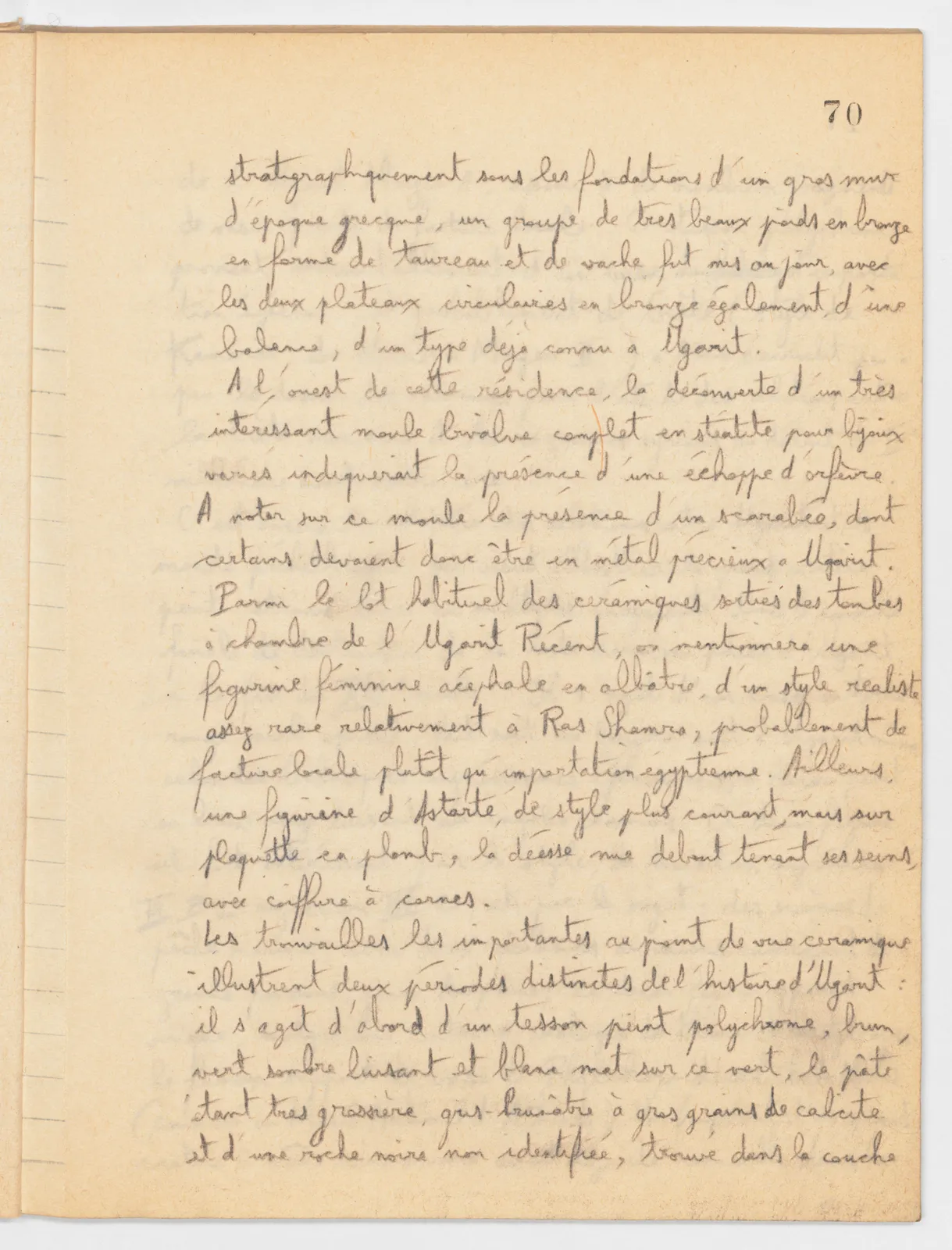
stratigraphically beneath the foundations of a large wall of Greek date, a group of very fine bronze weights in the shape of a bull and a cow was uncovered, together with the two circular bronze pans likewise, of a balance, of a type already known at Ugarit. To the west of this residence, the discovery of a very interesting complete bivalve steatite mould for jewellery of various kinds would indicate the presence of a goldsmith's workshop. To note on this mould the presence of a scarab, some of which must therefore have been in precious metal at Ugarit. Among the usual lot of pottery from the tombs with chambers of Late Ugarit, one will mention a headless female figurine in alabaster, of a realistic style fairly rare relatively at Ras Shamra, probably of local manufacture rather than Egyptian import. Elsewhere, a figurine of Astarte, of a more common style, but on a lead plaque, the goddess naked standing holding her breasts, with a horned headdress. The finds most important from the point of view of pottery illustrate two distinct periods of the history of Ugarit: it is first a polychrome painted sherd, brown, dark glossy green and matt white on this green, the fabric being very coarse, greyish-brown with large grains of calcite and an unidentified black rock, found in the layer
65 figures hard to readstruck struck outadded written in above” jug ditto, and what it repeatsword reading not certain