
Unnumbered pageScan 5 of 8
3.
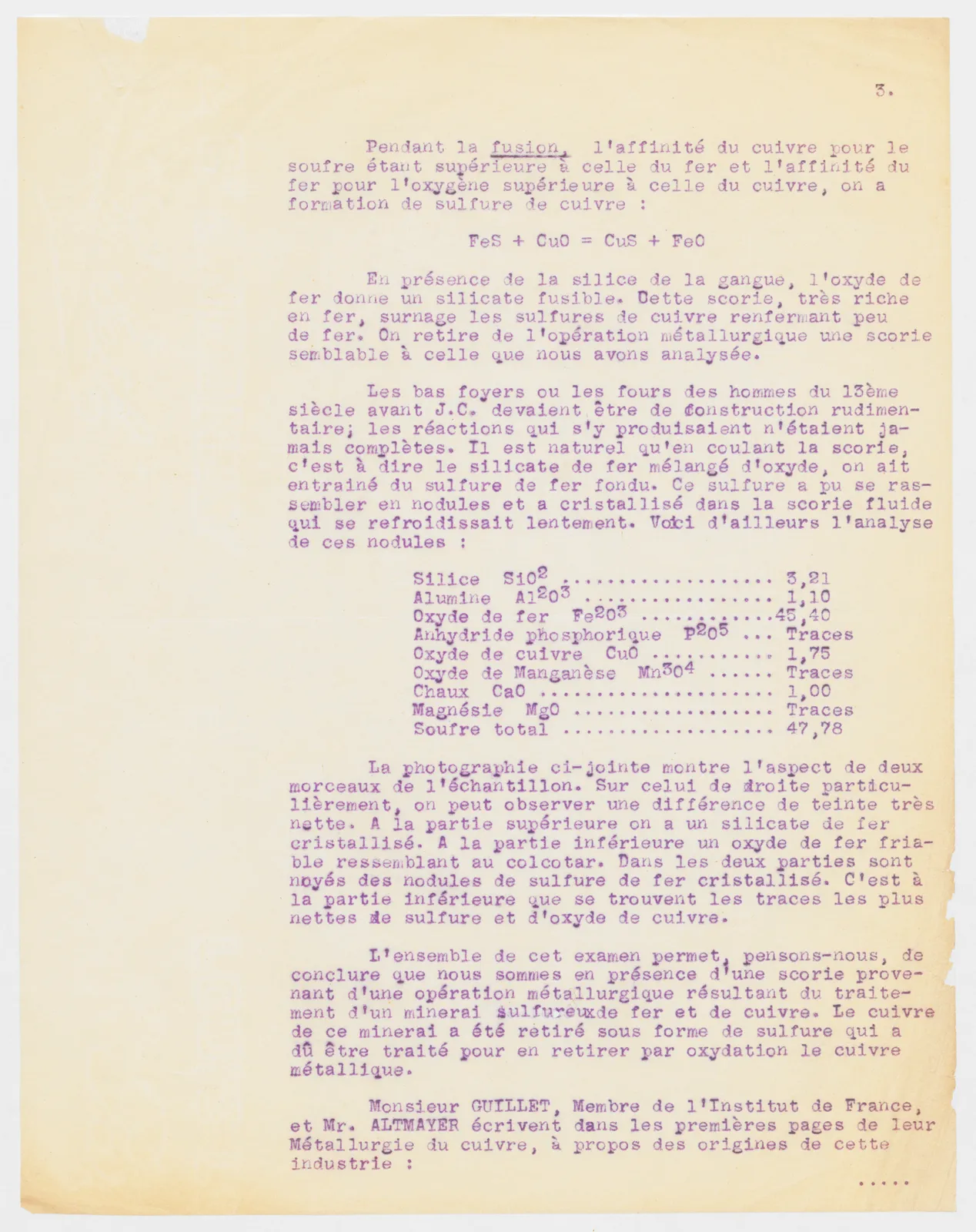
During the smelting, the affinity of copper for the sulphur being greater than that of iron, and the affinity of iron for oxygen greater than that of copper, one has formation of copper sulphide:
FeS + CuO = CuS + FeO
In the presence of the silica of the gangue, the oxide of iron gives a fusible silicate. This slag, very rich in iron, floats above the copper sulphides containing little iron. From the metallurgical operation one removes a slag similar to the one we have analysed.
The low hearths or the furnaces of the people of the 13th century B.C. must have been of rudimentary construction; the reactions which took place in them were never complete. It is natural that when the slag was poured, that is to say the iron silicate mixed with oxide, one should have carried off molten iron sulphide. This sulphide may have gathered in nodules and crystallised in the fluid slag which cooled slowly. Here, moreover, is the analysis of these nodules:
Silica SiO2 ..................... 3,21 Alumina Al2O3 .................. 1,10 Iron oxide Fe2O3 .............45,40 Phosphoric anhydride P2O5 ... Traces Copper oxide CuO ........... 1,75 Manganese oxide Mn3O4 ...... Traces Lime CaO ..................... 1,00 Magnesia MgO .................. Traces Total sulphur ................... 47,78
The enclosed photograph shows the appearance of two pieces of the sample. On that on the right in particular, one can observe a very clear difference of tint. At the upper part there is a crystallised iron silicate. At the lower part an iron oxide, friable resembling colcothar. In both parts are embedded nodules of crystallised iron sulphide. It is at the lower part that the most clear traces of copper sulphide and oxide are found.
The whole of this examination allows us, we think, to conclude that we are dealing with a slag originating from a metallurgical operation resulting from the treatment of a sulphurous ore of iron and copper. The copper of this ore was removed in the form of sulphide which has had to be treated to extract by oxidation the copper metallic.
Monsieur GUILLET, Member of the Institut de France, and Mr. ALTMAYER write in the first pages of their Metallurgy of copper, concerning the origins of this industry:
.....
65 figures hard to readstruck struck outadded written in above” jug ditto, and what it repeatsword reading not certain