
Page 2 (top right)Scan 3 of 8
2.
a fragmented material of which one wishes to keep a part important as a witness and for later study.
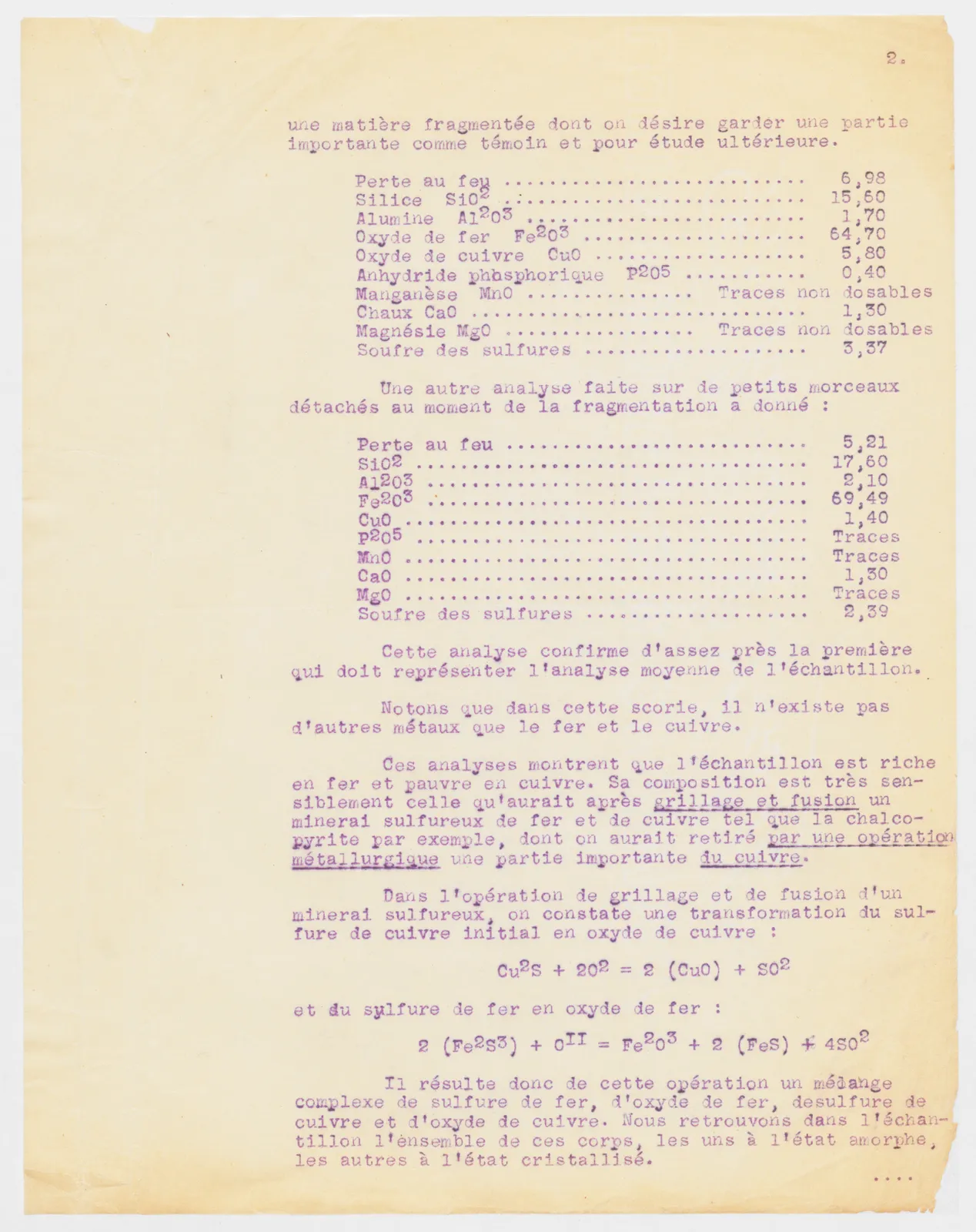
Loss on ignition ............................... 6,98 Silica SiO2 ................................ 15,60 Alumina Al2O3 ............................. 1,70 Iron oxide Fe2O3 ........................ 64,70 Copper oxide CuO ....................... 5,80 Phosphoric anhydride P2O5 ............ 0,40 Manganese MnO ................ Traces not determinable Lime CaO ................................. 1,30 Magnesia MgO ................. Traces not determinable Sulphur of the sulphides ...................... 3,37
Another analysis made on small pieces detached at the time of fragmentation gave:
Loss on ignition ............................... 5,21 SiO2 ....................................... 17,60 Al2O3 ...................................... 2,10 Fe2O3 ...................................... 69,49 CuO ........................................ 1,40 P2O5 ..................................... Traces MnO ...................................... Traces CaO ....................................... 1,30 MgO ..................................... Traces Sulphur of the sulphides ...................... 2,39
This analysis confirms fairly closely the first which should represent the average analysis of the sample.
We note that in this slag there is not any metals other than iron and copper.
These analyses show that the sample is rich in iron and poor in copper. Its composition is very sensibly that which would result after roasting and smelting a sulphurous ore of iron and copper such as chalcopyrite for example, from which one would have removed _by a metallurgical operation_ an important part of the copper.
In the operation of roasting and smelting a sulphurous ore, one notes a transformation of the sulphide of copper initial into copper oxide:
Cu2S + 2O2 = 2 (CuO) + SO2
and of iron sulphide into iron oxide:
2 (Fe2S3) + O^II = Fe2O3 + 2 (FeS) + 4SO2
There results therefore from this operation a mixture complex of iron sulphide, iron oxide, copper desulphide of copper and copper oxide. We find in the sample the whole of these bodies, some in the amorphous state, the others in the crystallised state.
....
65 figures hard to readstruck struck outadded written in above” jug ditto, and what it repeatsword reading not certain