
Page 2Scan 2 of 4
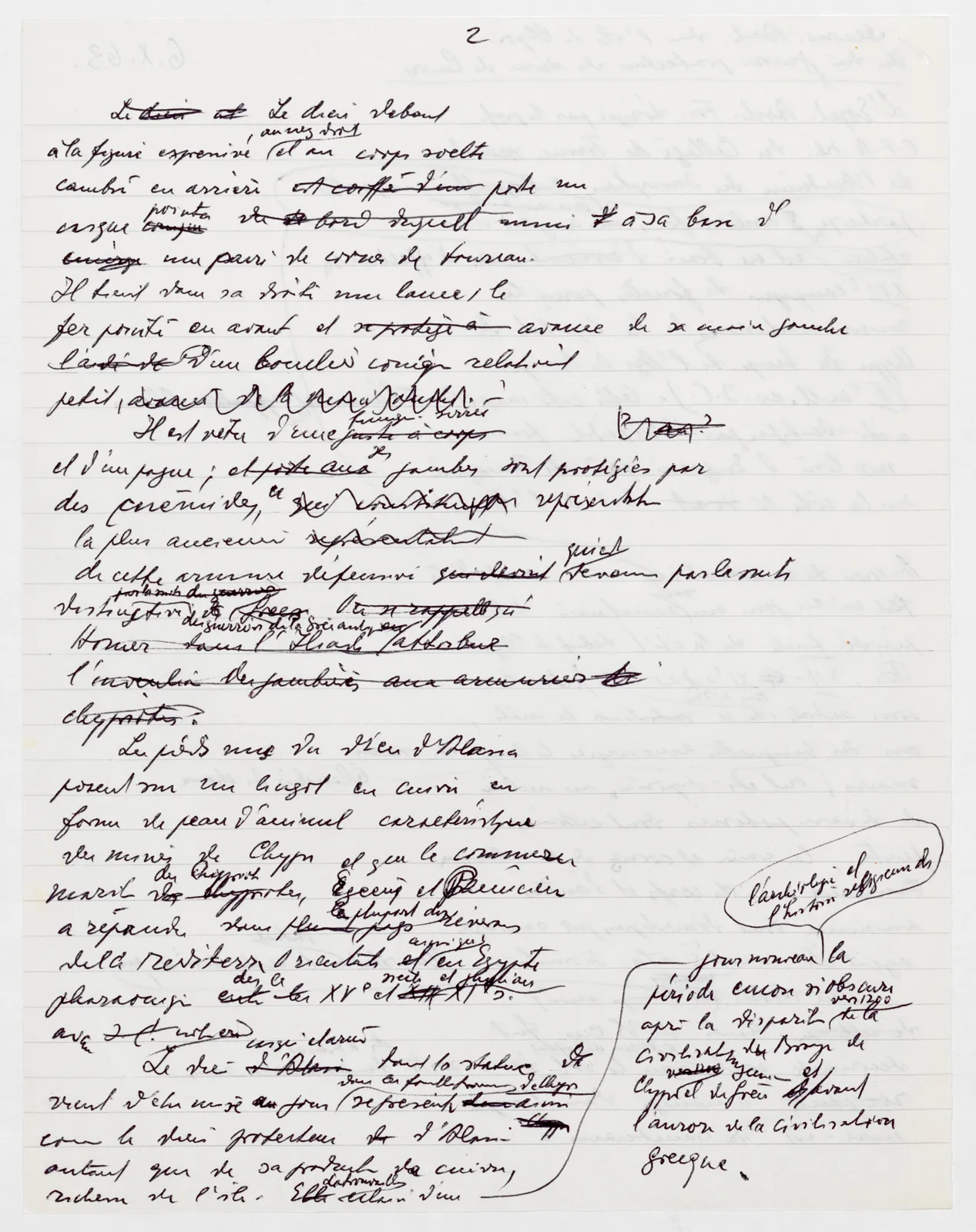
archaeology and / history illuminating anew light on the / period still so obscure / after the disappearn around 1200 of the / civilisatn of the Bronze / our Mycenae and / Cyprus and Greece and before / the dawn of / Greek civilisation.The god is The god standing with an expressive face , with a straight nose and a slender body arched backward is wearing a wears a helmet conical pointed of with a brim from which fitted at at its base emerging a pair of bull's horns. He holds in his right hand a spear, the iron point forward and protects himself with advancing with his left hand with the help of a conical shield relatively small, advancing with the left hand. He is dressed in a close-fitting body-armour tight tunic tunic and a loincloth ; and wears on the his legs are protected by greaves, and which constitute represents the oldest representation of this defensive armour which became which is later become later of the distinctive of the Greeks of the warriors of ancient Greece. We recall that Homer in the Iliad attributes it the invention of greaves to the armourers of Cypriot. The bare feet of the god of Alasia rest on a copper ingot in the shape of an animal hide, characteristic of the mines of Cyprus and which trade maritime of the of the Cypriots, Cypriots, Aegeans and Phoenicians spread in all most of the coastal countries of the Eastern Mediterranean Aegean and in Egypt Pharaonic from the between the XVth century and XII XIth c. until the before J.C. about so about The god of Alasia whose statue is has just been uncovered in the French excavations at Enkomi thus represents as the protective god of of Alasia and as much as for its copper production, wealth of the island. It The find sheds light on a
65 figures hard to readstruck struck outadded written in above” jug ditto, and what it repeatsword reading not certain