
Page 28Scan 3 of 6
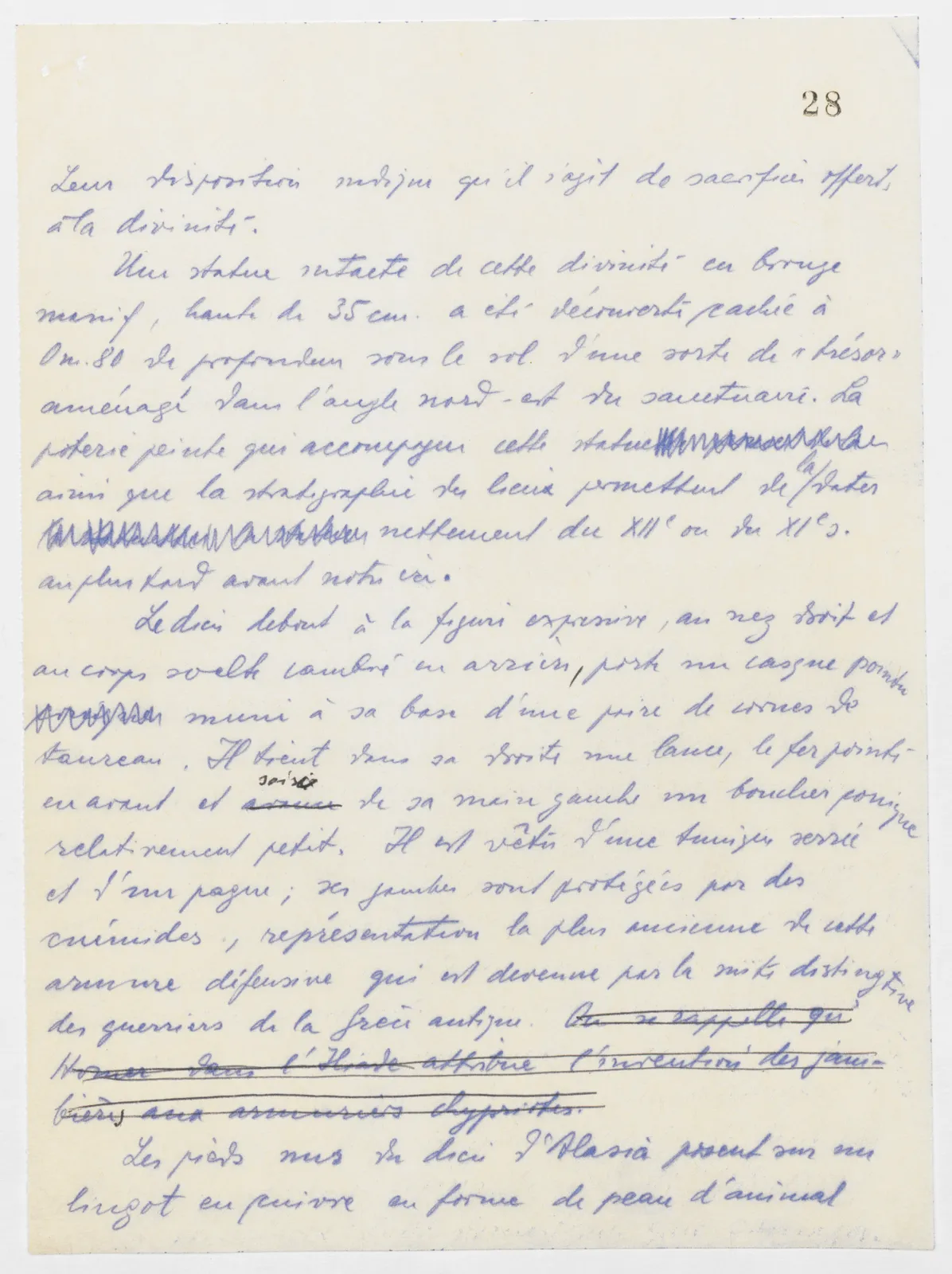
Their arrangement indicates that these were sacrifices offered to the deity. An intact statue of this deity in bronze solid, 35 cm. high, was discovered, hidden at 0 m. 80 depth below the floor of a sort of "treasure" arranged in the north-east corner of the sanctuary. The painted pottery which accompanies this statue [illegible] together with the stratigraphy of the site allow us to date it [illegible] clearly to the 12th or 11th c. at the latest before our era. The standing god with the expressive face, straight nose and slender body arched backward, wears a pointed helmet [illegible] fitted at its base with a pair of horns of a bull. He holds in his right hand a spear, the iron point forward and grasps advance with his left hand a conical shield relatively small. He is dressed in a close-fitting tunic and a loincloth; his legs are protected by greaves, the oldest representation of this defensive armour which later became distinctive of the warriors of ancient Greece. One recalls that Homer in the Iliad attributes the invention of greaves to Cypriot armourers. The bare feet of the god of Alasia rest on a copper ingot in the shape of an animal skin
65 figures hard to readstruck struck outadded written in above” jug ditto, and what it repeatsword reading not certain