
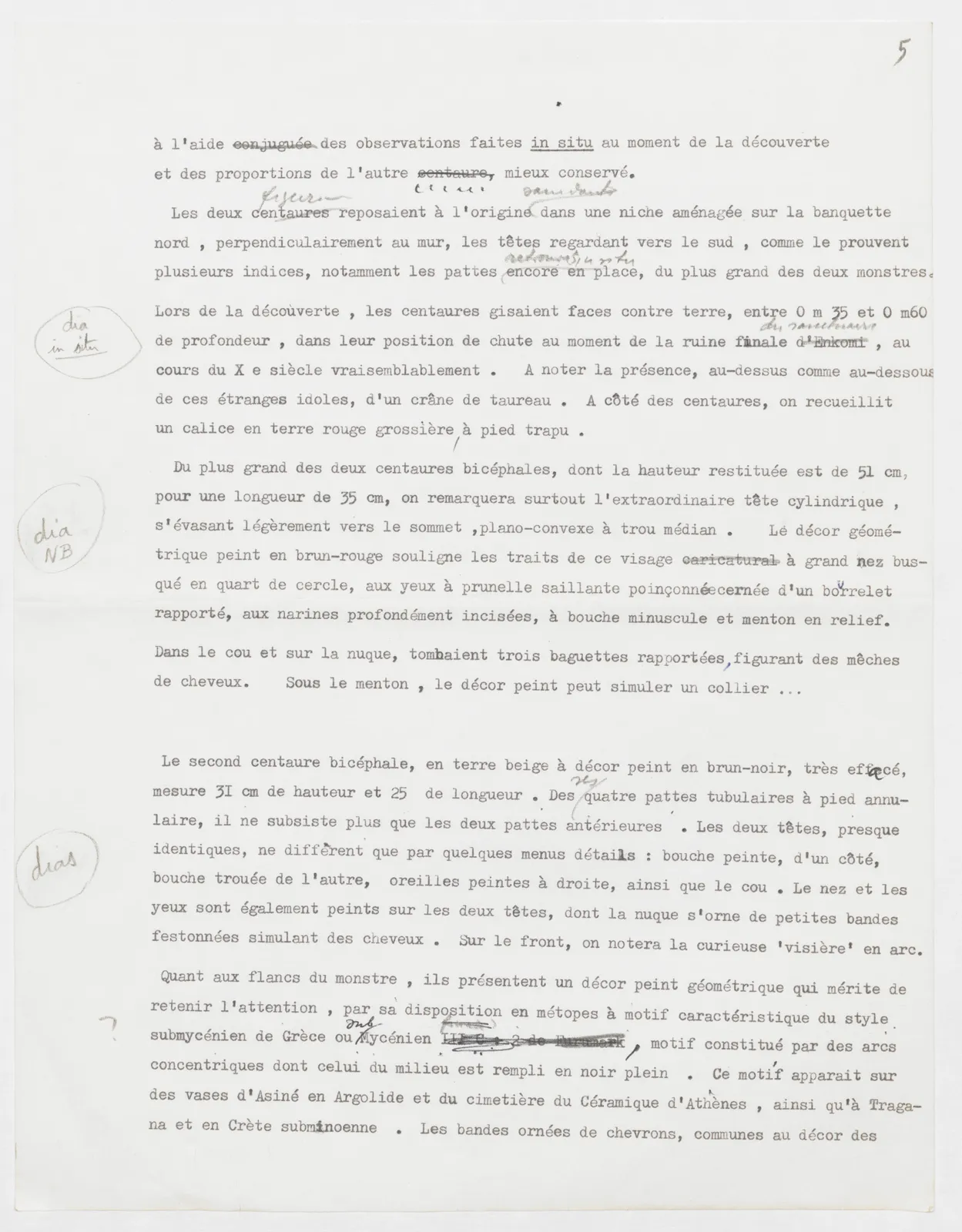
Page 5Scan 9 of 14
Continued from scan 8
… with the aid combined of observations made in situ at the time of discovery and of the proportions of the other centaur, better preserved.
[handwritten: fissure] [handwritten: two] [handwritten: ciccur] [handwritten: in niche]
The two centaurs originally lay in a niche arranged on the bench north, perpendicular to the wall, the heads facing south, as proved by several indications, notably the [handwritten: raised] legs still in place, of the larger of the two monsters.
Figure: marginal circled annotation "dia in situ"
At the discovery, the centaurs lay face down, between 0 m 35 and 0 m60 deep, in their fallen position at the time of the final ruin of Enkomi, in
Handwritten: of the sanctuary
cours du X e siècle vraisemblablement . A noter la présence, au-dessus comme au-dessous these strange idols, of a bull's skull. Beside the centaurs, one recovered a chalice in coarse red earth with a stocky foot.
Figure: marginal circled annotation "dia NB"
Of the larger of the two bicephalous centaurs, whose restored height is 51 cm, for a length of 35 cm, one notes above all the extraordinary cylindrical head, flaring slightly towards the top, plano-convex with a median hole. The geometric decoration painted in red-brown emphasises the features of this face caricatural with a large nose bented in a quarter circle, with eyes having a punched projecting pupil surrounded by a applied rim, with deeply incised nostrils, a tiny mouth and a raised chin.
On the neck and the nape, three applied strips fell, representing locks of hair. Beneath the chin, the painted decoration may simulate a necklace ...
The second bicephalous centaur, in beige earth with painted decoration in black-brown, very faded, measures 31 cm in height and 25 in length. Of the four tubular legs with annular foot, only the two front legs survive. The two heads, almost identical, differ only in a few minor details: mouth painted on one side, mouth pierced on the other, ears painted on the right, as well as the neck. The nose and the eyes are also painted on both heads, the nape of which is adorned with small bands festooned to simulate hair. On the forehead, note the curious arched 'visor'.
Figure: marginal circled annotation "dias"
As for the flanks of the monster, they bear a painted geometric decoration which deserves attention, by its arrangement in metopes with a motif characteristic of the style Submycenaean of Greece or [handwritten: Mycenaean] LH IIIC 2 of Danmark, motif consisting of arcs concentric, the middle one of which is filled in solid black. This motif appears on vases from Asine in Argolis and from the Ceramicus cemetery at Athens, as well as at Tragana and in subminoan Crete. The bands decorated with chevrons, common to the decoration of
65 figures hard to readstruck struck outadded written in above” jug ditto, and what it repeatsword reading not certain