
Page 4Scan 7 of 14
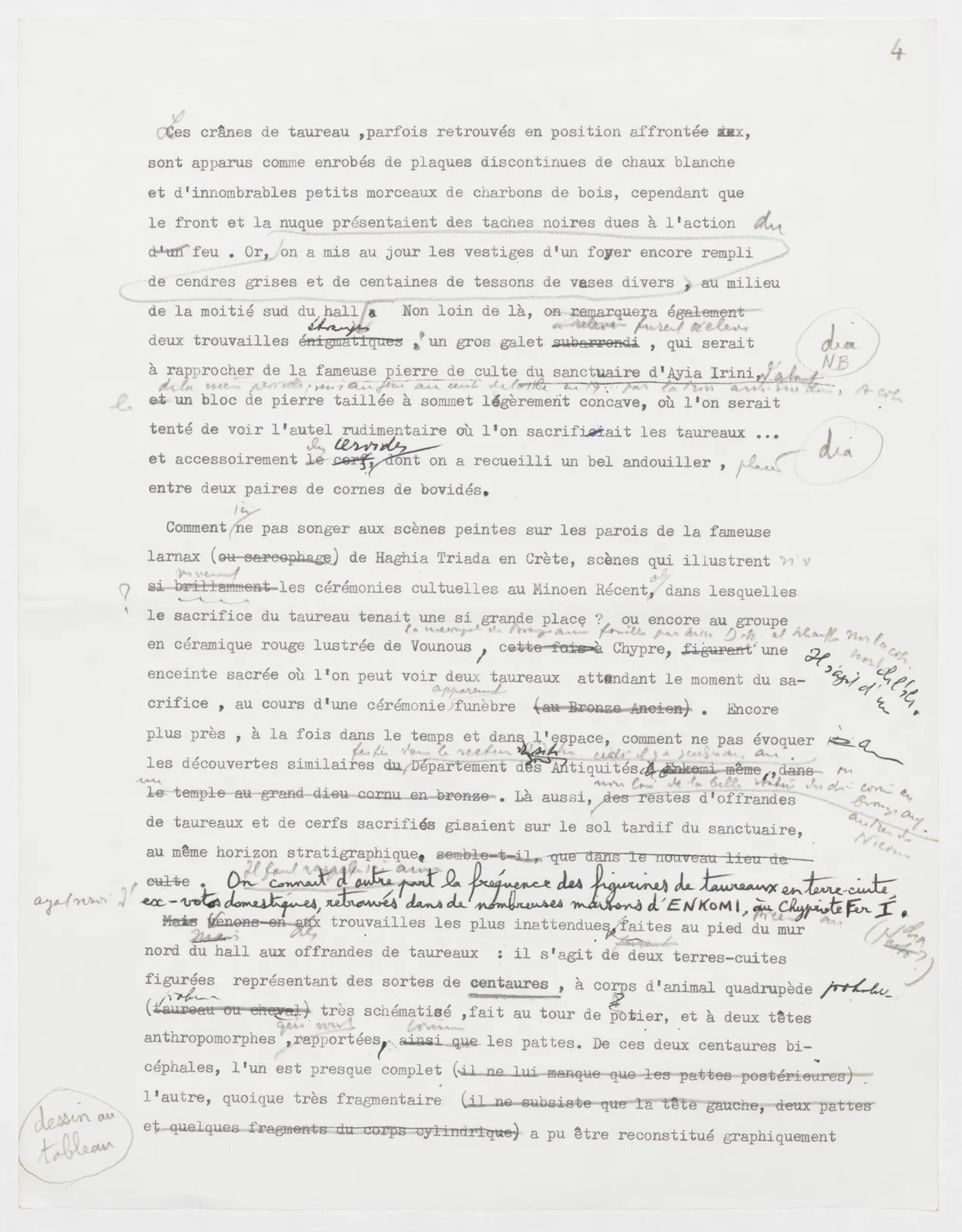
These bull skulls, sometimes found in confronted position two, appeared as if coated with discontinuous patches of white lime and countless small pieces of charcoal, while the forehead and nape showed black stains due to the action [handwritten: of the] of a fire. Now, the remains of a hearth still filled with grey ash and hundreds of sherds of various vessels, in the middle of the south half of the hall. Not far from there, one will also note two [handwritten: strange] finds enigmatic, a large pebble sub-rounded [handwritten: [illegible]], which would be to be compared with the famous cult stone from the sanctuary of Ayia Irini, and a block of dressed stone with a slightly concave top, where one would be tempted to see the rudimentary altar where the bulls were sacrificed ... and incidentally the stag, [handwritten: the deer] of which a fine antler was recovered, [handwritten: placed] between two pairs of bovid horns.
How [handwritten: there] not to think of the scenes painted on the walls of the famous larnax (or sarcophagus) from Haghia Triada in Crete, scenes which illustrate [handwritten: better] so brilliantly the cult ceremonies of the Minoan Late period, in which the sacrifice of the bull held such a great place? or again the group in red lustrous pottery from Vounous, this time in Cyprus, depicting an sacred enclosure where one can see two bulls awaiting the moment of the sacrifice, during a funerary ceremony [handwritten: apparently] (in the Early Bronze). Still closer, both in time and in space, how not to evoke the similar discoveries of the Department of Antiquities at Enkomi itself, in the temple of the great horned god in bronze. There too, remains of offerings of bulls and deer sacrificed lay on the late floor of the sanctuary, at the same stratigraphic horizon, it seems, as in the new place of worship. On the other hand, the frequency of terracotta bull figurines is known domestic votives, found in many houses at ENKOMI, in Cypriot Iron I. But [handwritten: Let us come] to the most unexpected finds, made at the foot of the wall north of the hall of bull offerings: these are two terracottas figured, representing a kind of centaur, with the body of a quadruped animal (bull or horse) very schematised, made on the potter's wheel, and with two heads anthropomorphic, attached, as well as the legs. Of these two centaurs bicephalous, one is almost complete (it lacks only the hind legs) the other, although very fragmentary (only the left head, two legs survive and some fragments of the cylindrical body) could be reconstructed graphically
Figure: hand-drawn circle annotation reading "dessin au tableau"; labels: drawing on the blackboard
65 figures hard to readstruck struck outadded written in above” jug ditto, and what it repeatsword reading not certain