
Unnumbered pageScan 11 of 14
6
two centaurs of Enkomi, are found again on several terracottas and vases from Cyprus, Rhodes and Crete, at Vrokastro in particular.
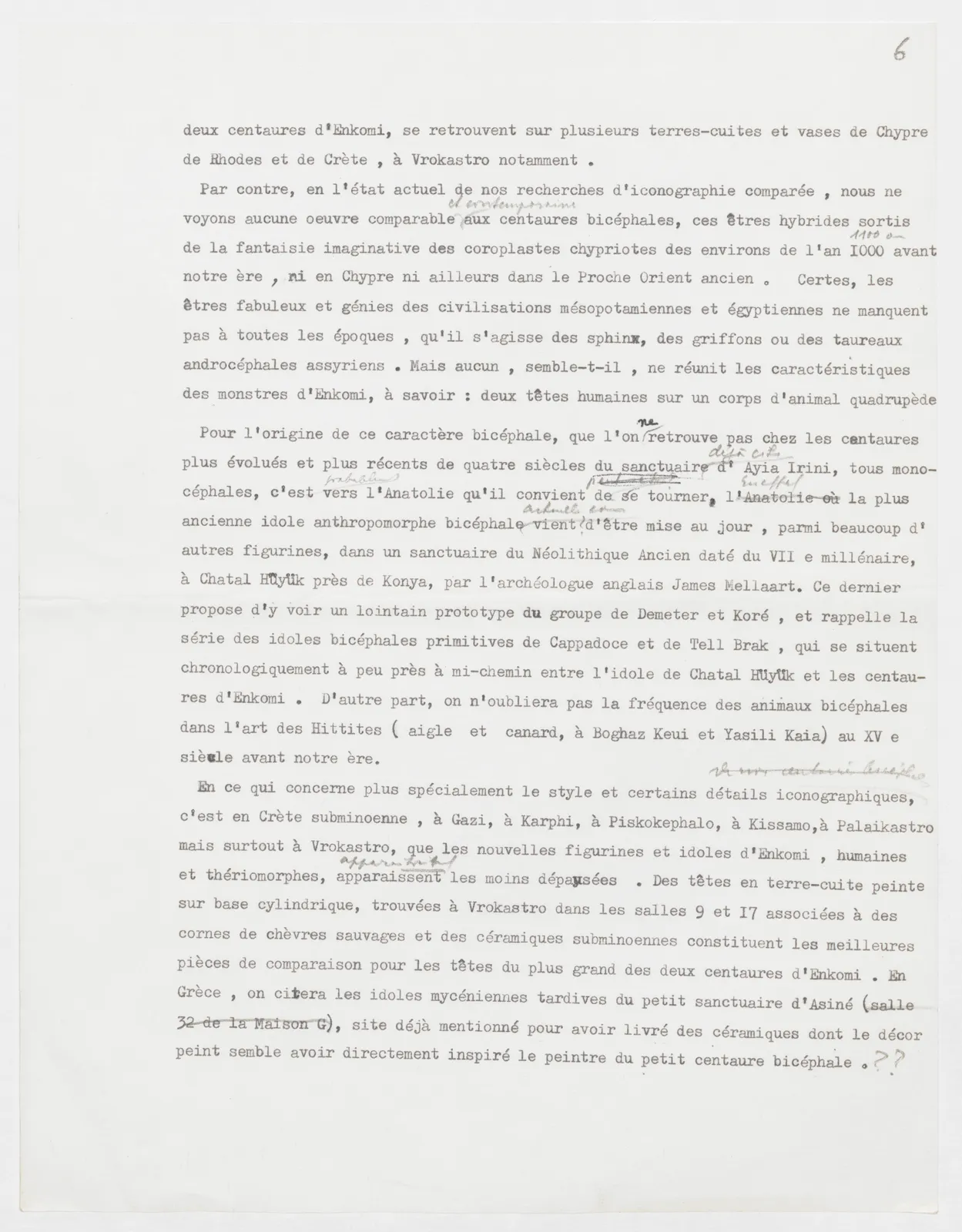
On the other hand, in the present state of our research in comparative iconography, we see no work [handwritten: and contemporary] comparable to the bicephalous centaurs, these hybrid beings born of the imaginative fancy of the Cypriot coroplasts around the year 1000 before [handwritten: 1100 BC] our era, neither in Cyprus nor elsewhere in the ancient Near East. Certainly, the fabulous beings and genies of the Mesopotamian and Egyptian civilizations are not lacking in any period, whether sphinxes, griffins or Assyrian androcephalous bulls. But none, it seems, combines the characteristics of the monsters of Enkomi, namely: two human heads on the body of a quadrupedal animal
Pour l'origine de ce caractère bicéphale, que l'on [handwritten: ne] retrouve pas chez les centaures plus évolués et plus récents de quatre siècles du sanctuaire d' Ayia Irini, tous monocéphales, c'est vers l'Anatolie qu'il convient de se tourner, l'Anatolie où [handwritten: ] la plus ancienne idole anthropomorphe bicéphale vient d'être mise au jour , parmi beaucoup d' autres figurines, dans un sanctuaire du Néolithique Ancien daté du VII e millénaire, à Chatal Hüyük près de Konya, par l'archéologue anglais James Mellaart. Ce dernier propose d'y voir un lointain prototype du groupe de Demeter et Koré , et rappelle la série des idoles bicéphales primitives de Cappadoce et de Tell Brak , qui se situent chronologiquement à peu près à mi-chemin entre l'idole de Chatal Hüyük et les centaures d'Enkomi . D'autre part, on n'oubliera pas la fréquence des animaux bicéphales dans l'art des Hittites ( aigle et canard, à Boghaz Keui et Yasili Kaia) au XV e siècle avant notre ère.
As regards more particularly the style and certain iconographic details, it is in sub-Minoan Crete, at Gazi, at Karphi, at Piskokephalo, at Kissamos, at Palaikastro but especially at Vrokastro, that the new figurines and idols of Enkomi, human and theriomorphic, [handwritten: appear] appear the least out of place. Painted terracotta heads on cylindrical bases, found at Vrokastro in rooms 9 and 17, associated with wild goats' horns and sub-Minoan pottery, provide the best comparanda for the heads of the larger of the two centaurs of Enkomi. In Greece, one may cite the Late Mycenaean idols of the small sanctuary of Asine (room 32 of House G), a site already mentioned for having yielded pottery whose painted decoration seems to have directly inspired the painter of the small bicephalous centaur. [handwritten: ??] … continues
65 figures hard to readstruck struck outadded written in above” jug ditto, and what it repeatsword reading not certain