
Unnumbered pageScan 3 of 6
/...
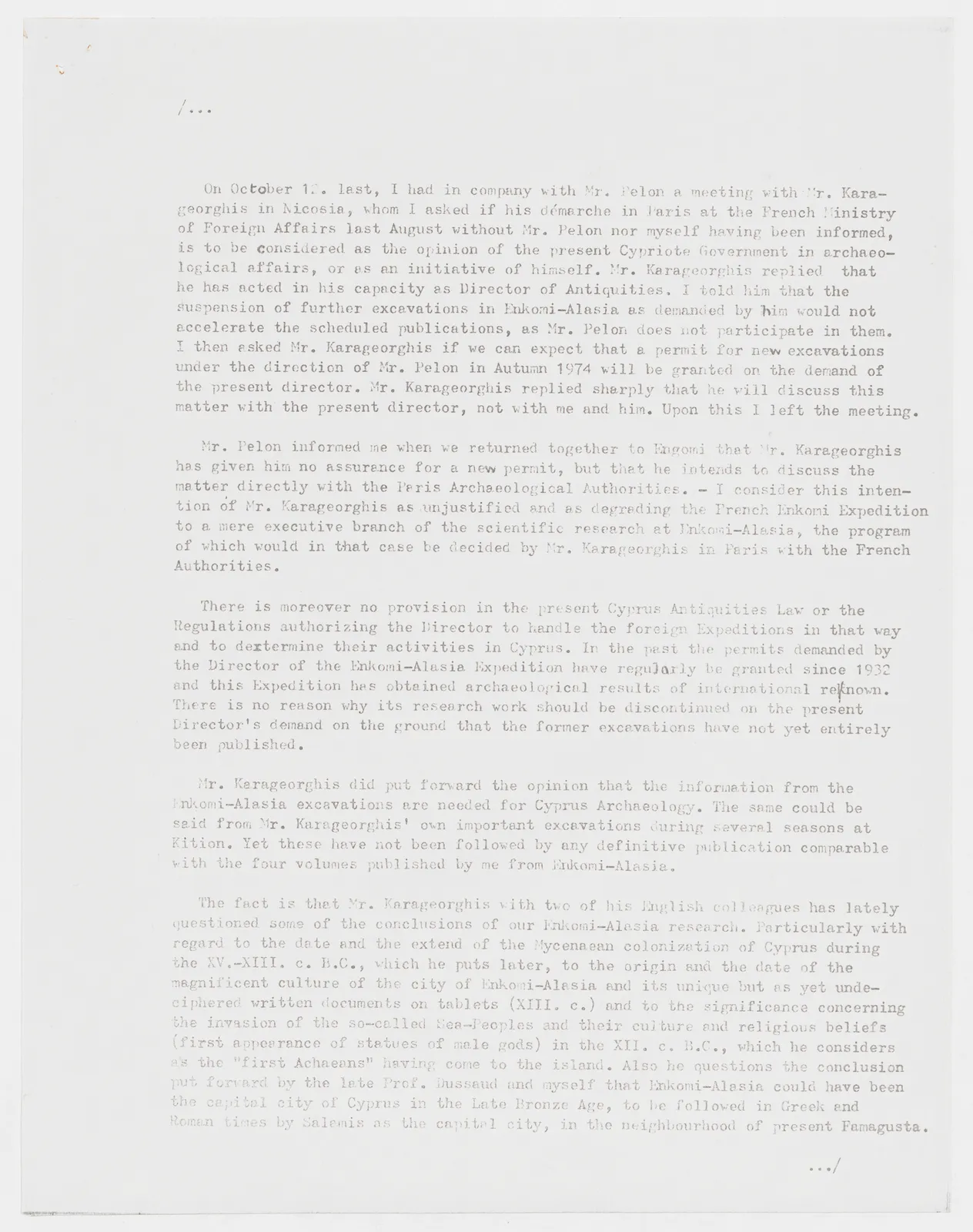
On October 1?. last, I had in company with Mr. Pelon a meeting with Mr. Karageorghis in Nicosia, whom I asked if his démarche in Paris at the French Ministry of Foreign Affairs last August without Mr. Pelon nor myself having been informed, is to be considered as the opinion of the present Cypriote Government in archaeological affairs, or as an initiative of himself. Mr. Karageorghis replied that he has acted in his capacity as Director of Antiquities. I told him that the suspension of further excavations in Enkomi-Alasia as demanded by him would not accelerate the scheduled publications, as Mr. Pelon does not participate in them. I then asked Mr. Karageorghis if we can expect that a permit for new excavations under the direction of Mr. Pelon in Autumn 1974 will be granted on the demand of the present director. Mr. Karageorghis replied sharply that he will discuss this matter with the present director, not with me and him. Upon this I left the meeting.
Mr. Pelon informed me when we returned together to Engomi that Mr. Karageorghis has given him no assurance for a new permit, but that he intends to discuss the matter directly with the Paris Archaeological Authorities. - I consider this intention of Mr. Karageorghis as unjustified and as degrading the French Enkomi Expedition to a mere executive branch of the scientific research at Enkomi-Alasia, the program of which would in that case be decided by Mr. Karageorghis in Paris with the French Authorities.
There is moreover no provision in the present Cyprus Antiquities Law or the Regulations authorizing the Director to handle the foreign Expeditions in that way and to determine their activities in Cyprus. In the past the permits demanded by the Director of the Enkomi-Alasia Expedition have regularly been granted since 1932 and this Expedition has obtained archaeological results of international renown. There is no reason why its research work should be discontinued on the present Director's demand on the ground that the former excavations have not yet entirely been published.
Mr. Karageorghis did put forward the opinion that the information from the Enkomi-Alasia excavations are needed for Cyprus Archaeology. The same could be said from Mr. Karageorghis' own important excavations during several seasons at Kition. Yet these have not been followed by any definitive publication comparable with the four volumes published by me from Enkomi-Alasia.
The fact is that Mr. Karageorghis with two of his English colleagues has lately questioned some of the conclusions of our Enkomi-Alasia research. Particularly with regard to the date and the extend of the Mycenaean colonization of Cyprus during the XV.-XIII. c. B.C., which he puts later, to the origin and the date of the magnificent culture of the city of Enkomi-Alasia and its unique but as yet undeciphered written documents on tablets (XIII. c.) and to the significance concerning the invasion of the so-called Sea-Peoples and their culture and religious beliefs (first appearance of statues of male gods) in the XII. c. B.C., which he considers as the "first Achaeans" having come to the island. Also he questions the conclusion put forward by the late Prof. Dussaud and myself that Enkomi-Alasia could have been the capital city of Cyprus in the Late Bronze Age, to be followed in Greek and Roman times by Salamis as the capital city, in the neighbourhood of present Famagusta.
.../
65 figures hard to readstruck struck outadded written in above” jug ditto, and what it repeatsword reading not certain