
Unnumbered pageScan 1 of 8
5th February, 1973
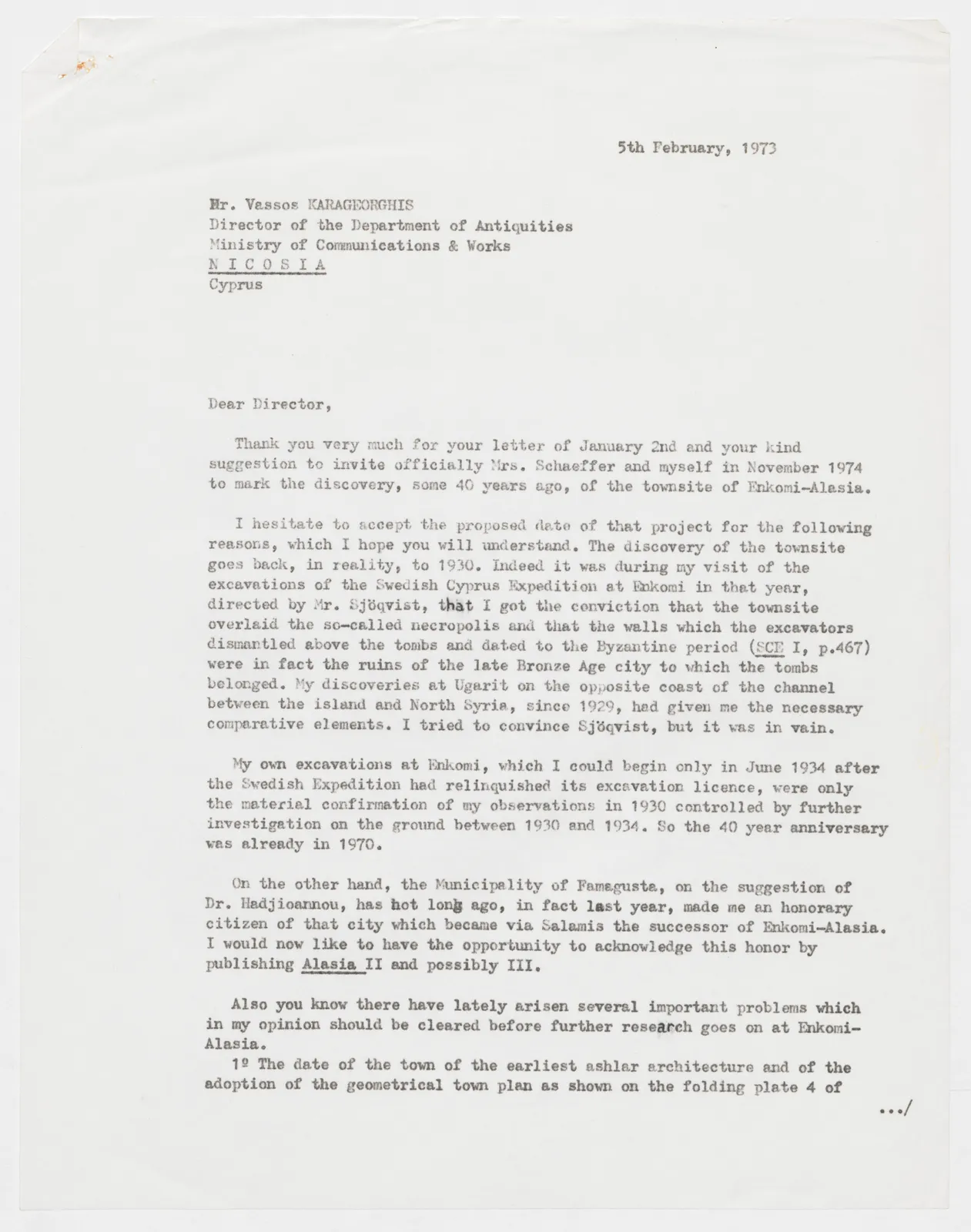
Mr. Vassos KARAGEORGHIS Director of the Department of Antiquities Ministry of Communications & Works N I C O S I A Cyprus
Dear Director,
Thank you very much for your letter of January 2nd and your kind suggestion to invite officially Mrs. Schaeffer and myself in November 1974 to mark the discovery, some 40 years ago, of the townsite of Enkomi-Alasia.
I hesitate to accept the proposed date of that project for the following reasons, which I hope you will understand. The discovery of the townsite goes back, in reality, to 1930. Indeed it was during my visit of the excavations of the Swedish Cyprus Expedition at Enkomi in that year, directed by Mr. Sjöqvist, [handwritten: ?] that I got the conviction that the townsite overlaid the so-called necropolis and that the walls which the excavators dismantled above the tombs and dated to the Byzantine period (SCE I, p.467) were in fact the ruins of the late Bronze Age city to which the tombs belonged. My discoveries at Ugarit on the opposite coast of the channel between the island and North Syria, since 1929, had given me the necessary comparative elements. I tried to convince Sjöqvist, but it was in vain.
My own excavations at Enkomi, which I could begin only in June 1934 after the Swedish Expedition had relinquished its excavation licence, were only the material confirmation of my observations in 1930 controlled by further investigation on the ground between 1930 and 1934. So the 40 year anniversary was already in 1970.
On the other hand, the Municipality of Famagusta, on the suggestion of Dr. Hadjioannou, has not long ago, in fact last year, made me an honorary citizen of that city which became via Salamis the successor of Enkomi-Alasia. I would now like to have the opportunity to acknowledge this honor by publishing Alasia II and possibly III.
Also you know there have lately arisen several important problems which in my opinion should be cleared before further research goes on at Enkomi-Alasia. 1º The date of the town of the earliest ashlar architecture and of the adoption of the geometrical town plan as shown on the folding plate 4 of
.../
65 figures hard to readstruck struck outadded written in above” jug ditto, and what it repeatsword reading not certain