
Unnumbered pageScan 5 of 8
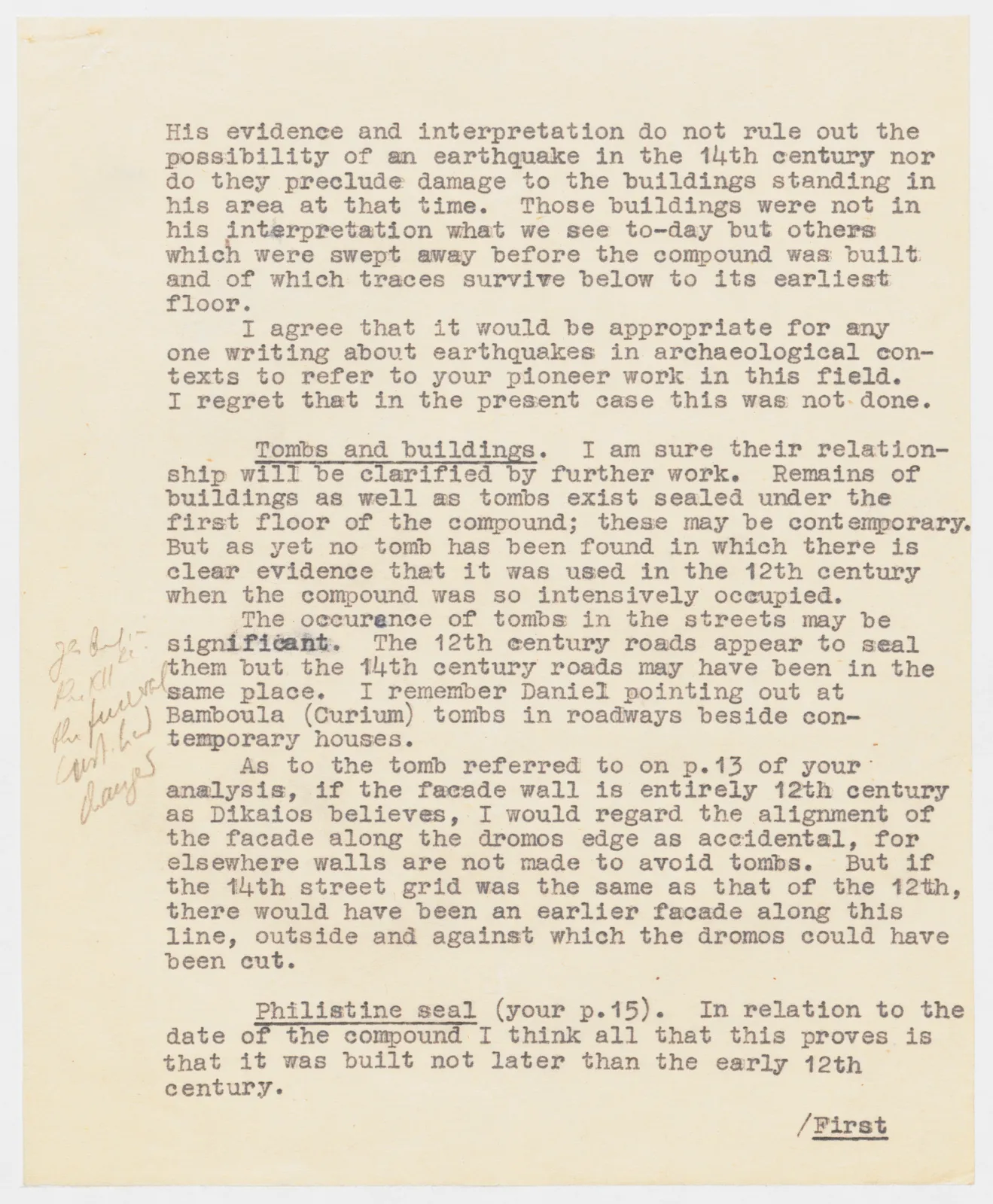
His evidence and interpretation do not rule out the possibility of an earthquake in the 14th century nor do they preclude damage to the buildings standing in his area at that time. Those buildings were not in his interpretation what we see to-day but others which were swept away before the compound was built and of which traces survive below to its earliest floor.
I agree that it would be appropriate for any one writing about earthquakes in archaeological contexts to refer to your pioneer work in this field. I regret that in the present case this was not done.
Tombs and buildings. I am sure their relationship will be clarified by further work. Remains of buildings as well as tombs exist sealed under the first floor of the compound; these may be contemporary. But as yet no tomb has been found in which there is clear evidence that it was used in the 12th century when the compound was so intensively occupied.
The occurance of tombs in the streets may be significant. The 12th century roads appear to seal them but the 14th century roads may have been in the same place. I remember Daniel pointing out at Bamboula (Curium) tombs in roadways beside contemporary houses.
As to the tomb referred to on p.13 of your analysis, if the facade wall is entirely 12th century as Dikaios believes, I would regard the alignment of the facade along the dromos edge as accidental, for elsewhere walls are not made to avoid tombs. But if the 14th street grid was the same as that of the 12th, there would have been an earlier facade along this line, outside and against which the dromos could have been cut.
Philistine seal (your p.15). In relation to the date of the compound I think all that this proves is that it was built not later than the early 12th century.
/First
Handwritten: marginal note in pencil, running vertically down the left margin: "Je crois qu'il faut lire 'the funeral' ... 'Chapel'?" — partly illegible
65 figures hard to readstruck struck outadded written in above” jug ditto, and what it repeatsword reading not certain