
Unnumbered pageScan 1 of 4
Printed: No....57/50.
Figure: coat of arms of the Department of Antiquities, Cyprus
Printed: TELEPHONE No. 61
[printed: DEPARTMENT OF ANTIQUITIES, CYPRUS.]
Nicosia, 27th June, 1950.
Dear Schaeffer,
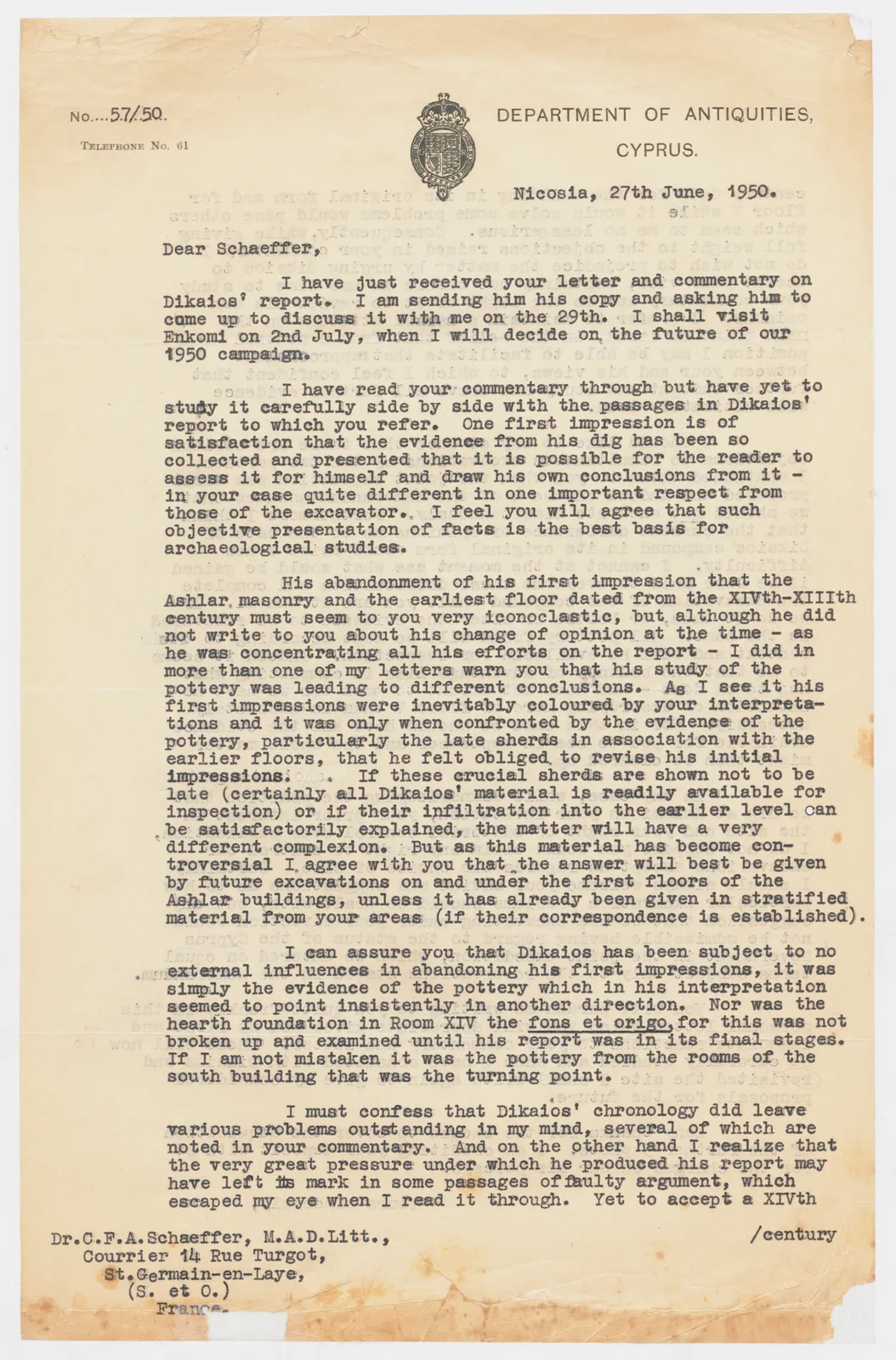
I have just received your letter and commentary on Dikaios' report. I am sending him his copy and asking him to come up to discuss it with me on the 29th. I shall visit Enkomi on 2nd July, when I will decide on the future of our 1950 campaign.
I have read your commentary through but have yet to study it carefully side by side with the passages in Dikaios' report to which you refer. One first impression is of satisfaction that the evidence from his dig has been so collected and presented that it is possible for the reader to assess it for himself and draw his own conclusions from it - in your case quite different in one important respect from those of the excavator. I feel you will agree that such objective presentation of facts is the best basis for archaeological studies.
His abandonment of his first impression that the Ashlar masonry and the earliest floor dated from the XIVth-XIIIth century must seem to you very iconoclastic, but although he did not write to you about his change of opinion at the time - as he was concentrating all his efforts on the report - I did in more than one of my letters warn you that his study of the pottery was leading to different conclusions. As I see it his first impressions were inevitably coloured by your interpretations and it was only when confronted by the evidence of the pottery, particularly the late sherds in association with the earlier floors, that he felt obliged to revise his initial impressions. If these crucial sherds are shown not to be late (certainly all Dikaios' material is readily available for inspection) or if their infiltration into the earlier level can be satisfactorily explained, the matter will have a very different complexion. But as this material has become controversial I agree with you that the answer will best be given by future excavations on and under the first floors of the Ashlar buildings, unless it has already been given in stratified material from your areas (if their correspondence is established).
I can assure you that Dikaios has been subject to no external influences in abandoning his first impressions, it was simply the evidence of the pottery which in his interpretation seemed to point insistently in another direction. Nor was the hearth foundation in Room XIV the fons et origo, for this was not broken up and examined until his report was in its final stages. If I am not mistaken it was the pottery from the rooms of the south building that was the turning point.
I must confess that Dikaios' chronology did leave various problems outstanding in my mind, several of which are noted in your commentary. And on the other hand I realize that the very great pressure under which he produced his report may have left its mark in some passages of faulty argument, which escaped my eye when I read it through. Yet to accept a XIVth /century
Dr.C.F.A.Schaeffer, M.A.D.Litt., Courrier 14 Rue Turgot, St.Germain-en-Laye, (S. et O.) France.
65 figures hard to readstruck struck outadded written in above” jug ditto, and what it repeatsword reading not certain