
Unnumbered pageScan 15 of 20
2
the demolition is probable.
As I have already said, I have touched floors that are purely Mycenaean, with Mycenaean and Cypriot pottery on top. Very interesting, as this sheds light on our palace. Each floor contains, besides pottery, objects of a domestic nature etc. etc. So far I have touched only the V or VI<sup>th</sup> floor and the first four are LC III. Obviously I must study the pottery, which is destroyed, before giving the limits chronological.
Handwritten: Plan VI / VI
Handwritten: req
The plan of the palace becomes clearer and clearer, but much more clearing is still needed before making it quite clear and above all to uncover the original plan. I hope that at the end of the campaign I puis shall be able to give you more details.
Handwritten: houses and tombs
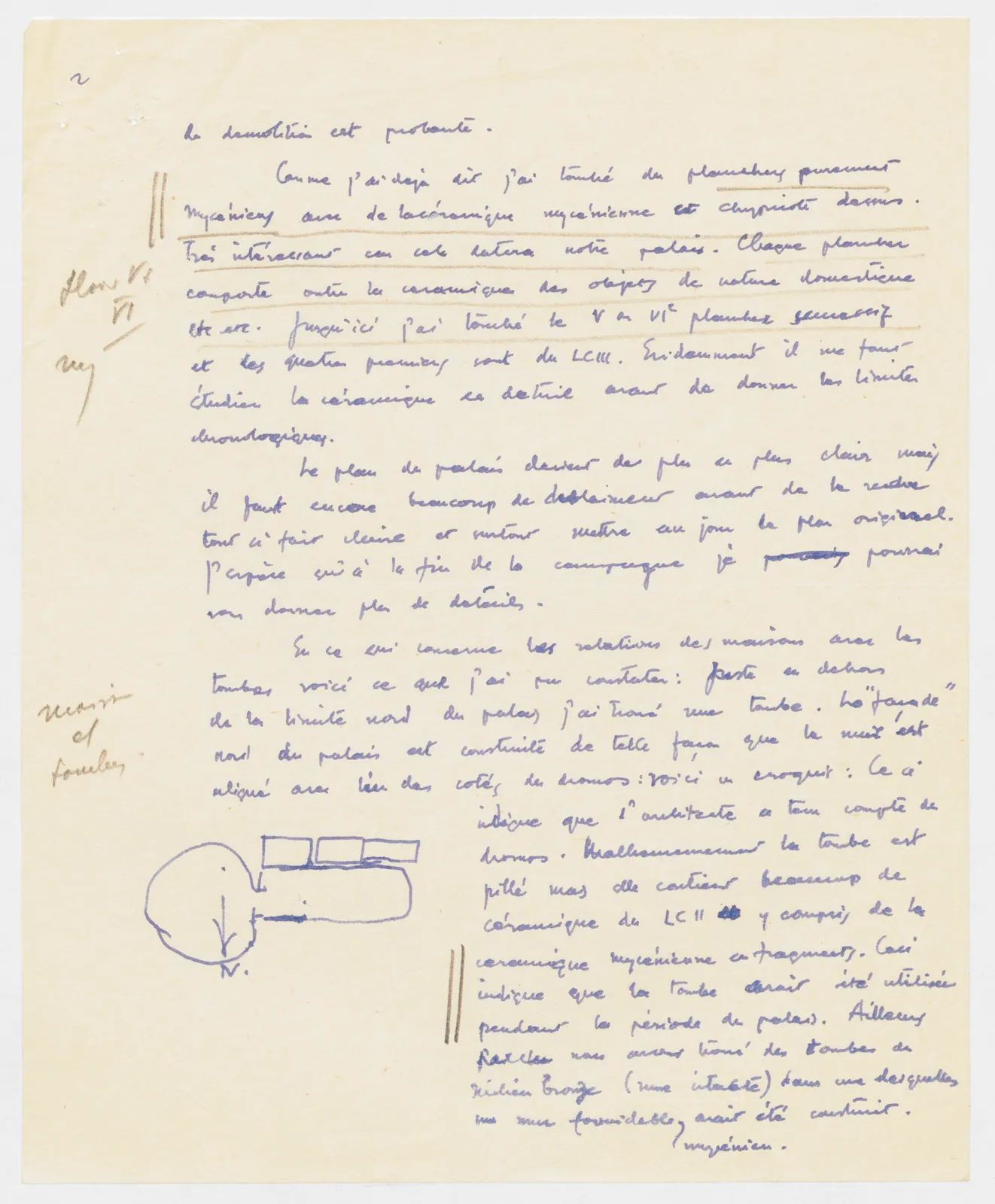
As regards the relations of the houses with the tombs, here is what I was able to observe: just outside of the north limit of the palace I touched a tomb. The "pit" of north of the palace is built in such a way that the wall is applied with the sides of the houses: here is a sketch: The ca shows that the entrance has a complete dromos. Unfortunately the tomb is looted but it contains a lot of LC II pottery y including the Mycenaean pottery in fragments. This shows that the tomb must have been used during the palace period. Elsewhere at Radelen we touched tombs of the Middle Bronze (one intact) in one of which a formidable wall had been built. Mycenaean.
Figure: sketch of a tomb plan with a rounded chamber at left, a long dromos extending right, three rectangular blocks (walls) above the dromos, and a north arrow marked N; labels: N
65 figures hard to readstruck struck outadded written in above” jug ditto, and what it repeatsword reading not certain