
Unnumbered pageScan 2 of 4
COPY
Enkomi Monastery of St. Barnabas 6 May 1949.
Dear friend,
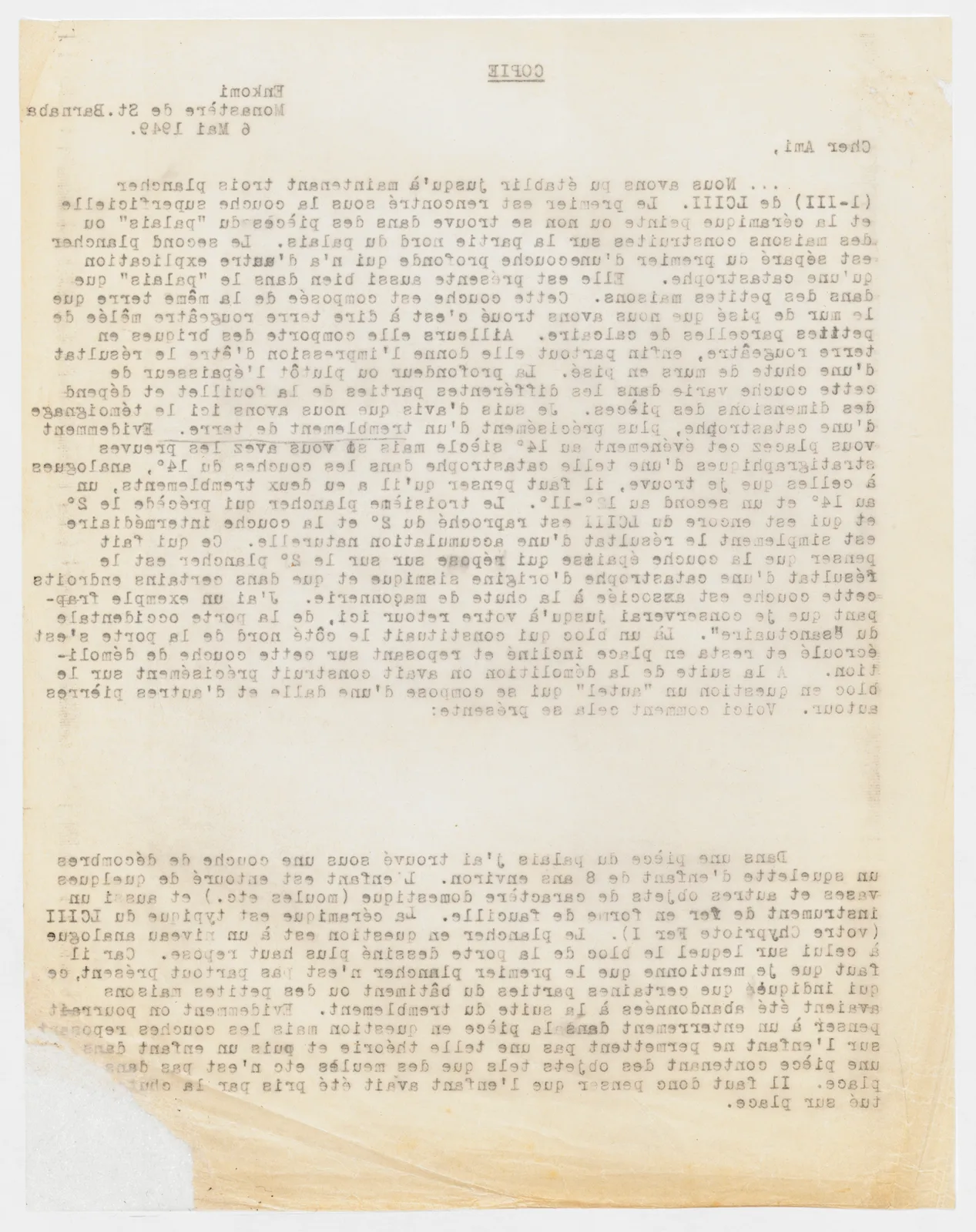
... We have so far been able to establish three floors (I-III) of LCIII. The first is met with under the superficial layer of pottery, whether or not sherds are found in the rooms of the "palace" or of houses built on the north part of the palace. The second floor is separated from the first by a deep layer which has no other explanation than a catastrophe. It is present both in the "palace" and in small houses. This layer is composed of the same earth as the pisé wall that we found, that is to say reddish earth mixed with small particles of limestone. Elsewhere it contains bricks of reddish earth; in short everywhere it gives the impression of being the result of a collapse of pisé walls. The depth or rather the thickness of this layer varies in the different parts of the excavation and depends on the dimensions of the rooms. I am of the opinion that we have here the evidence of a catastrophe, more precisely of an earthquake. Evidently you date this event to the 14th c. but you have the stratigraphic evidence of such a catastrophe in the 14th c. layers, analogous to those I find. One must think that there were two earthquakes, one in the 14th c. and a second in the 13th-11th c. The third floor, which precedes the 2nd and which is still of LCIII, is close to the 2nd and the intermediate layer is simply the result of natural accumulation. Which makes one think that the layer sketched which rests on the 2nd floor is the result of a catastrophe of seismic origin, and that in certain places this layer is associated with the fall of masonry. I have a striking example, which I will keep until your return here, of the western door of the Sanctuary". There a block which formed the north side of the door has collapsed and remained in place, tilted and resting on this demolition layer. Following the demolition, an "altar" had been built precisely on the spot in question, consisting of a slab and other stones around it. This is how it presents itself:
In a room of the palace I found under a layer of rubble a child's skeleton of about 8 years. The child is surrounded by some vessels and other objects of domestic character (moulds etc.) and also an iron instrument in the form of a sickle. The pottery is typical of LCIII (your Cypriot Iron I). The floor in question is at a level analogous to that on which the block of the door rests, as drawn higher up. For it must be mentioned that the first floor is not present everywhere, which indicates that certain parts of the building or of the small houses had been abandoned following the earthquake. Evidently one could think of a burial in this room in question, but the layers resting on the child do not allow such a theory, and besides a child in a room containing objects such as moulds etc. is not in place. One must therefore think that the child had been caught by the fall on the spot.
65 figures hard to readstruck struck outadded written in above” jug ditto, and what it repeatsword reading not certain