
Unnumbered pageScan 1 of 4
FRENCH EXCAVATIONS IN CYPRUS.
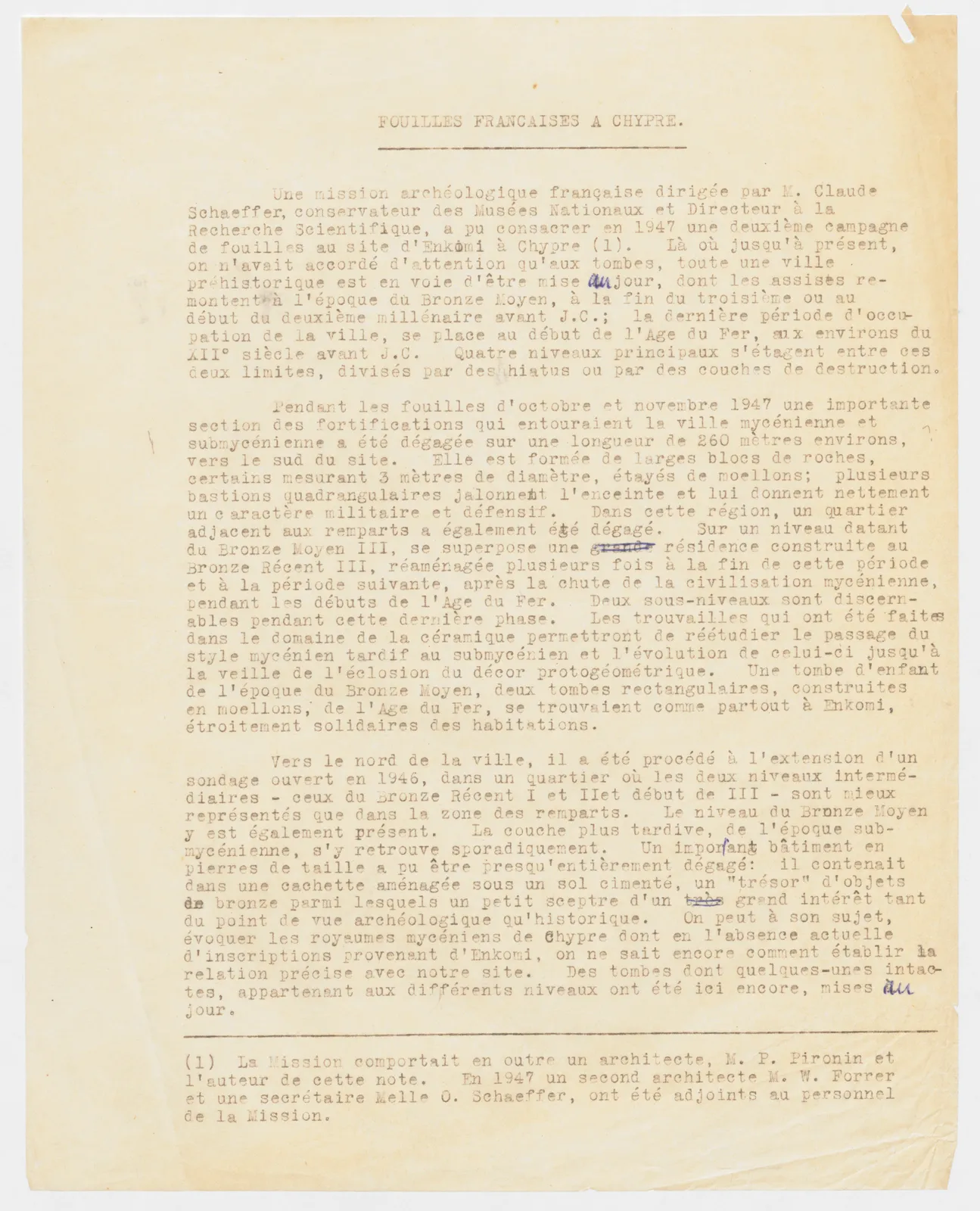
A French archaeological mission directed by Mr Claude Schaeffer, Curator of the National Museums and Director of Scientific Research, was able to devote in 1947 a second campaign of excavations to the site of Enkomi in Cyprus (1). Where until now only the tombs had received attention, an entire prehistoric town is in the process of being uncovered [handwritten: au] light, whose foundations date back to the Middle Bronze Age, to the end of the third or the beginning of the second millennium B.C.; the last period of occupation of the town falls at the beginning of the Iron Age, around the 12th c. B.C. Four main levels are spread between these two limits, separated by hiatuses or by layers of destruction.
During the excavations of October and November 1947 a large section of the fortifications which surrounded the Mycenaean and Sub-Mycenaean town was uncovered over a length of about 260 metres, towards the south of the site. It is formed of large blocks of rock, some measuring 3 metres in diameter, buttressed with rubble; several quadrangular bastions punctuate the enceinte and clearly give it a military and defensive character. In this area, a quarter adjacent to the ramparts was also uncovered. Over a level dating from Middle Bronze III, there is superimposed a grande residence built in Late Bronze III, remodelled several times at the end of this period and in the following period, after the fall of Mycenaean civilisation, during the beginnings of the Iron Age. Two sub-levels are discernible during this last phase. The finds made in the field of pottery will allow a re-study of the transition from late Mycenaean style to Sub-Mycenaean and the evolution of the latter up to the eve of the emergence of the Protogeometric decoration. A child's tomb of the Middle Bronze Age, two rectangular tombs, built of rubble, of the Iron Age, were found as everywhere at Enkomi, closely bound up with the houses.
Towards the north of the town, the extension of a sounding opened in 1946 was carried out, in an area where the two intermediate levels - those of Late Bronze I and II and beginning of III - are better represented than in the zone of the ramparts. The Middle Bronze level is also present there. The later layer, of the Sub-Mycenaean period, is found there sporadically. An important building in ashlar has been almost entirely uncovered: it contained, in a cache arranged beneath a cemented floor, a "treasure" of bronze objects among which a small sceptre of très great interest both from the archaeological and the historical point of view. One may, on this subject, mention the Mycenaean kingdoms of Cyprus, of which, in the current absence of inscriptions from Enkomi, it is not yet known how to establish the precise relation with our site. Tombs, some of them intact, belonging to the different levels, have here again been uncovered [handwritten: au] light.
(1) The Mission also included an architect, Mr P. Pironin, and the author of this note. In 1947 a second architect, Mr W. Forrer, and a secretary, Miss O. Schaeffer, were added to the staff of the Mission.
65 figures hard to readstruck struck outadded written in above” jug ditto, and what it repeatsword reading not certain