
Unnumbered pageScan 1 of 2
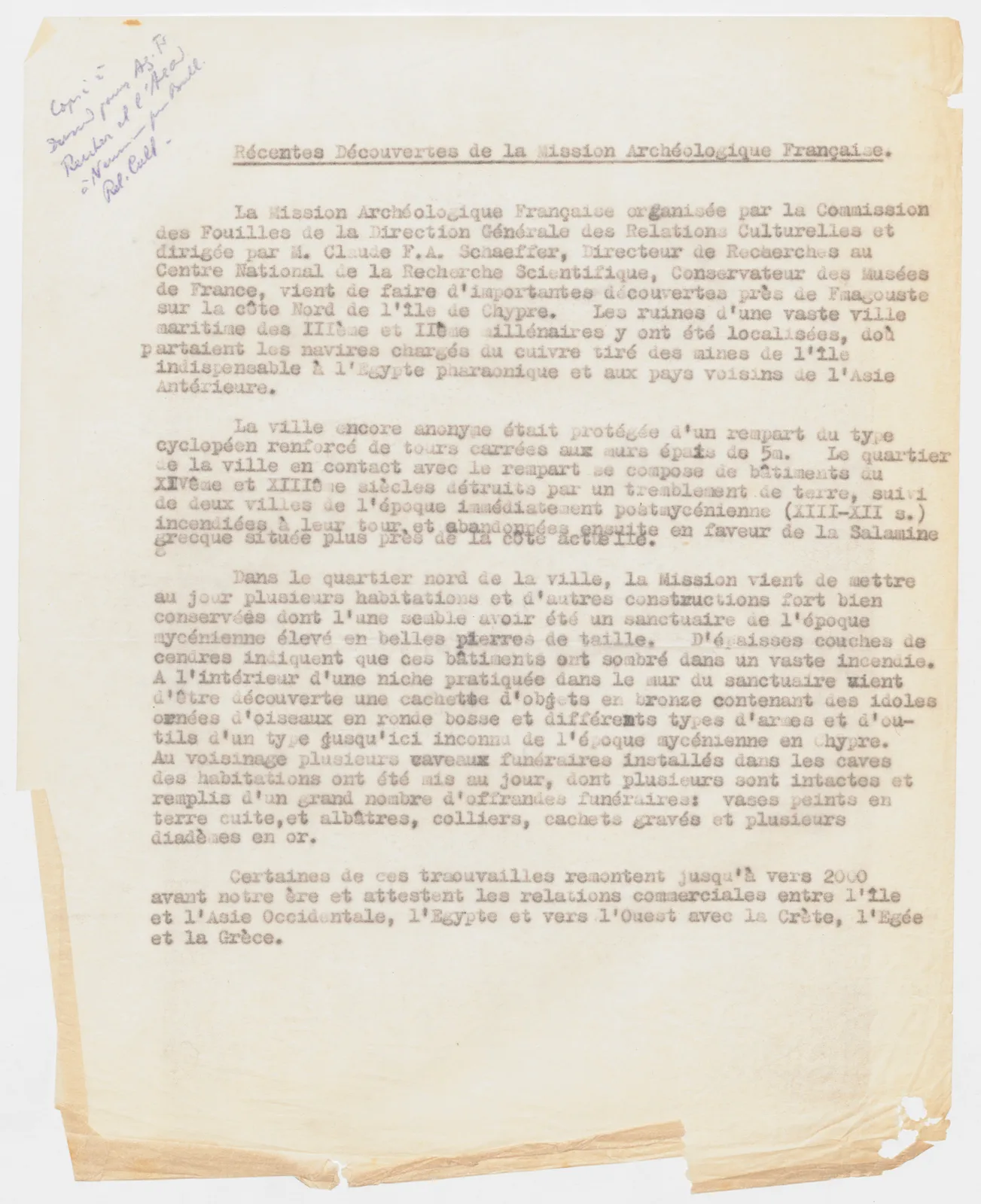
Handwritten: Copy for M. Fr. Ben. Reuter and the Ass. Ren Rel. Cull. (handwritten in blue ink at top left, partly legible: "Copy / for M. S. F. / Reuter and the Ass / Newman — for Ball / Rel. Cult.")
Recent Discoveries of the French Archaeological Mission.
The French Archaeological Mission organised by the Commission des Fouilles of the General Directorate of Cultural Relations and directed by Mr Claude F.A. Schaeffer, Research Director at the Centre National de la Recherche Scientifique, Curator of the Museums of France, has just made important discoveries near Famagusta on the north coast of the island of Cyprus. The ruins of a vast maritime town of the IIIrd and IInd millennia have been located there, from which ships set out laden with the copper drawn from the island's mines, indispensable to pharaonic Egypt and to the neighbouring countries of the Near East.
The still anonymous town was protected by a cyclopean-type rampart reinforced with square towers with walls 5m thick. The quarter of the town in contact with the rampart consists of buildings of the XIVth and XIIIth centuries destroyed by an earthquake, followed by two towns of the immediately post-Mycenaean period (XIII-XI c.), burned in their turn and then abandoned in favour of the Greek Salamis situated closer to the present coast.
In the north quarter of the town the Mission has just uncovered several houses and other very well preserved constructions, one of which seems to have been a Mycenaean sanctuary built of fine ashlar. Thick layers of ash indicate that these buildings were destroyed in a vast fire. Inside a niche made in the wall of the sanctuary has just been discovered a hoard of bronze objects containing idols decorated with birds in the round and various types of weapons and tools of a type hitherto unknown in Mycenaean Cyprus. In the vicinity several burial chambers installed in the cellars of the houses have been uncovered, several of which are intact and filled with a large number of funerary offerings: painted terracotta vases, and alabaster, necklaces, engraved seals and several gold diadems.
Some of these finds go back to around 2000 before our era and attest the commercial relations between the island and Western Asia, Egypt and, to the West, with Crete, the Aegean and Greece.
65 figures hard to readstruck struck outadded written in above” jug ditto, and what it repeatsword reading not certain